
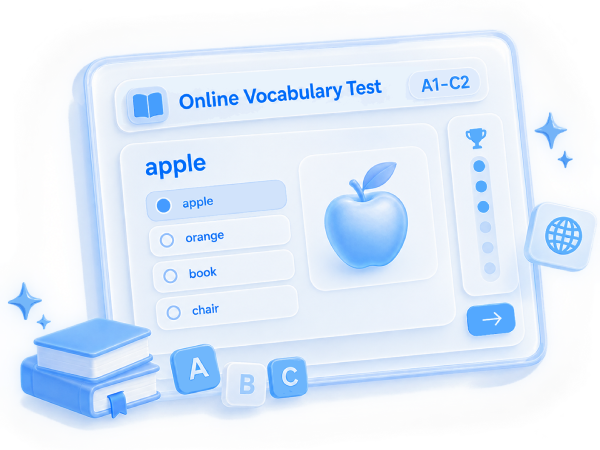
Choose a language. The test shows words from easy (A1) to hard (C2) — answer honestly whether you know each word. It usually takes 30–60 words. The database holds ≈ 387k words across levels A1–C2; each language shows how many words the questions are drawn from.
The tool estimates your passive vocabulary — how many words you recognise and understand — in one of 10 languages and determines your level on the CEFR scale (A1–C2). Words are picked at random from a database of about 387k words split by level, so every test is unique.
Language is very uneven: a small number of frequent words appear all the time. According to research (P. Nation, 2006), about 2–3 thousand of the most frequent words cover roughly 90–95% of everyday speech. Confident listening needs about 6–7 thousand word families, and fluent reading 8–9 thousand.
| Level | Words (English, test scale) | What you can do |
|---|---|---|
| A1 | ≈ 500 | simple phrases about yourself, shopping, directions, greetings |
| A2 | ≈ 1 500 | short everyday conversations, simple notices and letters |
| B1 | ≈ 4 000 | travel, work, study; the main point of clear speech |
| B2 | ≈ 9 000 | fluent conversation with natives, news, professional articles |
| C1 | ≈ 20 000 | complex texts, implicit meaning, flexible speech at work and in science |
| C2 | ≈ 40 000 | close to an educated native: literature, idioms, nuances |
A myvocab.info study of 123 thousand native Russian speakers shows that vocabulary grows at an almost constant rate until about 20 — around 10 new words a day at school age. Then growth slows to about 3 words a day and by 45–50 reaches a plateau of about 80–85 thousand words (median). After 60 it holds and only slightly declines.
Education matters, but it is not decisive: for adults over 30 the median rises from ~74 thousand with incomplete secondary education to ~81 thousand with higher education and ~86 thousand with an academic degree. Yet the spread within each group (10th to 90th percentile — 35–40 thousand words) is much bigger than the gap between groups. The main factor is how much and how varied you read.
Band is the 10th to 90th percentile, line is the median. The scales are non-linear: on the age chart early childhood is stretched and word counts are logarithmic (each step is 10 times more) so that the vocabulary spurt at 1.5–2 years is visible. Study: 123 thousand native Russian speakers over 12, passive vocabulary; education groups are over 30. Dashes and pale fill are an extrapolation to children (under 12 and school levels): an estimate, not study data. The orange line is the median vocabulary of people learning English as a foreign language (non-natives) aged 10 to 60; under 10 it is a rough extrapolation; the orange fill is an approximate 10th to 90th percentile range (an estimate). On the education chart the orange bars (below the blue ones) are a rough estimate for non-natives: the school-level median uses the typical age, adult levels use the average learner vocabulary adjusted for education; the spread is wider than for natives because it depends heavily on how long and how intensively people study.
The same holds for a foreign language: vocabulary grows fastest from reading and listening to lots of understandable content, while flashcards and word lists help lock in the most frequent words at the start.
The test shows words by CEFR levels starting from A1. For each word mark whether you know it. If you know more than 80% of the words at a level, the test moves to the next level; below 30% the test ends. The final vocabulary size is estimated in proportion to the share of known words at each level. Every test uses a new random set of words, so you can check the result again. The meaning of a word is hidden — hover over it to check yourself.
10 languages are available: English, German, French, Spanish, Italian, Portuguese, Russian, Chinese, Japanese and Arabic. Each level shows up to 12 words, and to pass a level you need to answer at least 4–12 words (more at higher levels). The whole test usually takes 30–60 words and 3–5 minutes.
The CEFR scale. Levels A1–C2 come from the Common European Framework of Reference for Languages (Council of Europe). Words in the database are split by these levels: A1 holds the most frequent and simple ones, C2 rare, literary and specialised ones. Baseline level sizes for English: A1 ≈ 500, A2 ≈ 1 000, B1 ≈ 2 500, B2 ≈ 5 000, C1 ≈ 11 000, C2 ≈ 20 000 words; each language uses its own values.
Sampling. Checking tens of thousands of words is impossible, so, like research vocabulary tests (P. Nation’s Vocabulary Size Test and others), the test takes a random sample of words at each level and applies the share of known words to the whole level. Adaptivity — moving on at 80% and stopping at 30% — saves time on words that are too easy or too hard.
Native speaker data. The age and education curves are based on the myvocab.info study: about 123 thousand native Russian speakers over 12, passive vocabulary; education groups are adults over 30. The study has no data for children under 12, so these values are extrapolated from child psychology estimates (the vocabulary spurt at 1.5–2 years, about 10 thousand words by age 6, about 10 new words a day at school age) and shown dashed on the charts.
Learner data. The average vocabulary of people learning English as a foreign language comes from a vocabulary growth chart for non-native learners (ages 10 to 60); younger ages are a rough extrapolation.
Study hours. The study plan is based on Cambridge English “Guided learning hours” — the cumulative number of hours of structured study from zero: A1 ≈ 80–100, A2 ≈ 180–200, B1 ≈ 350–400, B2 ≈ 500–600, C1 ≈ 700–800, C2 ≈ 1000–1200 h. For Chinese, Japanese and Arabic the hours are doubled, for Russian multiplied by 1.5, following FSI (US Foreign Service Institute) estimates of relative language difficulty.
Level advice. The descriptions of what you can do in everyday life and at work are based on the CEFR “can-do” statements and typical language requirements of employers, universities and immigration services: for example, B1 is often required for residence permits and citizenship, B2 for studying and working in international companies, C1 for management and research positions.
Take the test several times — the words are new each time, and the average will be more accurate. Repeat it every 1–3 months to track your progress. The red words from the breakdown are a ready list for flashcards: start with the unknown words of your level and the next one — they are the most useful in real speech.

Comments