Here you can evaluate the super-logarithm (slog) — the inverse function of tetration.
While tetration answers "what is the value of a power tower of a given height", the super-logarithm
answers the opposite question: "how tall must a power tower with the given base be to reach the given number".
Use the notation slog(x, base).
The super-logarithm to base b, written slogb(x), is the inverse function of
tetration b↑↑n (a power tower of n repeated exponentiations of the base b).
By definition the following holds:
if b ↑↑ y = x, then slogb(x) = y.
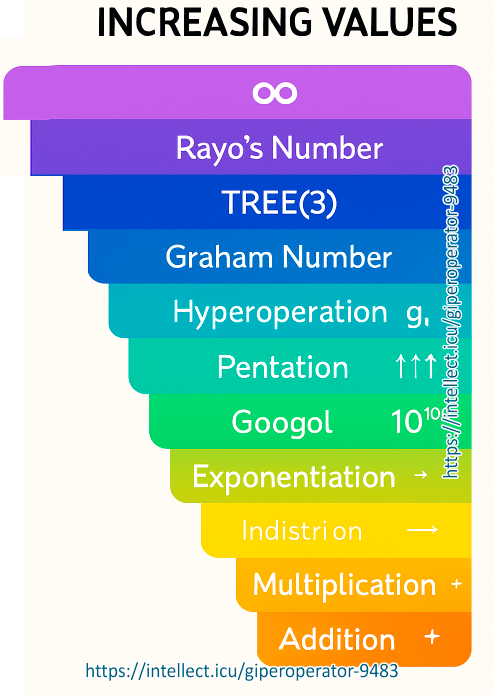
Brief theory. Hyperoperations form a sequence: addition → multiplication → exponentiation →
tetration → pentation, and so on. Each next level is the repeated application of the previous one.
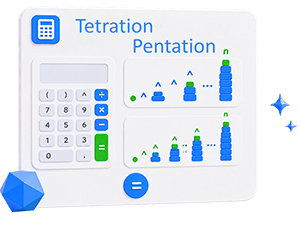
Tetration b↑↑n = bb···b
(with n stacked levels). Just as the ordinary logarithm is the inverse of exponentiation
(logb(by) = y), the super-logarithm is the inverse of tetration, one level up.
It returns the height of the power tower, not its value.
Properties. For integer heights the super-logarithm grows extremely slowly, because tetration
itself grows monstrously fast. The key recurrence is slogb(x) = slogb(logb(x)) + 1 — a single base-b
logarithm decreases the super-logarithm by exactly one. This is what lets us compute slog by taking
ordinary logarithms repeatedly until the value falls into a reference interval.
How to use. Enter an expression like slog(x, base), where x is the number
whose tower height you are looking for and base is the base of the tetration (if omitted,
base 2 is used). The computation is performed by the universal calculator of the service, so the
arguments may be ordinary expressions, for example slog(2^100, 2). The service works on
desktop and mobile devices, and the calculation is precise and instant.
Note. For fractional values the super-logarithm relies on a practical approximation rather than
a strict analytic continuation of tetration, so values around fractional heights are approximate.
The super-logarithm is useful in number theory, for estimating the magnitude of very large quantities,
and for working with hyperoperators.
Comments