Here calculate the base and height for pentation and tetration (including fractional):
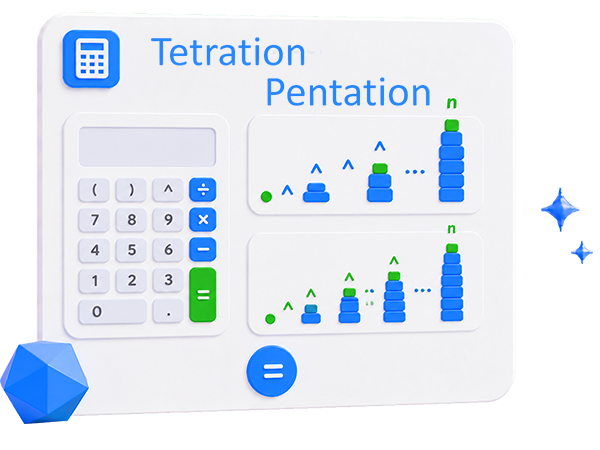
is an innovative online service that provides a convenient tool for calculating tatratation and penation operations known as Power Towers.
Regardless of your level of math experience, the service makes the calculation process fast, accurate and intuitive.
Main features of the service Compute Power Towers:
Ease of use: The intuitive interface makes the process of entering data and performing operations as simple and convenient as possible, even for beginners.
Accuracy and Reliability: The service provides highly accurate calculations, making it a reliable tool for students, professionals, and anyone else who needs mathematical calculations.
Advanced functionality:
- Evaluating tetration with approximation and with logarithmic representation for big values.
- Evaluating tetration with fractional values.
- Evaluating chain of tetration.
- Converting hyperoperators of any level to tetration and calculating for small values.
Mobile compatibility: the service is available not only on a computer, but also on mobile devices, which allows you to carry out calculations at any convenient time and anywhere.
Personalization and Saving: Users can save their calculations, create personal profiles, and set preferences for easy reuse and transaction history.
Security and Confidentiality: All data entered by the user is protected using advanced encryption methods, ensuring complete confidentiality of information.
Whether you need to solve simple arithmetic problems or perform complex mathematical calculations, the service
provides all the necessary tools to successfully complete the task. Find out how easy and convenient computing can be today!
Comments
The input 10↑↑x = 2 is an equation with an unknown variable x. Solving it requires finding the inverse tetration function, called the super-logarithm.
For integer tetration heights, we have:
10↑↑0 = 1
10↑↑1 = 10
Since 2 lies between 1 and 10, the solution would be between 0 and 1, but that requires a definition of tetration for fractional heights.
Solution n1:
You can still approximate the solution by evaluating expressions like 10↑↑0.1, 10↑↑0.2, 10↑↑0.3, etc., and using numerical search until the result is close to 2.
So the service can help with the calculation part, but it does not automatically solve tetration equations.
If we use this selection to solve the problem, the solution will be approximately 10^^0.3 = 1.99,
i.e. x = 0.3.
Solution n2:
we equation: 10↑↑x = 2
can be written as:
x = slog₁₀(2)
where slog is the superlogarithm, the inverse function of tetration.
But the superlogarithm is a more complex function than the ordinary logarithm.
An example for solving on our service
where 10 is the base
and 2 is the result of tetration (or the argument of the superlogarithm)
x = slog(2, 10) = 0.3010299294,
x = 0.3010299294,
then 10↑↑0.3010299294 ≈ 1.99999
due to the non-standardized calculations of tetration and superlogarithms for fractional values, the answer was different.
10^8.07= 10 ↑ 8.07 = 117489755.49395 work
10^153= 10 ↑ 153 = 1.0E+153 work
Or did you mean something else?
digits(a↑↑n) = floor((a↑↑(n−1)) · log10(a)) + 1
But the problem is that for large tetrations, even the number of digits itself becomes a tetration-scale number.
For example, to find the number of digits in 3↑↑4, it's enough to calculate:
floor((3↑↑3) · log10(3)) + 1
This is still feasible, because 3↑↑3 = 3^27.
But for 3↑↑5, the number of digits is already approximately equal:
(3↑↑4) · log10(3)
And 3↑↑4 is a number with 3,638,334,640,025 digits. That is, even the "number of digits" for 3↑↑5 cannot be displayed properly on the screen, because it itself contains trillions of digits.
Therefore, after a certain level, the calculator doesn't "give up," but rather runs into the problem that even the meta-information about the number becomes too large to display.
Another reason it doesn’t appear instantly is that the system generates responses in a chat mode. Instead of just outputting raw numbers, it builds the explanation word by word, phrase by phrase, to make the answer coherent and readable. So even if the computation is handled internally, the response is formed gradually as text.
Reason: when 𝑏=2, any hyperoperation 𝑎↑↑↑...↑2
is reduced to the previous operation (hyperoperation level).
The number of digits is greater than the number of grains of sand on the beach and cannot be displayed on the screen.
In pure mathematics, they look at the context: limits can have different values or be undefined.
4^^^4
and we'll get the full answer.
((3^3)^3)^3 etc. But if you try to do ‘3 tetration 2.5’, it becomes unclear what a ‘power of one and a half’ is. Unlike addition or multiplication, tetration has no straightforward, accepted way to handle fractional powers. There are advanced methods (like superpowers), but they require complex analytics, and most calculators and programming languages simply cannot handle them”
Think of tetration as a tower of blocks, where each block is a power. If you are told to build 3 blocks, that’s easy. But what if it’s 2.5 blocks? What is a half block? The tower becomes incomprehensible
10^^3 = 10^(10^10) is a number with 10 billion digits. To print it, you need about 5 million double-sided pages, not 2 million.
i.e. 10^^3 = 10^(10^10) = 10^10000000000 >> 10^ 80.
where 10^ 80 is the number of Atoms in the Universe.
And although this number can be represented on paper, 10^^4 is impossible to even imagine in reality - it exceeds the number of atoms in the observable Universe.
To leave a comment