
Lecture 14 min.
The theory that the brain is merely an antenna has no single author or name.
There are a number of different ideas and hypotheses that explore this concept, but none of them is generally accepted in the scientific community.
Some of the authors who have contributed to this field:
The theory that the brain is merely an "antenna" for receiving and sending thoughts is associated with the name of the English philosopher and biologist Rupert Sheldrake. Sheldrake proposed the concept of morphic resonance, which suggests that memory and consciousness can exist outside the brain, and that the brain serves as a kind of receiver for these external information fields.
The main ideas of morphic resonance include:
The theory of morphic resonance is highly controversial and has been criticized by the scientific community. The main criticisms include:
Despite the criticism, Sheldrake's ideas continue to be discussed in various esoteric and alternative-science circles.
The concept that the brain is a receiver for thoughts and consciousness also has parallels in various philosophical and religious teachings. For example:
Taken together, these theories and ideas offer alternative views of the nature of consciousness and its relationship to the brain.
Collective energy and collective memories are interesting and multilayered concepts in various fields of knowledge, such as psychology, sociology and esotericism.
The egregore is a term used in esotericism to describe a collective energy or consciousness that arises from the joint actions, thoughts and emotions of a group of people. The main characteristics of an egregore include:
The term "egregore" and the concept associated with it have their roots in occult and esoteric literature. There is no single "author" of this idea, since the concept developed gradually through many writers and thinkers. However, one can single out several key figures and sources that made a significant contribution to shaping and popularizing it.
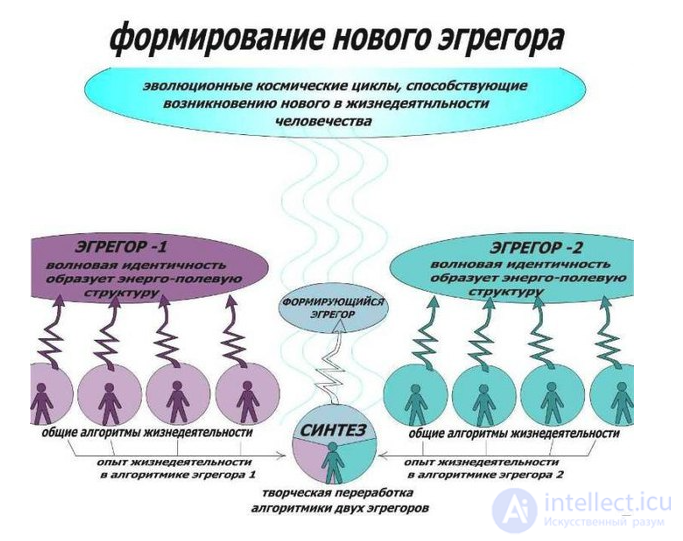
Egregore is a term derived from the Greek word "ἐγρήγορος" (egrégoros), meaning "watchful" or "watcher." The word first appeared in the Greek translation of the Book of Enoch, where it was used to designate a group of angels. However, its modern esoteric meaning took shape later.
Eliphas Lévi (1810-1875): A French occultist and writer who was the first to introduce the concept of the "egregore" in the modern esoteric context. Lévi used this term to describe collective spiritual entities that arise from group beliefs and rituals.
Papus (Gérard Encausse, 1865-1916): Another French occultist, who developed Lévi's ideas and popularized them in his works. Papus used the term "egregore" in his descriptions of magical and occult phenomena.
Grigory Pomerants (1918-2013): A Russian philosopher and cultural scholar who also explored the concept of the egregore in his works, viewing it as a collective psychic energy arising from the interaction of people.
In the 20th and 21st centuries the concept of the egregore received further development and popularization thanks to authors such as:
Dmitry Verkhoturov: A Russian writer and researcher of esotericism who examined the concept of the egregore in detail in the context of modern magical and occult practices.
Serge Kahili King: A Hawaiian shaman and author who incorporated the concept of the egregore into his teachings and books, linking it with traditional Hawaiian ideas about collective energy and spirits.
Vadim Zeland: A Russian author and creator of the theory of "Reality Transurfing," in which elements similar to egregores are described as "pendulums" — collective energies and structures that influence people and their behavior.
The concept of the egregore includes several key ideas:
The egregore as a supra-personal factor of control
The general scheme of control is well known: the object of control, the subject, the controlling action, the result of control, and feedback. The controlling action is information.
It then turns out that the egregore is the subject of control, and the people belonging to it are the objects of control.
Classification of Egregores
1. By the hierarchy of control in the Universe, egregores, if we unfold them starting from planet Earth (that is, from the very "bottom"), can be classified as follows:
2. Egregores differ from one another in the characteristics of the energetics of their people ("powerful," "medium," "weak," etc.)
3. Egregors differ in the information they contain:
4. Egregors differ in their algorithms of "operation" (complexes of algorithms). The classification by this criterion is very extensive, and it is not possible to give it in full. In principle, it is a classification by people's "way of life" and "way of thinking". Let us give the most significant and understandable ones.
5. By duration of existence:
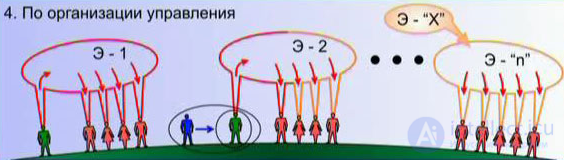
6. By the organization of control.
— One person, through the egregor, controls everyone who belongs to that egregor.
— "Someone" (who is unable to enter a particular egregorial state himself) influences the one who enters (or can enter) a particular egregor and is able to control the people belonging to the egregor. By influencing such a person, this "someone" thereby controls the people belonging to the egregor.
— One egregor is controlled by another egregor whose algorithm is "more powerful" ("smarter") than that of the first (controlled) egregor. (For example, the egregor of Yahweh controls all three Abrahamic egregors.)
7. By their interaction with each other, egregors can be:
8. By the types of psyche of the people belonging to the egregor:
The collective unconscious is a concept introduced by Carl Jung, consisting of shared memories, images and archetypes that are part of the unconscious of all people. The main characteristics of the collective unconscious include:

Although the concepts of the egregor and the collective unconscious differ in nature and origin, they have common features:
Collective thinking is often called "group thinking" (groupthink). This is a phenomenon in which a group's striving to reach agreement and unanimity leads to decisions that may be irrational or ineffective. The main characteristics and signs of groupthink include:
Groupthink can manifest itself in various contexts, such as:
Various religions and spiritual traditions have many theories and ideas about spirit. Below are the main concepts of spirit in several religions:
In Christianity, spirit occupies a central place in doctrine. The main ideas include:
The Holy Spirit: The Holy Spirit is the third person (hypostasis) of the Holy Trinity, alongside God the Father and God the Son (Jesus Christ). The Holy Spirit is considered a source of inspiration, comfort and strength for believers.
The soul and spirit of a person: In Christianity, the soul and spirit of a person are immortal and destined for eternal life after death. The soul is considered the bearer of personality and moral responsibility.
In Islam, the concept of spirit is also of great importance:
Ruh (روح): In Islam, Ruh denotes the spirit or soul breathed into a human being by God. It is a divine spark that gives life and awareness.
Jibril (Gabriel): The archangel Jibril plays an important role in Islam as the transmitter of revelations from Allah to the prophets, including the Prophet Muhammad.
In Hinduism, the concept of spirit includes the following aspects:
Atman: Atman is the inner essence or soul of every person, which is eternal and divine.
Brahman: Brahman is the supreme reality or universal spirit from which everything that exists proceeds. The Atman of each person is considered identical to Brahman.
In Buddhism, the concept of spirit differs from that of the monotheistic religions:
Anatman: The doctrine of non-self (anatman) asserts that there is no permanent and unchanging "I" or soul in a person. A personality consists of five aggregates (skandhas), which are constantly changing.
Karma and rebirth: Karma, or actions and their consequences, determine the future births and condition of beings. Spiritual development is aimed at purifying karma and attaining nirvana.
Many spiritual and esoteric traditions also pay attention to the concept of spirit:
The concept of spirit is fundamental to many religions and spiritual traditions. Depending on the context, spirit can mean a divine essence, the soul, inner strength or a state of enlightenment. These ideas help people search for the meaning of life, moral guidance and spiritual development.
It is important to note that:

Comments