
Lecture 13 min.
SaaS (software as a service; also software on demand) is a form of cloud computing and a service model in which subscribers are provided with ready-made application software that is fully maintained by the provider. In this model the provider manages the application on its own and gives customers access to its functions from client devices, usually through a mobile app or a web browser.
The main advantage of the SaaS model for the consumer of the service is the absence of costs for installing, updating and maintaining the hardware and the software running on it.
In the SaaS model:
As in all forms of cloud computing, customers pay not for owning the software as such, but for renting it (that is, for using it through a mobile app or a web interface). Thus, unlike the classical software licensing scheme, the customer bears comparatively small periodic costs and does not need to invest significant funds in purchasing the application and the software, platform and hardware needed to deploy it, and then keeping it operational. The periodic payment scheme means that if the software is temporarily not needed, the customer can suspend its use and freeze payments to the developer .
From the point of view of the developer of some proprietary software, the SaaS model makes it possible to combat unlicensed use of the software effectively, since the software as such never reaches the end customers. In addition, the SaaS concept often makes it possible to reduce the cost of deploying and introducing product technical and consulting support systems, although it does not eliminate them completely.
Originally the entire computer industry used a rental business model: the first computers cost enormous sums of money, and their computing power was leased out to customers. On the other hand, such rental cannot be considered a variety of SaaS, since customers accessed the computers directly rather than through global telecommunication networks.
Because the SaaS model is oriented toward providing services over a network, its development is directly tied to the development of global networks. The first companies offering software as a service appeared in Western countries in 1997–1999 , and the acronym SaaS came into wide use in 2001 .
Software on demand is provided to the customer for rent and always involves periodic payment. The billing unit is usually users (when providing a CRM) or the number of records in a database (when providing an HRM system), and less often some other functional characteristics (for example, the number of certain operations, or traffic) . In some cases customers are offered combined models in which extended features can be paid for additionally (for example, a customer may pay for the users of its services and for extended data storage).
A SaaS rental contract includes not only payment for using the software, but also payment for all the costs of keeping it operational, updating it and protecting data. A number of SaaS providers offer an advanced version of the rental contract, the SLA (Service Level Agreement). Such contracts fix parameters related to the software's performance. Usually these are guarantees of software availability, expressed as a percentage over a year. The best data centers are able to guarantee software availability of at least 99.5% of the time over a year.
If the software does not require initial adaptation to the customer's needs, the initial payment for the software may be absent altogether. This is a major advantage of the SaaS model over classical software licensing, which, if the software license is paid, also requires substantial initial investment to purchase it. Periodic rental payments can be compared with the cost of technical support: they are usually strictly specified in the contract and are therefore predictable. This protects the customer's investment in the software product used.
The terms Hosted Applications and Application Service Provider (ASP), which stand for a different concept of software promotion, are often mistakenly treated as synonyms of the terms SoD and SaaS. The key difference between SaaS and ASP is that in the SaaS model the customer buys access to a single software core used by all customers. The SaaS provider ensures centralized development and full maintenance of the software core. In the ASP model, by contrast, each customer is given a dedicated installation of the software, deployed at the software vendor's remote site and not accessible to several customers at once.
Many vendors claim to provide a SaaS solution but use this term quite loosely. It is precisely the customers' work with a single software core, and its centralized maintenance by the SaaS solution provider, that provides the main positive properties of SaaS (see below).
The key factor explaining the economic viability of SaaS is the "economy of scale": the SaaS provider maintains a single software core used by all clients, and therefore spends fewer resources than it would managing separate copies of the software for each customer. In addition, using a single software core makes it possible to plan computing capacity and reduces peak loads for individual customers. All this allows SaaS providers to lower the cost of operating the software substantially. As a result, the cost of the service to the end user of such software becomes lower than the costs incurred under the classical licensing model (especially if licensing is paid).
Another key factor is the level of SaaS service. A SaaS provider is able to offer a level of service and support for keeping the software operational that is unavailable to companies' internal IT departments. This is especially evident when working with a SaaS provider under an SLA contract.
Currently several main factors can be identified that encourage customers to use software on demand and developers to develop such products.
Alongside the factors that encourage customers to adopt software on demand and developers to invest resources in creating it, there are a number of restraining factors that limit the use of this model.
First, the SaaS concept is by no means applicable to all functional classes of systems. Since the main resource savings of a SaaS provider are achieved through scale, SaaS models are inefficient for systems that require deep customization (adaptation to each customer), as well as for innovative and niche solutions.
Second, many customers are afraid to use SaaS because of security concerns and possible information leaks on the part of the SaaS service provider. Security issues limit the use of the SaaS model in mission-critical systems that process confidential information. On the other hand, responsibility for information leaks on the developer's side is usually regulated by the relevant contracts, and the probability of such a leak is often lower than when using one's own internal systems. This is helped, among other things, by the fact that the hardware and software complex on which the system is deployed is inaccessible to the company's employees.
The third limiting factor is the need for a permanent Internet connection. Some SaaS products compensate for this by providing modules for offline work.
Software on demand has the following key features :
1. Monthly Recurring Revenue (MRR) — regular monthly revenue
The most important metric for subscription services. With a monthly subscription, MRR is simply the price that customers paid for a month of use.

If customers pay for more than 1 month (for example, 12 months), you simply divide that amount by the number of months in the subscription period.
2. Annual Recurring Revenue (ARR) — regular annual revenue
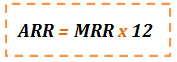
3. MRR movement
4. Average Revenue Per Paying User (ARPPU)
ARPPU is revenue per paying user. It is the average MRR per customer.

If a customer has several subscriptions, they must be combined into one to calculate ARPPU.
5. Average Revenue Per User (ARPU)
We assume that a USER is a site visitor.
ARPU is revenue per visitor attracted to the site.

6. Customer Acquisition Cost (CAC) — the cost of acquiring a customer (a paying user)
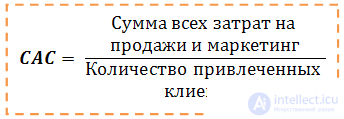
7. Cost Per Acquisition (CPA) — the cost of attracting a visitor to the site
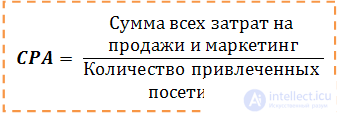
You can calculate CPA for each channel (contextual advertising, SMM, etc.). This makes it possible to identify unprofitable channels and focus on more profitable ones.
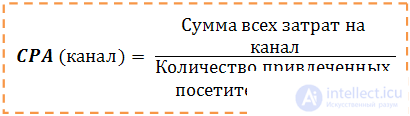
8. Average Profit Per User (APPU) — profit from an acquired visitor
To quickly determine the effectiveness of promotion spending or of a channel, it is enough to calculate the difference between the revenue from a visitor and the cost of acquiring them.
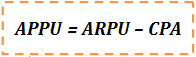
If APPU is positive, you are moving in the right direction.
9. Average Sale Price (ASP) — the average selling price
ASP is used to measure the effectiveness of the sales team

10. Customer Churn Rate — the rate of customer loss

When calculating churn, do not mix subscriptions of different periods, for example monthly and annual ones.
11. MRR Churn Rate
The rate of MRR loss. MRR churn occurs if customers do not renew their subscription or move to a cheaper plan.
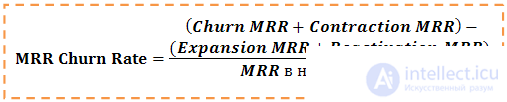
When calculating churn, do not mix subscriptions of different periods. For example, monthly and annual ones. For startups at an early stage of development, Retention Rate may be more meaningful for evaluation.
12. Customer Lifetime Value (LTV) — the revenue from a customer over the entire period of their life in the service
Useful for calculating investment in customer acquisition.

This is a simplified formula; it can be used in most cases.
13. Customer Retention Rate
The customer retention rate. It is the ratio of users who renewed their subscription to all users whose subscription was expiring and who were supposed to renew it.
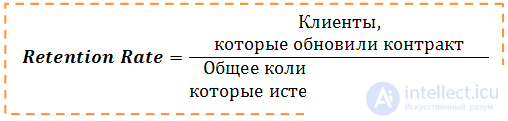
14. MRR Retention Rate
Similar to Customer Retention Rate, but here we look at the MRR retention rate (whether payments on expiring subscriptions are renewed).
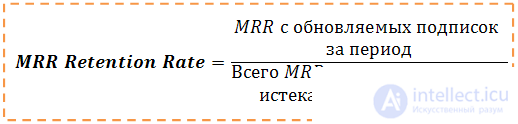
Retention can be a more convenient metric than Churn MRR, because this data can be collected faster and more easily.
Advocates of free software, and Richard Stallman in particular, describe "cloud technologies" as the equivalent of universal spyware and a big "back door", because such approaches give the server operator unjust power over the user's equipment.

Comments