
Lecture 30 min.
The term "non-fungible token" (NFT) refers to a type of digital asset that is not interchangeable, unlike traditional cryptocurrencies such as Bitcoin or Ethereum, which are fungible: every identical token of such a cryptocurrency has the same value and can be exchanged for other tokens of the same type.
NFTs are unique digital assets, each of which has its own uniqueness and cannot be replaced by another token. This makes them suitable for representing digital works of art, music, virtual real estate and other digital goods where uniqueness and authenticity are highly valued. Each NFT stores information about its uniqueness on a blockchain, which confirms its authenticity and ownership history.
A non-fungible token ( NFT ) is a unique digital identifier that is recorded on a blockchain and is used to certify ownership and authenticity. It cannot be copied, substituted or subdivided. Ownership of an NFT is recorded on the blockchain and can be transferred by the owner, which allows NFTs to be sold and traded. An NFT can be created by anyone, and creating one requires little or no programming skill. NFTs typically contain references to digital files , such as artworks, photographs, videos and audio. Because NFTs are uniquely identifiable, they differ from cryptocurrencies , which are fungible .
Proponents argue that NFTs provide a public certificate of authenticity or proof of ownership , but the legal rights conveyed by an NFT can be uncertain. Ownership of an NFT, as defined on the blockchain, has no inherent legal meaning and does not necessarily grant copyright , intellectual property rights or other legal rights over the associated digital file. An NFT does not restrict the sharing or copying of the associated digital file and does not prevent the creation of NFTs that refer to identical files.
The trading volume of NFTs increased in 2021 to 17 billion dollars, compared with 82 million dollars in the previous year. NFTs have been used as speculative investments and have drawn criticism because of the energy cost and carbon footprint associated with some types of blockchains, as well as their use in art fraud . The NFT market has also been compared to an economic bubble or a Ponzi scheme . At its peak, the three largest NFT platforms were Ethereum, Solana and Cardano In 2022 the NFT market collapsed; by May 2022 the number of sales was estimated to have fallen by more than 90% compared with 2021 By September 2023, one report claimed that more than 95% of NFT collections had zero monetary value.
An NFT is a data file stored in a digital ledger called a blockchain, which can be sold and traded. An NFT may be linked to a specific asset – digital or physical – such as an image, artwork, music or a recording of a sporting event. It may grant licensing rights to use the asset for a particular purpose. An NFT (and, where applicable, the corresponding license to use, copy or display the underlying asset) can be traded and sold on digital marketplaces. However, the extralegal nature of NFT trading usually results in an informal exchange of ownership rights to the asset that has no legal basis for enforcement, and therefore often provides nothing more than use as a status symbol.
NFTs function as cryptographic tokens, but unlike cryptocurrencies, NFTs are usually not interchangeable, so they are not fungible . A non-fungible token contains references to data, for example pointing to details about where the associated artwork is stored, which can be affected by link rot .
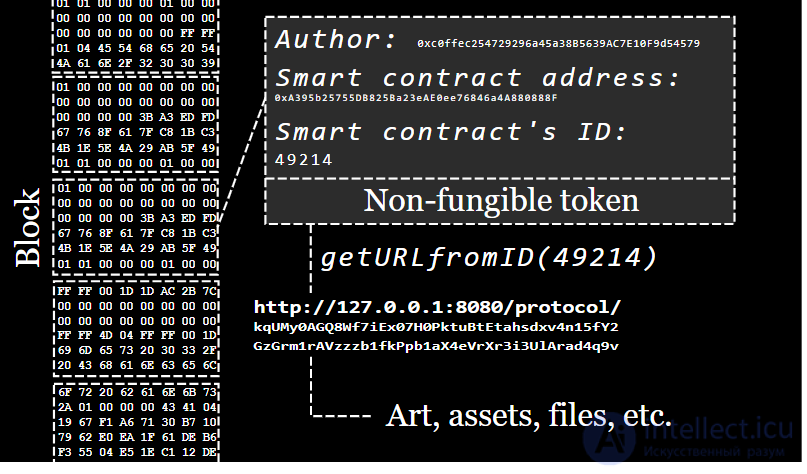
Illustration of a non-fungible token created by a smart contract (a program designed to execute the terms of a contract automatically)
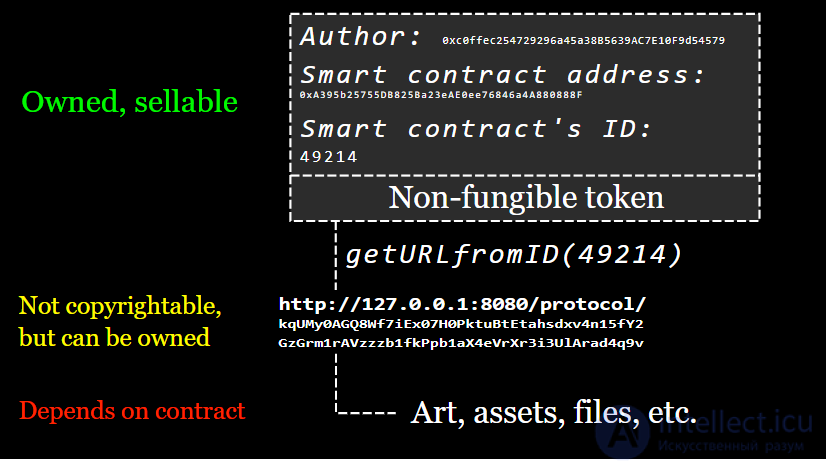
Diagram showing ownership of a non-fungible token and the associated file. In most cases this depends heavily on the token's smart contract.
An NFT is solely proof of ownership of a blockchain record and does not necessarily mean that the owner holds intellectual property rights to the digital asset that the NFT is intended to represent. Someone can sell an NFT representing their own work, but the buyer will not necessarily receive the copyright to that work, and the seller cannot be prevented from creating additional NFT copies of the same work. According to legal scholar Rebecca Tushnet , "in a sense the buyer gets whatever the art world thinks they've gotten. They definitely don't own the copyright in the underlying work unless it's explicitly transferred."
Some NFT projects, such as Bored Apes , explicitly transfer intellectual property rights to individual images to their respective owners. The CryptoPunks NFT collection was a project that originally prohibited the owners of its NFTs from using the corresponding digital images for commercial purposes, but later permitted such use after the collection was acquired by its parent company.
The first known "NFT", Quantum , was created by Kevin McCoy and Anil Dash in May 2014. It consists of a video clip made by McCoy's wife, Jennifer. McCoy registered the video on the Namecoin blockchain and sold it to Dash for 4 dollars during a live presentation at the Seven on Seven conference at the New Museum in New York. McCoy and Dash called the technology "monetized graphics". This explicitly linked a non-fungible, tradable blockchain token to a work of art through on-chain metadata (supported by Namecoin).
In October 2015, the first NFT project, Etheria, was launched and demonstrated at DEVCON 1 in London, the first Ethereum developer conference, three months after the launch of the Ethereum blockchain . Most of Etheria's 457 buyable and sellable hexagonal tiles went unsold for more than five years, until 13 March 2021, when renewed interest in NFTs sparked a buying frenzy. Within 24 hours, all tiles of the current and previous versions, each hard-coded at 1 ETH ( 0.43 US dollars at the time of launch), were sold for a total of 1.4 million US dollars .
The term "NFT" only gained wider currency thanks to the ERC-721 standard, first proposed in 2017 via the Ethereum GitHub , after various NFT projects were launched that same year. The standard coincided with the launch of several NFT projects, including Curio Cards , CryptoPunks (a project for trading unique cartoon characters released by the American studio Larva Labs on the Ethereum blockchain), and rare Pepe collectible cards .
The 2017 online game CryptoKitties became profitable through the sale of tradable NFT cats, and its success drew public attention to NFTs.
In 2020 the NFT market experienced rapid growth: its value tripled, reaching 250 million US dollars . In the first three months of 2021, more than 200 million US dollars was spent on NFTs .
In the early months of 2021, interest in NFTs grew after a series of high-profile sales and art auctions.
In May 2022, The Wall Street Journal reported that the NFT market was "collapsing". Daily sales of NFT tokens had fallen by 92% from September 2021, and the number of active wallets in the NFT market had dropped by 88% from November 2021. Although rising interest rates have affected risky bets across financial markets, the publication said that "NFTs are among the most speculative".
A September 2023 report by dappGambl, a site dedicated to cryptocurrency gambling, claimed that 95% of NFTs had fallen to zero monetary value.
NFTs have been used to exchange digital tokens that are linked to a digital file asset. Ownership of an NFT is often associated with a license to use the linked digital asset, but usually does not transfer the copyright to the buyer. Some agreements grant a license for personal, non-commercial use only, while other licenses also permit commercial use of the underlying digital asset. This kind of decentralized intellectual property copyright is an alternative to established forms of copyright protection controlled by government agencies and intermediaries in the relevant industry.
Digital art is a common use case for NFTs. High-profile NFT auctions of digital art have drawn significant public attention; the first such major in-house auction took place at Christie's in 2021. The artist Mike Winkelmann (known professionally as Beeple) ranks second in value, with US$69.3 million in 2021.
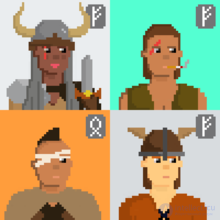
Some digital art NFTs, such as these pixel-art characters, are examples of generative art.
Some NFT collections, including Bored Apes, EtherRocks and CryptoPunks, are examples of generative art, in which many different images are created by assembling a set of simple image components in different combinations.
In March 2021, the blockchain company Injective Protocol bought an original screenprint titled Morons (White) from the English graffiti artist Banksy for $95,000 and filmed someone setting it on fire with a lighter. They uploaded the video (called "minting" in the NFT scene) and sold the video as an NFT. The person who destroyed the artwork, who called himself "Burnt Banksy", described the act as a way of moving the physical artwork into the NFT space.
The American curator and art historian Tina Rivers Ryan, who specializes in digital works, said that many art museums are not convinced that NFTs have "lasting cultural significance". Ryan compares NFTs to the net art craze before the dot-com bubble. In July 2022, after the scandalous sale of Michelangelo's "Doni Tondo" in Italy, the sale of NFT reproductions of famous works of art was banned in Italy. Given the complexity and unsettled nature of the issue, the Italian Ministry of Culture temporarily asked its institutions to refrain from signing contracts involving NFTs.
There are no centralized means of authentication that could prevent stolen and counterfeit digital works from being sold as NFTs, although auction houses such as Sotheby's and Christie's, as well as various museums and galleries around the world, have begun collaborations and partnerships with digital artists such as Refik Anadol, Dangiuz and Sarah Zucker.
NFTs linked to digital artworks can be sold and bought through NFT platforms. OpenSea, launched in 2017, was one of the first marketplaces to host various types of NFTs. In July 2019, the National Basketball Association, the NBA Players Association and Dapper Labs, the creator of CryptoKitties, launched the joint venture NBA Top Shot for basketball fans, which allows users to buy NFTs of historic moments in basketball. In 2020, Rarible appeared, allowing multiple assets to be used. In 2021, Rarible and Adobe partnered to make it easier to verify and secure the metadata of digital content, including NFTs. In 2021, the cryptocurrency exchange Binance launched its NFT marketplace. [54] In 2022, the company eToro Art by eToro was founded, aimed at supporting NFT collections and emerging creators.
The auction houses Sotheby's and Christie's display artworks linked to the corresponding NFTs, both in virtual galleries and on physical screens, monitors and televisions.
Mars House, an architectural NFT created in May 2020 by the artist Krista Kim, was sold in 2021 for 288 ether (ETH), the equivalent at the time of US$524,558.
NFTs can represent in-game assets, such as digital plots of land and personalized avatars. Some commentators describe them as being controlled by the "user" rather than the game developer [61] if they can be traded on third-party marketplaces without the game developer's permission. However, the reaction of game developers has generally been mixed: some, such as Ubisoft, have embraced the technology, but Valve and Microsoft have formally banned it.
NFTs have been proposed for use in the film industry as a way to tokenize movie scenes and sell them as collectibles in the form of NFTs. Artists working in the entertainment industry can receive royalties through NFTs. [81] So far, NFTs have often been used in both the music and film industries.
By February 2021, revenue from sales of artworks and songs as NFTs had reached US$25 million. On 28 February 2021, the electronic dance musician 3LAU sold a collection of 33 NFTs for a total of US$11.7 million to mark the three-year anniversary of his album Ultraviolet . On 3 March 2021, an NFT was created to promote the Kings of Leon album When You See Yourself . Other musicians who have used NFTs include the American rapper Lil Pump, Grimes, the visual artist Shepard Fairey in collaboration with the producer Mike Dean, and the rapper Eminem.
A paper presented at the 40th International Conference on Information Systems in Munich in 2019 proposed using NFTs as tickets for various types of events. This would allow the organizers of such events, or the artists performing at them, to receive royalties from the resale of each ticket.
NFTs have been proposed for scientific and medical purposes. Proposals include converting patient data into NFTs, tracking supply chains and issuing patents as NFTs.
The monetary side of selling NFTs has been used by academic institutions to fund research projects.

George M. Church sold an NFT with an "artistic image" of his genome and likeness in 2022.
NFTs representing digital collectibles and artworks are a speculative asset. Experts have called the surge in NFT purchases an economic bubble and have also compared it to the dot-com bubble. In March 2021, Mike Winkelmann called NFTs a "bubble of irrational exuberance". By mid-April 2021, demand had subsided, leading to a significant drop in prices. [137] The financial theorist William J. Bernstein compared the NFT market to the 17th-century tulip mania, saying that any speculative bubble requires technological progress to get people "excited", with part of this enthusiasm coming from the extreme predictions made about the product. For regulatory policymakers, NFTs exacerbate problems such as speculation, fraud and high volatility.
NFTs, like other blockchain securities and traditional art sales, can potentially be used for money laundering. NFTs can be used for wash trading by creating multiple wallets for one person, carrying out several sham sales and then selling the relevant NFT to a third party. According to a Chainalysis report, these kinds of wash trades are becoming popular among money launderers because of the largely anonymous nature of transactions on NFT marketplaces. Looksrare, created in early 2022, became known for the large sums generated from NFT sales in its first days, which amounted to US$400,000,000 per day. These large sums were generated mainly by wash trading. The Royal United Services Institute said that any money-laundering risks associated with NFTs can be reduced through the use of "best practices in KYC, strict cybersecurity measures and a registry of stolen artworks (...) without restricting the growth of this new market".
NFT auction platforms may face pressure from regulators to comply with anti-money-laundering laws. Guo Wenjun, director of the monitoring center of the People's Bank of China, said that NFTs "could easily become tools for money laundering". He pointed to the illegal use of cryptographic technologies and said that illicit actors often pose as innovators in financial technology.
A 2022 study by the US Department of the Treasury found "some evidence of money-laundering risk in the high-value art market", including through the "evolving market for digital art, such as the use of non-fungible tokens (NFTs)". The study examined how NFT transactions could become an easier option for laundering money through artworks, avoiding the complications of transporting or insuring physical works of art. Several NFT exchanges were flagged as virtual asset service providers that may be subject to Financial Crimes Enforcement Network rules. In March 2022, two people were charged with running a million-dollar NFT scheme through wire fraud.
In July 2022, the European Commission announced that it planned to develop anti-money-laundering rules by 2024.
Several blockchains have added support for NFTs since Ethereum created the ERC-721 standard.
ERC-721 is an "inheritable" smart contract standard. This means developers can create contracts by copying from a reference implementation. ERC-721 provides the basic methods that make it possible to track the owner of a unique identifier and that allow the owner to transfer the asset to others. Another standard, ERC-1155, offers "semi-fungibility", under which a token represents a class of fungible assets.
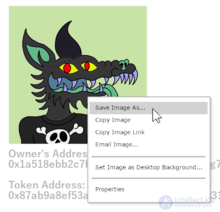
A digital artwork linked to a non-fungible token, like an image on the Internet, can be right-clicked and saved like any other image file.
Because the content of an NFT is publicly accessible, anyone can easily copy the file the NFT refers to. Moreover, owning an NFT on the blockchain does not in itself transfer legally enforceable intellectual property rights to the file.
It became well known that an NFT image can be copied or saved from a web browser by using the context menu to download the image the link points to. NFT supporters dismiss this duplication of NFT images, calling it the "right-click mentality". One collector quoted by Vice, compared the value of a purchased NFT (as opposed to an unpurchased copy of the underlying asset) to that of a status symbol, "to show that they can afford to pay that much".
The phrase "right-clicker mentality" went viral after it appeared, especially among those who criticized the NFT market and appropriated the term to show off their ability to grab NFT-backed digital art with ease. This criticism was backed by the Australian programmer Geoffrey Huntley, who created "The NFT Bay" modeled on The Pirate Bay. The NFT Bay advertised a torrent file allegedly containing 19 terabytes of NFT digital images. Huntley compared his work to an art project by Pauline Pantsdown and expressed hope that the site would help users learn what NFTs are and what they are not.
NFTs that represent digital art usually do not store the associated artwork file on the blockchain, because of the large size of such a file and the limited processing speed of blockchains. Such a token acts as a certificate of ownership with a web address pointing to the artwork in question; however, this makes the art itself vulnerable to link rot.
Buying and selling NFTs is made possible by the high energy consumption, and the resulting greenhouse gas emissions, associated with blockchain transactions. Although all forms of Ethereum transactions have an environmental impact, the direct impact of a transaction also depends on the size of the Ethereum transaction. The proof-of-work protocol needed to regulate and verify blockchain transactions in networks such as Ethereum consumes a large amount of electricity. Estimating the carbon footprint of a specific NFT transaction requires many assumptions or estimates about the way that transaction is set up on the blockchain, the economic behavior of blockchain miners (and the energy needs of their mining equipment), and the amount of renewable energy used in these networks. There are also conceptual questions, such as whether the carbon footprint estimate for an NFT purchase should include some share of the underlying network's ongoing energy demand or only the marginal impact of that particular purchase. An analogy would be the carbon footprint associated with an additional passenger on a particular airline flight.
Some NFT technologies use verification protocols, such as proof of stake, that use much less energy per verification cycle. Other approaches to reducing electricity consumption include the use of off-chain transactions as part of NFT creation. A number of NFT art sites hope to address these problems, and some are moving to lower-cost technologies and protocols. Others now allow the option of buying carbon offsets when purchasing an NFT, although the environmental benefits of this are questioned. In some cases, NFT artists have refused to sell some of their works in order to limit carbon dioxide emissions.
Sales platforms charge artists and buyers fees for minting, listing, approval and secondary sales. An analysis of NFT markets in March 2021, just after Beeple's sale of "Everydays: the First 5000 Days" for US$69.3 million, found that most NFT artworks sold for less than US$200, and a third sold for less than US$100. Those who sold NFTs worth less than US$100 paid platform fees of 72.5% to 157.5% of that amount. On average, fees amount to 100.5% of the price, meaning that such artists on average paid more money in fees than they earned from sales.
There have been cases in which the works of artists and creators were sold by others as NFTs without permission. After the death of the artist Qing Han in 2020, a fraudster assumed her identity, and a number of her works became available for purchase as NFTs. Similarly, a seller posing as Banksy managed to sell an NFT allegedly made by the artist for $336,000 in 2021; the seller returned the money after the case drew media attention. In 2022, it was discovered that, as part of its NFT marketing campaign, the NFT company with which the voice actor Troy Baker had announced a partnership had plagiarized voice lines generated from 15.ai, a free artificial-intelligence text-to-speech project.
The anonymity associated with NFTs and the ease with which they can be forged make it difficult to prosecute NFT plagiarists.
In February 2023, a New York court ordered the artist Mason Rothschild to pay Hermès $133,000 in damages for harm caused by his 2021 work. [
Some NFT marketplaces have responded to cases of plagiarism by creating "takedown teams" to respond to complaints from artists. The NFT marketplace OpenSea has rules prohibiting plagiarism and deepfakes (intimate images obtained without consent). Some artists have criticized OpenSea's efforts, saying that it is slow to respond to takedown requests and that artists are being scammed by users who claim to be representatives of the platform. Others argue that NFT marketplaces have no market incentive to combat plagiarism.
In January 2022 it was reported that sellers had used some NFTs to unknowingly collect users' IP addresses . The "exploit" works through the off-chain nature of NFTs, since the user's computer automatically follows the web address in the NFT to display the content. The server at that address can then record the IP address and, in some cases, dynamically change the returned content to display the result. OpenSea is particularly vulnerable to this loophole because it allows HTML files to be linked.
Critics compare the structure of the NFT market to a pyramid or Ponzi scheme , in which early participants profit at the expense of those who buy later. In June 2022, Bill Gates said he was convinced that NFTs are "100% based on greater fool theory ".
A "rug pull" is a scam similar to an exit scam or a "pump and dump" scheme , in which the developers of an NFT or other blockchain project inflate the project's value to raise its price and then suddenly sell all of their tokens to lock in enormous profits, or otherwise abandon the project while draining its liquidity, which permanently destroys the project's value.
NFTs have become popular in the worlds of art, music, gaming and entertainment, and many artists, musicians and creative professionals use them to sell and showcase their digital works. Collectors and investors are also interested in NFTs, often buying unique digital assets as investments.

Comments