
Lecture
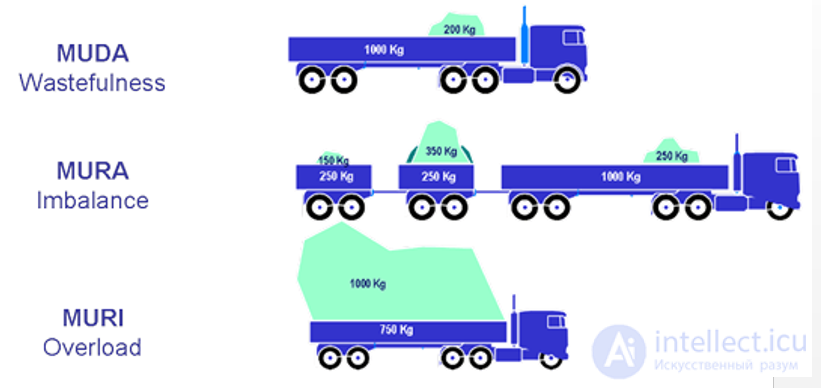
It is not only the actual losses that arise in the production process, but also actions that do not create value (utility) for the product yet still consume resources. In effect, this is waste that we are forced to bear under the existing organizational and technical conditions.
There are two types of muda:
Taiichi Ohno, the founder of the Toyota Production System, identified seven types of muda — seven types of waste.
It is customary to distinguish seven types of muda in production: overproduction, waiting, transportation, inappropriate processing, excess inventory, unnecessary motion, and defects.
1. Overproduction
This means producing more goods than the market requires. It leads not only to direct costs but also to higher storage expenses, and it reduces the ability to control quality and detect defects.
In real life it can be difficult to decide to cut back or stop production. However, experience shows that companies that have managed to do so, and have tied production to consumer demand, have always come out ahead.
2. Waiting
If products are not being processed, moved, or undergoing quality control, this means waiting is taking place. In the traditional "warehouse–shop floor–warehouse" production scheme, most of the time is spent precisely on waiting.
The main causes of waiting losses are poor organization and planning of work, irrational logistics of the production process, long distances between processing locations, and downtime from equipment stoppages (see TPM, process maps and diagrams). Waiting is a type of waste that cannot be made up for later.
3. Transportation
Moving products (parts, semi-finished goods) between operations is work that does not create value (utility) for those products. In addition, damage is possible during movement, that is, a deterioration in quality. Special personnel and equipment have to be used for transportation, which increases costs. Process maps and diagrams are a convenient tool for analyzing transportation losses.
4. Inappropriate processing
This means using methods of processing a product that do not match the purpose of the given processing stage. At many enterprises, high-precision equipment is used in cases where equipment of standard precision would suffice. There can be many reasons for this type of muda: the drive to improve quality through a mechanistic approach and weak control, the particulars of the enterprise's planning, or attempts to load the equipment as fully as possible in order to "justify" the cost of acquiring it more quickly, and so on. Common sense and control charts help most in eliminating this type of muda.
5. Excess inventory
Excessive inter-operation stock and work in progress are a direct consequence of overproduction and waiting. Excess inventory, as a rule, hides shortcomings in the organization of production, and it should be identified and reduced. Excess inventory lengthens the production cycle, occupies part of the production floor space and makes it inefficient, makes it harder to identify production problems, and hampers communication. The drive toward a uniform production process and a smooth movement of products along production flows inevitably leads to the need to reduce inventory, and therefore the costs of maintaining and storing it (see 5S).
6. Unnecessary motion
These are losses associated with staff having to make unnecessary movements while working, that is, above all, with ergonomics. It is also an occupational safety issue. Many examples could be given. The most common cause is poor organization of workplaces. All jobs should be analyzed, unnecessary movements eliminated from them, and the organization of workplaces improved (see 5S, time study).
7. Defects
One of the most important and obvious types of waste is defects. Defects lead to additional costs for correcting them, or for producing new products to replace the defective ones. Additional expenses also arise from the need to keep reserve stocks, carry out repeated quality inspections, and change work schedules. In addition, one can speak of an actual loss of part of the production capacity. Creating a quality control department at the enterprise and increasing the number of inspectors does yield a certain positive result, but only by drawing additional resources into the process. There is another tool for solving the problem — 7QCT.
Mura arises from uneven demand for products, from an uneven production plan, and from the uneven speed at which different operations are performed.
Waste and overload arise from unevenness — if we fail to level the workload of staff and production capacity, then at some times they will stand idle, and at others they will be overloaded with work.
Lean manufacturing or lean production , is a method of production derived from Toyota's 1930s operational model, "The Toyota Way" ( Toyota Production System , TPS). The term "lean production" was coined in 1988 by John Krafcik and defined in 1996 by James Womack and Daniel Jones as consisting of five key principles: "Precisely specify value for a specific product, identify the value stream for each product, make value flow without interruptions, let the customer pull value from the producer, and pursue perfection".

Comments