
Lecture
Double taxation is the simultaneous taxation of the same income by the same kinds of taxes in different countries. It arises because a tax non-resident (an individual or legal entity that does not permanently reside in the country of which it is a citizen or subject) may be required to pay tax on worldwide income both in the place where it is actually located and in its country of citizenship. To avoid such conflicts, countries sign agreements for the avoidance of double taxation.
A distinction is made between international economic double taxation (two different taxpayers are taxed on the same income) and international juridical double taxation (the same income of the same taxpayer is taxed by more than one state).
When designing a tax system, every state has two fundamental approaches: either to tax all the worldwide income of its residents (the residence principle), or to levy taxes where the economic activity takes place (the territoriality principle).
If all the countries of the world agreed to use one of these two approaches, based on the same criteria for determining sources of income and place of activity, there would be no problems. But because countries differ in their level of development and tax burden, most states apply both principles at the same time. This leads to international double taxation: the levying of comparable taxes in two states on the same taxpayer, in respect of the same object and for the same period, arising from a conflict between the tax laws of two or more countries.
The problem is solved in two ways. The first is a unilateral credit given to a country's own residents for taxes paid abroad. The second is the development of rules that divide jurisdiction between the country where a company is resident and the country from which it receives the income.
Countries can reduce or avoid double taxation either by exempting income from foreign sources from taxation (the exemption method, EM) or by granting a foreign tax credit (FTC) for tax paid on income from foreign sources.
The EM method requires the country of origin to collect the tax on income from foreign sources and transfer it to the country where it arose. Tax jurisdiction extends only as far as the national border. When countries use the territorial principle described above, they usually use the EM method to avoid double taxation. However, the EM method is common only for certain categories or sources of income, such as income from international transport.
The FTC method is used by countries that tax the income of residents (individuals or legal entities) regardless of where it arises. The FTC method requires the country of residence to grant a tax credit against domestic tax liability if the individual or legal entity pays income tax abroad.
Another solution in use is the "granting of concessions". These create more favourable conditions for multinational companies to (remain) based in countries that use less effective measures than the EM or FTC method.
Agreements between countries on the avoidance of double taxation in respect of real estate are, as a rule, based on the following principle: the property is taxed as an asset, and the income from it is taxed as income, in the country where it is located. The other country party to the agreement (the country of residence of the property owner) either exempts the property from its own taxes or credits the taxes levied by the other country.
Double tax treaties are international intergovernmental agreements intended to prevent the unlimited taxation of the same income in several states. Treaties are generally concluded to encourage economic cooperation between different countries.
It should be understood, however, that such treaties apply to a limited circle of persons (residents of the contracting parties) and to clearly defined types of taxes. Double tax treaties usually do not apply to companies operating in the offshore sector or benefiting from preferential tax regimes. The benefits of a double tax treaty can be claimed only in respect of so-called "direct" taxes: on profits, on capital gains and on property. The rules for "indirect" taxes (for example, VAT) are not regulated by treaties.
With offshore jurisdictions, developed countries usually sign only agreements on the exchange of tax information, rather than agreements on the avoidance of double taxation, in order to rule out the possibility of using "grey" tax schemes.
In Russia there are quite a lot of property owners who:
All these persons are tax non-residents under Russian law.
Personal income tax (NDFL) is levied on all income received by tax non-residents from sources in the Russian Federation, including from the sale of real estate. NDFL for tax residents is 13%, while for non-residents it is 30% (except for dividends, at 15%, and for work under a patent or as highly qualified specialists, refugees, seamen and so on, at 13%).
At the same time, tax non-residents are not covered by the rules:
It must also be taken into account that income received in Russia by a foreigner (non-resident or resident) is also subject to taxation in his country of residence, i.e. in this case the tax is paid twice: the first time under Russian law, the second under the law of the foreigner's country of residence (where tax on worldwide income is, as a rule, paid).
So as not to pay taxes twice, states conclude international agreements on the avoidance of double taxation with each other, since international treaties and agreements take precedence over the national rules of any country. The list of countries with which double tax treaties have been concluded is given on the official website of the Federal Tax Service of the Russian Federation .
Legal regulation is carried out in accordance with Article 232 of the Tax Code of the Russian Federation, "Elimination of Double Taxation".
In March 2019, the Ministry of Finance drafted amendments to the Tax Code that give new opportunities for resolving disputes over international transactions. Under the amendments, if the actions of tax authorities abroad contradict the provisions of a double tax treaty, the taxpayer has the right to file an application with the Ministry of Finance within three years.
On 8 August, Russian President Vladimir Putin signed a decree suspending double tax treaties with "unfriendly" countries that have imposed sanctions against the Russian Federation.
Ukrainian residents dealing with counterparties from other countries should remember the possibility of optimizing their tax burden through the mechanism for avoiding double taxation. To use this mechanism, it is enough to obtain a certificate from the competent authority, which does not even always need to be legalized. The situation is similar for income of non-residents received from Ukraine.
The main document for residents to exercise their right to avoid double taxation is Order of the State Tax Administration of Ukraine No. 173 of 12.04.2002 "On Confirmation of the Status of a Tax Resident of Ukraine".
The European countries with which double tax treaties are in force include: Austria, Belgium, Belarus, Bulgaria, the United Kingdom, Greece, Denmark, Estonia, Iceland, Spain, Italy, Cyprus, Latvia, Lithuania, Macedonia, Moldova, the Netherlands, Norway, Poland, Portugal, the Republic of Serbia, the Republic of Montenegro, the Russian Federation, Romania, Slovakia, Slovenia, Turkey, Hungary, Finland, France, Germany, Croatia, the Czech Republic, Switzerland and Sweden. Among other countries of the world, the following should be noted: Azerbaijan, Algeria, Brazil, Vietnam, Georgia, Egypt, Israel, India, Indonesia, Iran, Kazakhstan, Canada, China, the Republic of Korea, Kuwait, Malaysia, the UAE, South Africa, Syria, Singapore , the USA, Turkmenistan, Japan and others.
Application of Ukraine's international treaty in respect of exemption from taxation or application of a reduced tax rate is permitted only if the non-resident provides the person (the tax agent) with a document confirming tax resident status. The basis for exempting income with a Ukrainian source from taxation is the non-resident's provision, to the person (tax agent) paying the income, of a certificate (or its notarized copy) confirming that the non-resident is a resident of a country with which Ukraine has concluded an international treaty, as well as other documents, if provided for by Ukraine's international treaty.
Ukraine also determines tax residency. The main criterion is the centre of vital interests (family, housing, business). Even if you physically spend more time in Georgia, Ukraine may consider you its resident if your main ties remain there.
If you retain Ukrainian tax residency, you are required to declare your worldwide income and pay tax in Ukraine.
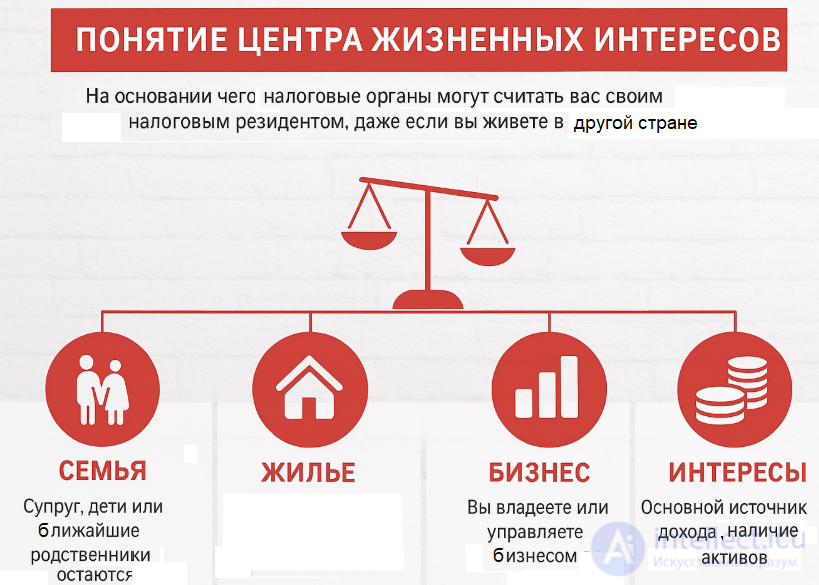
The "centre of vital interests" condition is regulated by the tax code of the relevant country.
example
"The centre of vital interests of an individual is deemed to be located in the Republic of Kazakhstan if the following conditions are met simultaneously:
1) the individual holds citizenship of the Republic of Kazakhstan or a residence permit for the Republic of Kazakhstan;
2) the individual's spouse and/or close relatives reside in the Republic of Kazakhstan;
3) there is real estate in the Republic of Kazakhstan, owned by the individual and/or the spouse and/or close relatives, or held on other grounds, that is available at any time for the individual's residence and/or the residence of the spouse and/or close relatives."
If the centre of interests remains in country A → then country A may try to treat you as its resident, and you will then have to prove your right to residency in country B through the treaty.

Comments