
Lecture 5 min.
| Magnon | |
| Composition: | Quasiparticle |
|---|---|
| Family: | Boson |
| Theoretically proposed: | 1930 by Felix Bloch |
| Mass | 0 MeV/c2 (theoretically) |
| Lifetime: | ∞ (theoretically) |
| Quantum numbers: | |
| Electric charge: | 0 |
| Spin: | 1 ħ |
Magnon is a quasiparticle corresponding to an elementary excitation of a system of interacting spins. In crystals with several magnetic sublattices (for example, antiferromagnets), several kinds of magnons with different energy spectra may exist. Magnons obey Bose–Einstein statistics. Magnons interact with each other and with other quasiparticles. The existence of magnons is confirmed by experiments on the scattering of neutrons, electrons and light, which is accompanied by the creation or annihilation of a magnon
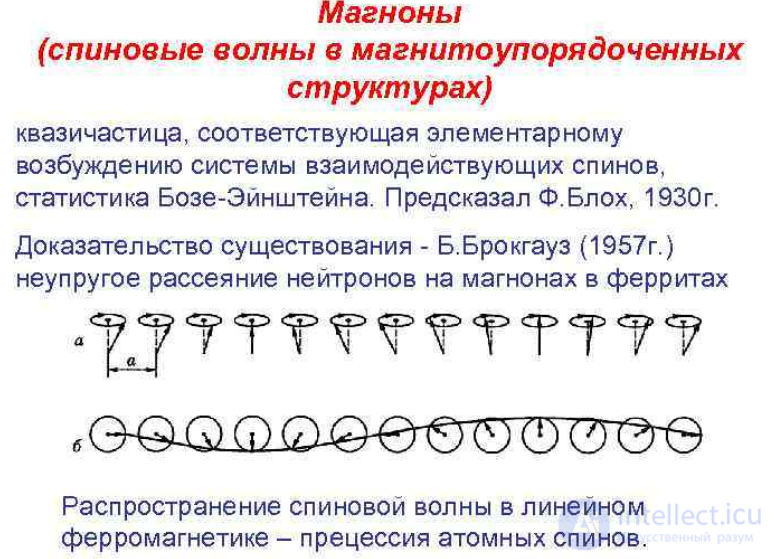
The concept of the magnon was introduced in 1930 by Felix Bloch to explain quantitatively the decrease of spontaneous magnetization in ferromagnets. At absolute zero temperature a ferromagnet reaches its lowest-energy state, in which the atomic spins (and hence the magnetic moments) are aligned in one direction. As the temperature rises, the spins begin to deviate from the common direction, thereby increasing the internal energy and reducing the total magnetization. If a perfectly magnetized ferromagnet is regarded as the vacuum state , then the state at low temperatures, in which the perfect order is disturbed by a small number of flipped spins, can be regarded as a gas of quasiparticles, the magnons. Each magnon reduces the number of correctly aligned spins by  and the total magnetic moment along the quantization axis by
  , where
  is the gyromagnetic ratio.
The quantitative theory of magnons (quantized spin waves) was developed further in the work of Ted Holstein[en], Henry Primakoff and Freeman Dyson . Using the model of second quantization, they showed that magnons behave as weakly interacting quasiparticles obeying Bose–Einstein statistics. A detailed description of magnon theory can be found in Charles Kittel's textbook on solid state physics or in the early review article by Van Kranendonk and Van Vleck .
Direct proof of the existence of magnons was found in 1957 by Bertram Brockhouse, who demonstrated inelastic scattering of neutrons by magnons in ferrites . The existence of magnons has been demonstrated in ferromagnets, ferrimagnets and antiferromagnets.
Experiments with antiferromagnets in strong magnetic fields demonstrated that magnons indeed obey Bose–Einstein statistics. Bose–Einstein condensation of magnons in an antiferromagnet at low temperatures was demonstrated by Nikuni et al. , and in a ferrimagnet at room temperature by Demokritov et al. .
The study of magnons is of great importance for understanding the magnetic properties of materials and for developing magnetoelectronics (spintronics), where electron spins are used to transmit and process information. Magnons can also serve as a model for studying collective quantum phenomena in crystalline materials.
Paramagnons are magnons in magnetic materials that are in their high-temperature disordered ( paramagnetic ) phase. At sufficiently low temperatures the local atomic magnetic moments (spins) in ferromagnetic or antiferromagnetic compounds become ordered. Small oscillations of the moments around their natural direction propagate as waves (magnons). At temperatures above the critical temperature, long-range order is lost, but the spins still align locally in patches, which allows spin waves to propagate over short distances. These waves are known as paramagnons and undergo diffusive (rather than ballistic) transport, whether short-range or long-range.
The concept was first proposed on the basis of spin fluctuations in transition metals by Berk and Schrieffer and Doniach and Engelsberg to explain the additional repulsion between electrons in some metals, which lowers the superconducting critical temperature .
The behavior of magnons can be studied with various scattering methods. Magnons behave as a Bose gas without a chemical potential. Microwave pumping can be used to excite spin waves and to create additional nonequilibrium magnons, which thermalize into phonons . At a critical density a condensate forms, which manifests itself as the emission of monochromatic microwaves. This microwave source can be tuned with an applied magnetic field.

Comments