
Lecture 8 min.
Stupidity is a lack of intelligence , understanding , reason or wit , an inability to learn. It may be innate, assumed or reactive. The word stupid comes from the Latin word stupere . Stupid characters are often used for comedy in fictional stories. Walter B. Pitkin called stupidity an "evil", but in a more romantic spirit William Blake and Carl Jung held that stupidity can be the mother of wisdom .
The root of the word "stupid" , which can serve as both an adjective and a noun, comes from the Latin verb " stupere " — "to be numb" or "to be amazed", and is related to the word "stupor" . In Roman culture the " stupidus " was a professional scapegoat in theatrical mimes .
According to the online Merriam-Webster dictionary, the words "stupid" and "stupidity" entered the English language in 1541. Since then the word "stupidity" has taken its place alongside the words " fool ", " idiot ", " dumb ", " moron " and related concepts as a derogatory label for misdeeds, whether intentional or accidental, caused by a lack of mental ability.
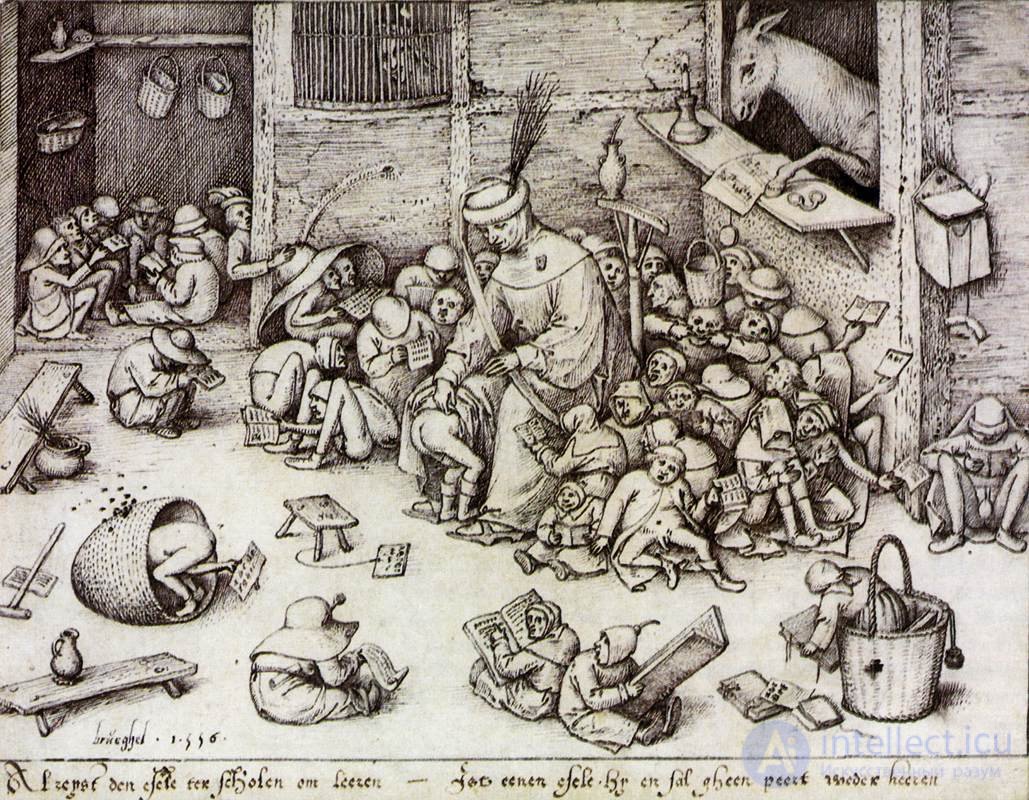
"The Ass at School" — an engraving after Pieter Bruegel the Elder , 1556.
Caption: Al rijst den esele ter scholen om leeren, ist eenen esele hij en zal gheen peert weder keeren . ("Even if the Ass goes to school to learn, he will not come back a horse.")
Stupidity is the quality or state of being stupid, or an act or idea that exhibits the properties of stupidity. In the character study "The Stupid Man", attributed to the Greek philosopher Theophrastus (c. 371 – c. 287 BC), stupidity was defined as "mental slowness in speech or action". The modern English word "stupid" has a wide range of uses: from slow-witted (indicating a lack of intelligence, care or reason), through dulled senses or sensation (sluggish, pointless, insensible), to lacking interest or meaning (annoying, irritating). It may imply either an innate inability to reason or a temporary state of numbness or slowness.
In the book Understanding Stupidity , James F. Welles defines stupidity as follows: "The term may be used to designate a mentality that is considered to be informed, intentional, and maladaptive." Welles distinguishes stupidity from ignorance ; stupidity means that the person must know that they are acting against their own best interests, that it must be a choice rather than a forced action or an accident. Finally, it requires that the activity be maladaptive, in the sense that it is against the actor's best interests, and is specifically carried out to prevent adaptation to new data or existing circumstances."
There are various tests for measuring intelligence quotient (IQ), as well as tests that measure aptitude , such as the mandatory General Classification Test (GCT) of the US Marine Corps and the US Army General Classification Test .
Researchers Michael Kleine and Matthew Cancian reported a decline in aptitude among college-educated applicants entering the Marine Corps over the past 34 years, although this effect was not observed among enlisted personnel as a whole.
Researchers Michael J. McFarland, Matt E. Hauer and Aaron Reuben report that people born between 1951 and 1980 may have lost an average of 2.6 IQ points due to exposure to leaded gasoline.
Eric Berne described the game "Stupid" as having the thesis "... 'I am laughing with you at my own clumsiness and stupidity ' ." He points out that the player has the advantage of lowering other people's expectations and thus avoiding responsibility and work; but he or she may still stand firm under pressure, like the foolish youngest son spoken of in the proverb .
Wilfred Bion considered that psychological projection creates a barrier to learning anything new and is thus a form of pseudo-stupidity.
Otto Fenichel argued that "a significant percentage of so-called feeble-mindedness turns out to be pseudo-feeble-mindedness caused by inhibition... Every intelligence begins to show weakness when affective motives work against it." He suggests that "people become stupid ad hoc , that is, when they do not want to understand, because understanding would cause anxiety or guilt or would threaten an existing neurotic equilibrium."
In a somewhat different vein, Doris Lessing claimed that "there is no fool like an intellectual... a kind of clever stupidity, bred by a logical line in the head that has nothing to do with experience"
In the Romantic reaction to the wisdom of the Enlightenment, an appreciation arose for the irrational , the foolish and the unreasonable, as in William Blake's saying that "if the fool would persist in his folly he would become wise"; or in Jung's belief that "it takes no art to become stupid; the art lies in extracting wisdom from stupidity. Stupidity is the mother of the wise, but cleverness never"
Similarly, Michel Foucault argued that stupidity is necessary in order to reconnect with what our articulated categories exclude, and to regain the otherness of difference .
In his book A Short Introduction to the History of Human Stupidity (1932), Walter B. Pitkin warns of the influence of stupid people:
Stupidity can easily be proved to be the supreme Social Evil. Three factors combine to make it so. First, the number of stupid people is legion. Second, most of the power in business, finance, diplomacy and politics is in the hands of more or less stupid people. Finally, high ability is often linked with serious stupidity.
Dietrich Bonhoeffer pointed to stupidity as "a more dangerous enemy of the good than malice", because there is no defense against it: "Neither protest nor force can touch it. Reasoning is futile. Facts that contradict personal prejudice can simply be disbelieved." The great danger of stupidity appears when it affects large groups. In a large group, "the stupid person will also be capable of any evil and at the same time incapable of seeing that it is evil".
According to Carlo Cipolla, the efforts of stupid people are counterproductive to their own interests and to those of others. He argues that reasonable people cannot imagine or understand unreasonable behavior, which makes stupid people dangerous and damaging, even potentially more dangerous than the "bandit", whose actions at least have a rational purpose, namely his own gain.
The fool or jester has been a central character in many comedies . Alford and Alford found that humor based on stupidity was common in "more complex" societies compared with some other forms of humor. Some analyses of the comedy of William Shakespeare have found that his characters tend to hold mutually exclusive positions; since this implies a lack of careful analysis, it points to stupidity on their part.
Today there are many television shows featuring stupidity, such as The Simpsons . Stupid comedy is a class of naive, idiotic humor, typified by the actor Leslie Nielsen .
Stupidity is a 2003 film directed by Albert Nerenberg . It presents examples and analysis of stupidity in modern society and the mass media, and attempts to "explore the prospect that willful ignorance is increasingly becoming a strategy for success in the spheres of politics and entertainment".
Idiocracy , a 2006 film by Mike Judge , explores a dystopian future America in which a man of average IQ is cryogenically frozen and wakes up 500 years later to find that humanity, increasingly dependent on technology created by previous generations that it neither maintains nor properly understands, has regressed in intelligence to the standards of what the modern era would call intellectual disability , and that he has become effectively the smartest man on Earth. Americans have become so stupid that society faces famine and collapse, and, in the words of Pete Vonder Haar of Film Threat , "... every laugh is tempered by the disturbing realization that [Judge's] vision of humanity's future may not be all that far from the truth".

Comments