
Lecture 40 min.
Geoeconomics is a scientific discipline that studies the economic situation of a given country on the basis of various indicators, such as its geographic position, historical development and culture, in order to determine its level of economic development and its place in world politics, taking into account only the level of economic influence. It is closely related to other social sciences and humanities, and therefore also overlaps with geopolitics and the study of globalization.
As a political strategy, geoeconomics is a new geopolitics (geopolitical economy), which develops a strategy for increasing a state's influence on the basis of its economic power and ensures the attainment of foreign policy goals, and of global or regional power, by economic means.
The first attempts to link various economic processes and phenomena with spatial factors can be seen in the works of various scholars beginning in the eighteenth century. The foundations of the geoeconomic concept can first be found in Fritz Rörig, a German historian, who suggested that economic factors are the primary determinants of the geopolitical alignment of states. He argued that dominance is won precisely by those countries in which the greatest number of productive resources and the greatest amount of information are concentrated. The Italian scholars Gian Carlo and Paolo Savona, for their part, held that economics and politics have always been closely interconnected. A state, in pursuing a given policy, inevitably took economic capabilities and interests into account; moreover, without economic resources it could not carry out either foreign or domestic policy at all.
The foundations of geoeconomic theory can also be found in Friedrich List's "National System of Political Economy," written at the beginning of the nineteenth century. This book contains the claim that a state's economic well-being and influence depend directly on geographic factors, and that at the early stages of development it is precisely these factors that determine how much the state is in demand in the world trading space, since the productive path of any state begins with land cultivation and agriculture.
However, until almost the end of the last century there was neither a separate scientific discipline nor the very term "geoeconomics." The concept was introduced in the late 1980s by Edward Luttwak, a political scientist and consultant to the National Security Council of the US Department of State. Scholars attribute this late emergence of geoeconomics as a separate science to various factors. It was at the end of the twentieth century that the process of globalization began, which strengthened the dependence of states on one another. In addition, geographic boundaries between states were overcome owing to the virtualization of information and, subsequently, of capital, which created the need for what was in essence a new geography, based on the location of centers where information and capital accumulate.
Luttwak himself explained the emergence of geoeconomics as a line of scientific and political thought separate from politics by reference to the following two circumstances:
E. G. Kochetov, a Russian scholar, identified four main reasons for the emergence of geoeconomics as an independent discipline. These are the erosion of borders between states, as a result of which domestic and foreign policy become ever more closely linked; the growing influence of the economy on the political process, both within the state and in its external activity; the emergence of universal economic rules that make it possible to preserve global economic equilibrium; and the priority of economic development over the political, ideological and other strategic goals of the policy a state pursues.
The link between geopolitics and the world economy is also substantiated in Immanuel Wallerstein's world-systems theory, in which the rise and fall of global geopolitical hegemonies is correlated with the restructuring of the world economy described in N. D. Kondratieff's long-wave economic cycles.
The geoeconomic approach was first developed in the United States after the end of the Second World War and was reflected in the "doctrine of containment of the USSR." The new geopolitics played an important role in the Cold War.
Geoeconomics is a policy of redistributing resources and world income. The main super-profits (the rent of marginal energy) are received by the economically most developed countries.
Geoeconomics can be regarded as a variety of globalist geopolitics. However, it considers only a state's level of economic development; for it, the very notions of statehood, nationality and territorial peculiarities recede to a secondary level.
Geoeconomic policy is aimed at gaining power by increasing a country's economic might, and all of that country's actions should be directed toward extracting economic benefit from its relations with other countries. In addition, this policy is characterized by establishing the dependence of economically weaker states on stronger ones, in order to consolidate the position of the latter.
This type of policy is inseparably linked with the notion of geoeconomic rivalry, which consists of two components. So-called applied geopolitics involves a combination of two kinds of protectionism, "defensive" and "offensive." In the first case, the state suppresses competition among producers in its domestic market and promotes the fastest possible development of various industries. After this preparation, it moves on to "offensive" rivalry, in the course of which, conversely, it increases competition while selectively supporting individual producers. The second kind of protectionism is also called "effective," and among other things this policy consists in the state ensuring the development of its national industries.
The development strategies for the state proposed by geoeconomics are by no means always safe for it. Such a policy may run counter to the national and other interests of the country.
Luttwak himself asserts that at the present stage of world development geoeconomic policy differs from geopolitics primarily in that, whereas earlier states within geopolitics created certain national territories, now they are forced to operate in a "neutral" economic space.
One component of geoeconomic strategy is also the preservation and development of the nation-state, with its particular features in production and economic activity, since these are determined mainly by its original geographic position. Because national features in the sphere of production, and in a state's specialization, are determined precisely by natural factors, it is in its interest to give priority to developing those spheres of economic activity (for example, agriculture where the soil is favorable) that are natural for it by virtue of national and natural characteristics, because it will use its resources more efficiently, increase production and, accordingly, strengthen its position in the economic space.
The German economist and political scientist F. List argued that one strategy for achieving world dominance is the rapid development of one country in all spheres of production (agriculture, manufacturing) while preventing such all-round development in other states, which will foster the formation of the economic dependence of those states on this world power.
In contemporary conditions, one of the goals of geoeconomics as a policy is to take possession of territories where information and financial flows are concentrated and so-called "financial hubs" are formed. Gaining control of precisely such territories allows a state to genuinely increase its geoeconomic competitiveness. Managing such economic flows promotes the formation of economic clusters or networks of various actors that are competitive in the aggregate while competing with one another.
According to M. Porter (the founder of cluster theory), a cluster is a group of geographically proximate, interconnected companies and associated organizations operating in a particular field, characterized by commonality of activity and complementing one another. Thus, the structure of a cluster includes, on the one hand, the owners of the resources and technologies needed to produce the cluster's key goods and, on the other, the consumers of these goods (both as final and as intermediate products). The general structure of a cluster is shown in Fig. 3.
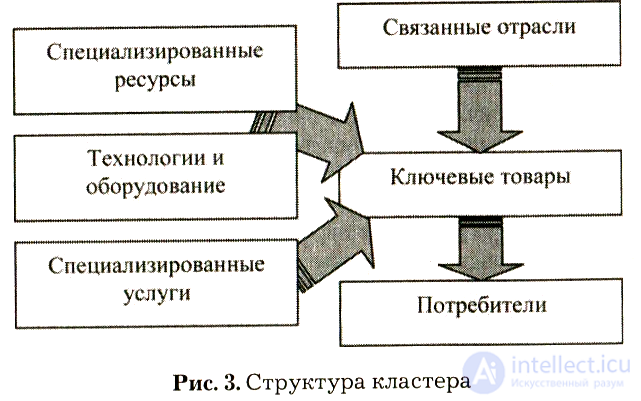
The value of a cluster lies not so much in its comprehensiveness as, first, in the presence of an internal competitive environment (a cluster is not a vertically integrated company) and, second, in the cluster's substantial presence in the global economy and its strong competitive positions in the global market.
Another group of effective ways of conducting geoeconomic policy is geoeconomic wars. In essence, they represent a fusion of the notions of trade war and cold war. In this situation there is no open military conflict; pressure on a competitor is exerted exclusively by economic means, and such actions are carried out within a definite and comprehensive strategic plan. Popular tactics of such a war include disrupting the enemy country's trade links with the outside world, drawing it into debt, and withdrawing capital from it.
Besides disguised interference in competitors' economies, one of the methods of geoeconomic war is strengthening a state's own competitiveness. This consists not only in building up its economic power but also in establishing, in the common economic space, special rules to which its closest competitors will be forced to submit. The danger of such a strategy is the possibility of destroying the entire international economic system, which is why hidden, indirect methods are used alongside direct methods of rivalry.
Among the many methods and means of waging geoeconomic war, the following can be singled out: increasing the share of the state's national capital in investment in other countries and the share of imports of its national product into competitor countries; dragging developing and peripheral countries into debt traps and increasing their external debt; and making the exchange rate of competitors' currencies dependent on the currency of the state waging the geoeconomic war.
The subject of geoeconomics includes the development processes not only of state and regional entities but also of real international structures: economic, financial and integration associations, transnational corporations, euroregions, free economic zones (special economic zones), as well as geopolitical actors (or blocs).
Geoeconomics studies the development of states in various aspects: cultural, historical and territorial. The aim of this study is to identify the reasons why one or another economic system has formed in a given country, and to construct a further strategy of the state's economic development using information about its geopolitical, geographic and other characteristics.
The basis of geoeconomics' study of a state is its territorial position and the influence of the environment in that territory on its economic activity, as well as the characteristic features of various economic aspects, such as the nature of resource redistribution, the type of division of labor, and the traditions of producing particular goods.
Geoeconomics also studies the political actions of a state on the geopolitical stage, aimed primarily at increasing its competitiveness under conditions of constant rivalry between countries.
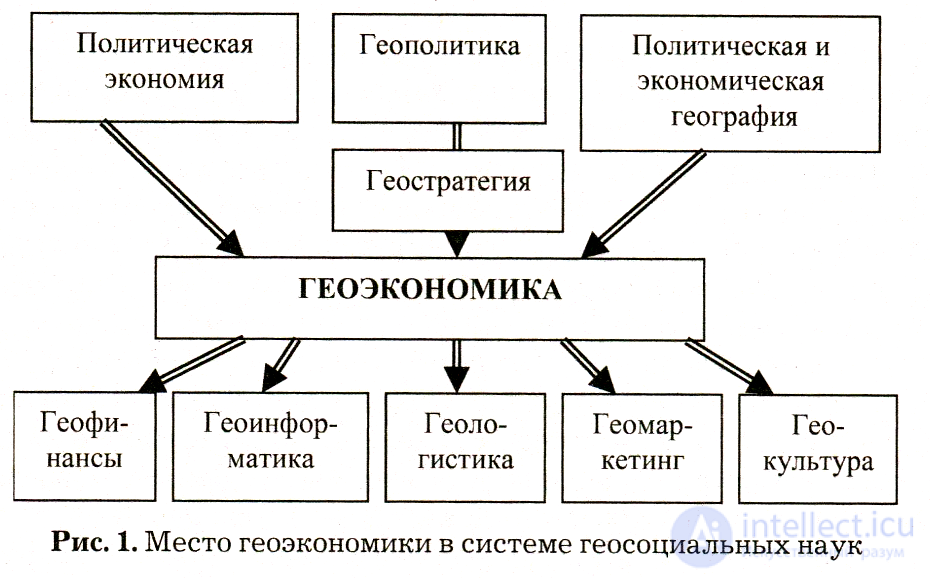
One of the main problems in geoeconomics as a science is the role of space in a state's well-being. The space that a given country occupies directly affects its economic prosperity. If its territory has fertile soil, predominantly flat terrain and a temperate climate, such a territory promotes the state's economic development. If, however, a country is not large enough or lacks the necessary natural endowments, then in order to achieve economic prosperity it must either resort to conquest or enter into an economic union with a number of other countries.
Friedrich List, one of the founders of geoeconomic ideas, wrote about developing a state's national characteristics. Thus, strengthening the nation-state and studying the effect of such a strategy on the country's position in the world are also part of the range of problems of geoeconomics.
The range of problems of geoeconomics also includes aspects of the development of colonial and neocolonial systems under the control of metropolitan states (metropolitical economy), as well as the formation and development of large urban formations: agglomerations, conurbations and megalopolises (megapolitical economy).
In its research methods, geoeconomics relies on a number of principles. In studying any state, it must consider it not in isolation but as part of a whole, analyzing it as a subject of geopolitical and geoeconomic activity, since only by assessing a country's position in the overall system of states can one understand its real level of economic development. In addition, geoeconomics must take into account the fact that the objects of its study, which are at the same time subjects of economic activity, are subject to constant change and are not static. Any state undergoes constant gradual change and experiences upswings and crises within its historical development. Therefore, geoeconomics as a science must continually adapt its tools to the changing objects of its study.
Geoeconomic research is both positive and theoretical, and normative and pragmatic in character, which is expressed in formulating proposals for real measures aimed at adjusting foreign and domestic economic policy and long-term strategy in order to improve the geoeconomic positioning of a particular state or supranational bloc, in particular to increase their competitiveness.
Geoeconomic research also uses other approaches to identifying supranational (largely hypothetical) blocs. Among the most traditional approaches are the division of the world into the rich North and the poor South; the Christian West and the non-Christian East; and the American (NAFTA and South America), European (European Union) and Pacific (China, Japan, South Korea, Taiwan) geoeconomic spaces.
In addition to the ways of segmenting the world described above, there are a number of other geoeconomic systems. In its theory, geoeconomics identifies certain supranational formations, based on the concentration within them of production and exchange relations, legal regulation of the economy, and patterns of behavior of economic agents that are limited in their rules and have distinctive features.
According to one such classification, geoeconomics distinguishes the European and American economic centers and the countries of the Asia-Pacific region (APR). In addition, there are more detailed classifications of the world economic space, for example, based on territorial location or on the nature of economic relations between agents.
Luttwak argues that the same logic that underlies military conflict is applicable to international trade:
There is as yet no authoritative definition of geoeconomics that is clearly separated from geopolitics. The problem of dividing geopolitics and geoeconomics into separate spheres stems from their interdependence: the interaction between nation-states as indivisible sovereign units exercising political power, and the predominance of the "logic of trade" of neoclassical economics, which supposedly separates market dynamics from political power. The following descriptions of geoeconomics point to the problem of separating it from the sphere of geopolitics:
Moreover, the levels of analysis in geoeconomics (policy, integration and transactions) are similarly intertwined with national policy, which can range from tax breaks for particular industries to anti-money-laundering laws or sanctions restricting certain cross-border financial transactions.
Geoeconomic wars differ substantially from cold wars, whose core is the militarization of the economy through the artificial escalation of military threats, the planned obsolescence of weaponry, and the formation of global large-scale initiatives (such as the SDI in the USA). The main features of geoeconomic wars are presented in Fig. 4.
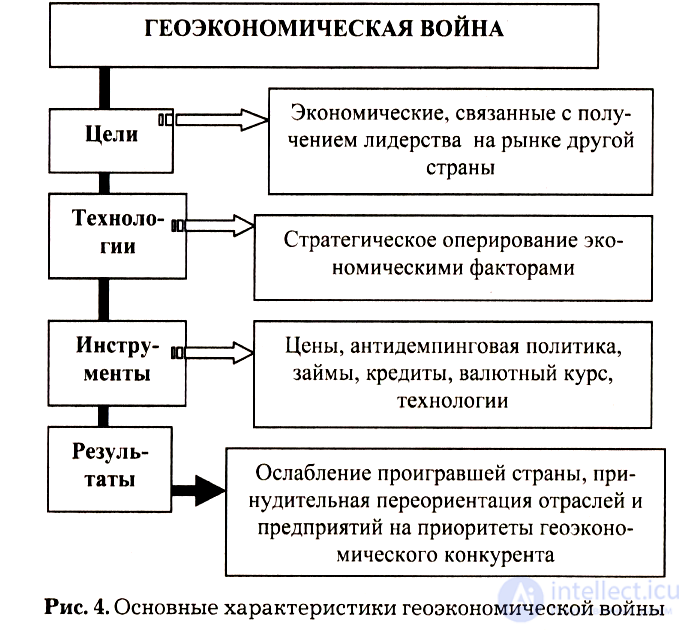
Geoeconomic wars are called new-generation wars. They include:
information wars, which have propaganda and psychological components and are designed to form and consolidate mass perceptions needed by the party waging the war;
communication and hacker wars, whose arenas include not only the theft of money from electronic bank accounts, but also the launching of computer viruses into the internet system, and penetration into specialized electronic systems that support the work of military and intelligence agencies, as well as especially hazardous industrial facilities;
financial wars: sending large batches of counterfeit money into "enemy" territory; targeted financial attacks on currency markets, etc.;
network wars: establishing and maintaining control through diverse networks built according to a particular algorithm. Examples of network wars are the "color revolutions" in Serbia, Georgia, Ukraine, etc., where heterogeneous information strategies and non-governmental organizations and foundations were able to bring about the political result desired, above all, by the USA without direct military intervention. The rules of conducting network war in conditions of a "hot" conflict are being tested in Iraq, Afghanistan and Libya.
Thus, it can be concluded that, under globalization, the ability to wage a geoeconomic war within competitive struggle, or to resist a foreign geoeconomic war, becomes an important condition of a state's economic viability, determining its place in the world economic and political hierarchy. Accordingly, issues related to geoeconomic wars become paramount for national security.
Geoeconomics should not be confused with mercantilism or neomercantilism. Under mercantilism, whose aim was to maximize national gold reserves, commercial quarrels grew into political ones, which could then lead to military conflicts. Mercantilist competition was therefore subordinated to military competition, since the former modality was governed by the ever-present possibility that the "loser" in a commercial quarrel could then contest the outcome by military means. For example:
"Spain could decree that all trade to and from its American colonies could be carried only in Spanish ships through Spanish ports, but British and Dutch armed merchantmen could still deliver profitable cargoes to disloyal colonists in defiance of Spanish sloops; and, with the declaration of war, privateers could directly seize even more profitable cargoes bound for Spain. Similarly, the Dutch sent their frigates up the Thames in response to the mercantilist legislation of the British Parliament that prohibited their coastal trade, just as much earlier the Portuguese had sunk the Arab ships with which they could not compete in the India trade".
In the new era of geoeconomics, however, there is no higher modality: both the causes and the instruments of conflict may be economic. When commercial disagreements lead to international political clashes, disputes must be settled with the weapons of commerce.
States take part in geoeconomic competition both by assisting or guiding domestic private actors and through direct actions opposing foreign commercial interests:
According to Luttwak, offensive weapons matter more in geoeconomics than in war. Moreover, state-sponsored research and development is the most important of these weapons.
"Just as in war artillery conquers territory with fire, which the infantry can then occupy, here the aim is to conquer the industries of the future by achieving technological superiority".
The "infantry" in this analogy corresponds to commercial production, which can also be supported by the state through various forms of subsidies. Another geoeconomic weapon is predatory financing . If operating subsidies are insufficient to enable domestic exporters to overcome strong competitors, states can offer loans at below-market interest rates. For example, the US Export-Import Bank provides credit guarantees to finance exports, and similar institutions exist in all major industrial countries.
"Foreigners thus usually pay lower interest rates than local borrowers, whose taxes pay for the very concessions that foreigners receive. This already amounts to hunting for exports with low-interest ammunition, but the accusation of predatory financing is reserved for cases in which interest rates are suddenly cut in the course of a contested sale. Naturally, the main trading states have promised each other that they will do nothing of the kind. Naturally, they often break that promise".
"Weaponized interdependence" is a term defined by Henry Farrell and Abraham L. Newman . Farrell and Newman do not address geoeconomics directly, but their article examines the underlying factors of how power is exercised within geoeconomics:
"In particular, we show how the topography of economic networks of interdependence intersects with domestic institutions and norms to shape coercive power. Our study places networks such as financial communications , supply chains and the Internet , which have been largely ignored by international relations scholars , at the center of a new and compelling understanding of globalization and power".
The framework used by Farrell and Newman is based on network theory and describes the structure of power as a network of asymmetric interconnections that allow central actors to "weaponize structural advantages for coercive purposes". States that obtain a sufficient structural advantage will be able to use either the "panopticon effect", the "chokepoint effect", or both. The panopticon effect is based on Jeremy Bentham's " panopticon ", which allows several central actors to observe the actions of others thanks to the access to information that the network structure provides. The chokepoint effect is the ability of advantageously positioned states to limit or penalize others' use of key information nodes (sometimes called " hubs ").
M. Nicholas J. Firzli of the Singapore Economic Forum argues that "compliance with the laws of geoeconomic gravity", including the need for financial self-sufficiency and the possession of advanced, diversified energy and transport infrastructure assets, is now crucial to ensuring a state's effective sovereignty: "the government of Qatar is now paying a disproportionate price for believing that it could ignore the laws of geoeconomic gravity forever".
From this perspective, investment attractiveness and the ability to project soft power over significant distances, as China has done through its Belt and Road Initiative, are also regarded as key factors of geoeconomic power.
Large private-sector asset owners, such as pension funds, are expected to play an increasingly important role here alongside the state actors of the USA and China:
Even the self-absorbed, thrifty "America First" policymakers in the White House eventually realized that they could not ignore these momentous geoeconomic developments. In November 2018, Vice President Mike Pence traveled to Asia to promote President Trump's "Indo-Pacific Vision" , an ambitious plan backed by tens of billions of dollars in new loans and credit-enhancement mechanisms to encourage "private investment in regional infrastructure assets", insisting that "business, not bureaucrats, will drive our efforts". The new Great Game has only just begun, and pension investors will be assiduously courted by both Washington and Beijing in the years to come, which is not a bad position to be in for the "age of geoeconomics".
Geoeconomics studies the behavior of the state under geoeconomic competition and analyzes the features of its strategy and tactics in the global market. The role of geoeconomics is that it makes it possible to examine and ultimately resolve the problem of balanced and proportional development of the entire modern complex of world economic ties.
However, despite the significance of geoeconomics, there is no complete unanimity in understanding its subject and boundaries. It is, first, regarded as one of the offshoots of geopolitics; second, it lays claim to the place formerly occupied by geostrategy, to the extent that the practice of interstate conflict is shifting from the sphere of military confrontation to the sphere of economic rivalry.
The subject of "geoeconomics" is also linked with the processes of economic and political dynamics of nation-states in the context of global world-economic shifts. In this sense, geoeconomics is presented as economic geopolitics, studying state behavior aimed at increasing national competitiveness under harsh competition in the international arena.
There are also other points of view, for example those that contrast geopolitics and geoeconomics. All these approaches are reflected in the various concepts of the national schools of geoeconomics.
The founder of geoeconomics as a science, as already noted, is the leader of the American school of geoeconomics, Edward Luttwak. He contrasted geoeconomics, understood as a theoretical justification of state policy aimed above all at winning the economic competition between developed states, with geopolitics, with its emphasis on the use of military power to achieve foreign economic and foreign policy goals. Geoeconomics requires the development of techniques of economic defense and offense aimed at "ensuring the best possible employment for the largest part of one's population", and, if necessary, even at the expense of the populations of other countries.
In E. Luttwak's original formulation, the mission of geoeconomics was defined as follows: "If the internal cohesion [of a nation] must be sustained by a consolidating threat, then today that threat must be an economic one".
The main difference between geoeconomics and classical geopolitics should, according to Luttwak, be determined by two factors. First, a greater pluralism in world politics, in which the military-force orientation ceases to be the outright leader. Second, the fact that previously states were not only subjects of the world struggle but at the same time formed its very field. Spaces that had acquired agency fought among themselves, seeking to undermine one geographic position in favor of another or to subordinate it. Now, however, states must compete in the field of the world economy, which they do not cover entirely: a significant part of it is formed by private, including transnational, capital, whose logic may not coincide with the geoeconomic objectives of nations. In Luttwak's view, geopolitical conflict is being replaced by geoeconomic conflict. Geoeconomics analyzes state strategies and develops instruments for enhancing national competitiveness. Geoeconomics studies the relationship between power and space, but a "virtual" space, freed from the territorial boundaries and physical characteristics inherent in geopolitics. The main difference between geoeconomics and geopolitics is technological and commercial primacy rather than control of regions. Geoeconomics does not mean the end of the era of geopolitics as an interpretation of phenomena and of power rivalry over regions. The geoeconomic approach shows the current assessment of the relative weight of various factors in international politics. The connection between economic interests and foreign policy is expected to become closer and more important, "but at the same time less amenable to regulation and more difficult for the public to understand".
Luttwak later developed the thesis of the "consolidating economic threat". He advanced the now very popular notions of "turbo-capitalism", of financial flows moving around the planet, and of the "specter of poverty" that appears before countries because of the capriciousness of geofinance.
Among the most prominent representatives of the American school of geoeconomics one should also name Andrew Leyshon andWilliam Nester,. Leyshon argued, for example, that the emerging geoeconomic theory contains many different elements, of which three are particularly notable:
an understanding of the new role of states amid the triumph of economic neoliberalism;
the "universal marketization" of international relations, in which geopolitical interests lose their meaning;
the existence of many "economic worlds" that lie within national borders.
Nester also argued for the primacy of geoeconomics in international relations on the basis of an analysis of modern history. He introduced a number of terminological innovations of great importance for the formation of the science. These include: geoeconomic conflict, geoeconomic cooperation, geoeconomic power, its sources, balance, and use.
The most prominent representative of the French school of geoeconomics is Jacques Attali (born 1943), who for many years was a personal adviser to French President F. Mitterrand and for a time director of the European Bank for Reconstruction and Development. In the book "Lignes d'horizon" (Millennium: Winners and Losers in the Coming World Order) he examines world economic reality in its relation to world space, and concludes that for "geoeconomics it is completely unimportant which people live in a given territory, what its history, cultural traditions, etc. are; what deserves attention is only where the centers of the world stock exchanges, mineral resources, information centers, and the largest enterprises are located, i.e. it approaches the world and its realities as if a world government existed and a single planetary state had already come into being". According to Attali, the modern world of dominant liberal values, market relations and information technologies is being formed on the principles of geoeconomics. At the same time, the whole of business life revolves around three business cores, economic spaces or financial-industrial zones: the American, the European and the Pacific, which concentrically structure the less developed regions located in spatial proximity around themselves.
The Italian school of geoeconomics was actively developed by General Carlo Jean (born 1936), who published, among other things, in early 1991 the article "Geoeconomics: Instruments, Strategy and Tactics", which bears the stamp of geopolitical constructs and of the author's military-strategic style of thinking. In Jean's view, "geoeconomics is based not only on logic, but on a synthesis of geopolitics and geostrategy, and, in a broader sense, on the whole praxeology of conflict situations". In general, in the works of Italian scholars geoeconomics is understood as "a discipline that studies those aspects of international competition where the main actors are not corporations, trusts or banks, but states". These authors are characterized by a desire to integrate economic concepts into political science, stating that "the economic goals pursued by geoeconomics are structurally much closer to the ultimate political aspirations of the state (the creation of wealth, and the prosperity and well-being of citizens are not only economic but also political goals)", since, ultimately, "the economy is not only a goal but also a means of politics". According to Jean and P. Savona, "geoeconomics is an economic policy that is replacing, at least in industrialized states, the predominantly military geopolitics of the past. Geoeconomics itself, its laws and mechanisms, are becoming the paradigm of the administrative and legal organization of the state", and "the geoeconomic approach unites all the economic attitudes and structures of a country into a single strategy that takes the global situation into account". The Italians were among the first to recognize the danger of geoeconomic expansionism, especially in high geoeconomic technologies, of the world's wandering reproduction cores, of the frenzied restructuring of economic borders, and of the weakness of state institutions and their inability to withstand supranational structures, and they raised the question of protecting statehood from the impending danger of the unregulated behavior of transnationalized international structures.
In Russia, the development of geoeconomic tools by researchers and the adoption of the geoeconomic approach by government agencies began immediately after the collapse of the USSR. The Russian school of geoeconomics is represented by various concepts covering a vast range of theoretical, methodological and practical problems in the development of the science and of the country. All researchers are united by the search for a model of the geoeconomic world order based on an equilibrium of strategic interests, a balance of the actually established zones of geoeconomic influence with due regard for civilizational factors. As for views on the place of geoeconomics in the system of scientific knowledge relative to geopolitics, the Russian school's authors can be conditionally divided into three groups.
The representatives of the first group, who regard geoeconomics as a continuation of and an alternative to geopolitics, include first of all Ernest Kochetov , the founder of the Russian school of geoeconomics, and Alexander Neklessa , a well-known political scientist specializing in the geoeconomic analysis of global problems. In their works the concept of geoeconomics has to a large extent moved away from reading the subject in the vein of geopolitics and conflict studies, and has come under strong influence from economics and globalistics. Kochetov became the author of the first geoeconomics textbook in the CIS, one oriented toward practical work on developing a national development strategy. He defines his understanding of the essence of geoeconomics as follows: "Geoeconomics is 1) a conceptual view reflecting an interpretation of the global world through a system of economic attributes; 2) a system of economic attributes and economic relations, extended beyond national frameworks, that determines the contour of the global economic space in which world economic processes unfold. Geoeconomics acts as a symbiosis of national economies and state institutions, an interweaving of national and supranational economic and state structures; 3) a political-science system of views (concepts) according to which state policy is predetermined by economic factors, by operating on the geoeconomic atlas of the world (including its national part), and by the inclusion of national economies and their economic agents in world internationalized reproduction cores (cycles) with the aim of participating in the formation and distribution of world income, using high geoeconomic technologies".
A. Neklessa is characterized by a definition of geoeconomics as "the spatial localization of types of economic activity in a global context and the associated new formula of the world division of labor, as well as the merger of politics and economics in the sphere of international relations, and the formation on this basis of a system of strategic (global) interactions".. In his view, the contemporary world division of labor creates a clear division of the world into economic macrostructures, depending on the "degree of modernization of the economy and its place in the global community.
The second group of researchers regards geoeconomics as an integral part of modern geopolitics. For example, V. Rogov asserts that "Geoeconomics is the economic language of geopolitics. Geoeconomics as a concept makes it possible to generate economic pictures of the world and images of national economies. The diversity of geopolitical pictures of the world is, partly for subjective reasons, the initial precondition for the emergence of different economic pictures of the world as the environment in which states interact. This is legitimate, since the notion of an environment is inseparable from a subject, in our case the state as a geographical organism". Similar views are held by V. Tsymbursky, who characterizes geoeconomics as a branch of geopolitics that is fairly autonomous but nevertheless in natural interaction with the other geopolitical branches".
The third group includes researchers who argue that geopolitics and geoeconomics are connected with each other but are not simply continuations of one another. Thus, A. D. Bogaturov asserts that "contemporary reality rules out the use of a geopolitical approach in isolation from a geoeconomic one, to the extent that over the last century economic pulls have acquired the ability to genuinely influence the foreign policy of states and international relations without showing up explicitly at the level of formal, officially recognized and easily observable changes and consequences. The main line of analytical methodology will most likely become a certain synthesis of both geo-approaches".
Instead of counterposing geoeconomics and geopolitics, V. Pantin and V. Lapkin believe, it is more fruitful to synthesize them within a field that they propose to call geoeconomic politics, which studies the role of spatial-geographical and resource-economic factors in the functioning of political systems, as well as the role of spatial and political factors in the functioning of economic systems". An attempt to take civilizational factors of development into account allows M. A. Shepelev, A. T. Bariskaya and M. I. Shmeleva to define geoeconomics as a branch of economic science that studies the processes and results of the impact of economic agents, national economies and the global economy on international space with the aim of using it in their own economic interests. Under this approach, geoeconomics, in inseparable connection with geopolitics, geoecology and geoculturology, forms a new system of geosocial sciences.
Thus, the Russian school of geoeconomics is characterized by a broader range of directions than the American, Italian and French scholarly schools considered above. At the same time, the fundamental theoretical and methodological distinction of the views of Russian researchers of geoeconomics is the development of new mechanisms of interaction among the local agents operating in the global geoeconomic sphere. Geoeconomics, in the opinion of Russian scholars, should address the following tasks: identifying new forms, methods and strategies of global operation; forming efficient transnational reproduction chains that create new labor productivity and bring enormous strategic effect; clarifying the causes of emerging geoeconomic conflicts (wars) in the world market; and finding a balance of interests and ways of harmonizing all the factors of the world economic system.
The problems of geoeconomics are beginning to be examined by researchers in other post-Soviet states. For example, in Ukraine it is regarded chiefly as modern geopolitics, implemented by new means and taking shape under the influence of globalization and regionalization. Thus, V. Derhachov defines geoeconomics as a "new system of economic organization of the world economy" and a "science of the state strategy for achieving world or regional power primarily by economic means"1.
A study of theoretical and methodological approaches to the analysis of the subject and content of geoeconomics shows that its place in the system of scientific knowledge has not yet been determined.
Despite the absence of an unambiguous reading and interpretation of its content, geoeconomics in the modern period is becoming a major instrument of state policy. Under globalization, it is precisely the geoeconomic approach that makes it possible to carry out the entrepreneurial function of the state, directing government and administrative bodies toward creating an institutional environment favorable to competition that guarantees business security, minimizes political and social risks, and so on. This brings to the fore the problem of operationalizing geoeconomic methods and indicators, translating them into the parameters of the activity of various structures and organizations capable of achieving the goals of the country's internal and external development.
In the modern economic space there are a number of development trends that imply the need for a radical restructuring of the geoeconomic strategies and production-and-exchange technologies of all states, including those that are centers of the world economy. Such trends include the virtualization of capital (the emergence of cryptocurrencies, the move away from cash settlement, etc.), the changing role of the state as an economic agent, and the ever-increasing publicity of the political elite and its ever more open interaction with the people. In such conditions, developing countries must not only devise geoeconomic strategies but, first of all, modernize all spheres of production, because without advanced technologies it is impossible in present-day realities to achieve economic dominance.
Geoeconomics uses a range of different methods in conducting economic policy with the aim of increasing the competitiveness of the state. First, there are traditional methods, which include, for example, institutional ones: changing the tax system, introducing innovative technologies, developing infrastructure, and social support for the population that increases its welfare.
The range of measures recommended within geoeconomics includes both defensive (protectionist, mercantilist) and offensive actions, associated in particular with economic wars (trade, technology and currency wars), economic intelligence (including industrial espionage) and counterintelligence, and the like.
In present-day realities, the state's continued existence depends on the success of the geoeconomic policy it has chosen, and therefore the geoeconomic strategy of its development must be subject to constant adjustment depending on the world economic situation.
продолжение следует...
Часть 1 Geoeconomics as a Science: Laws and Features

Comments