
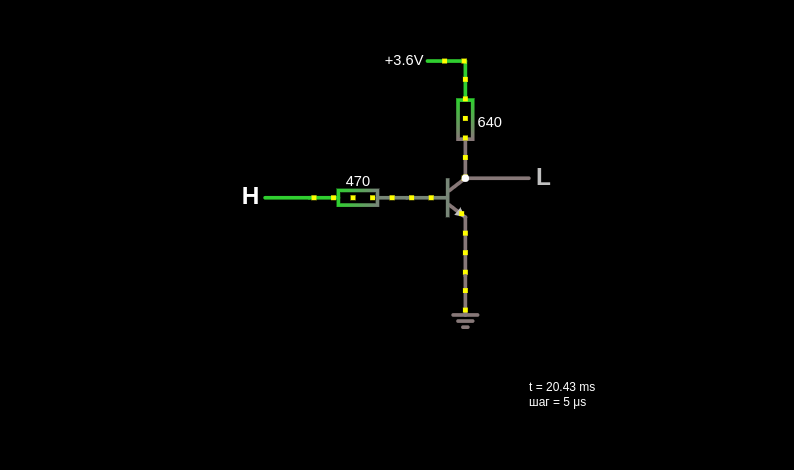
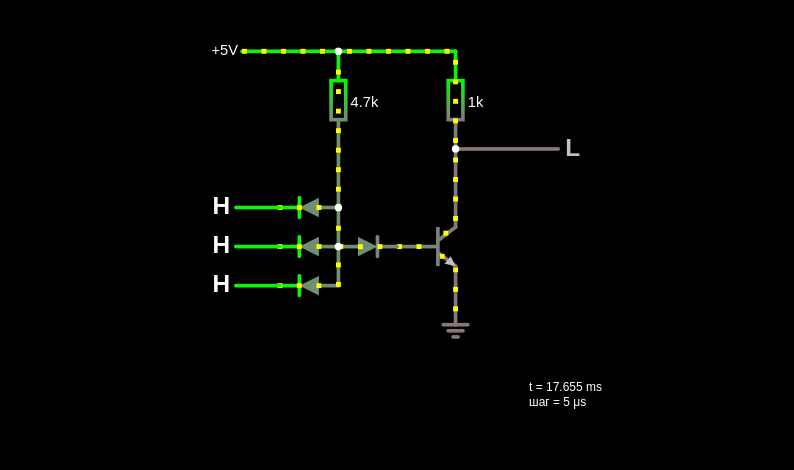
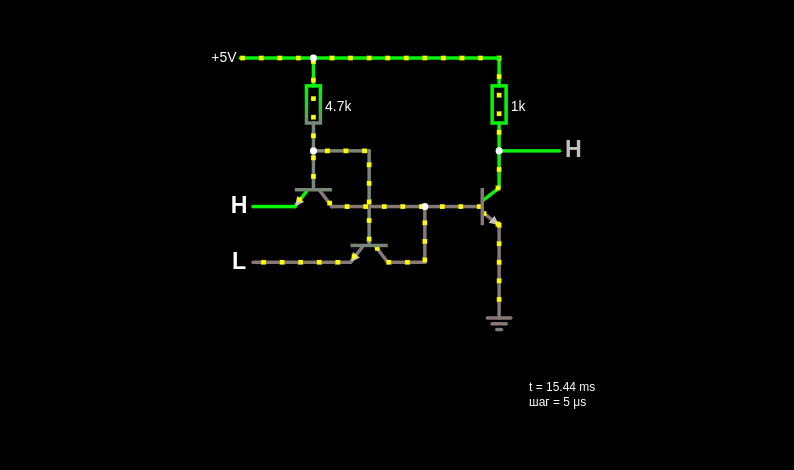
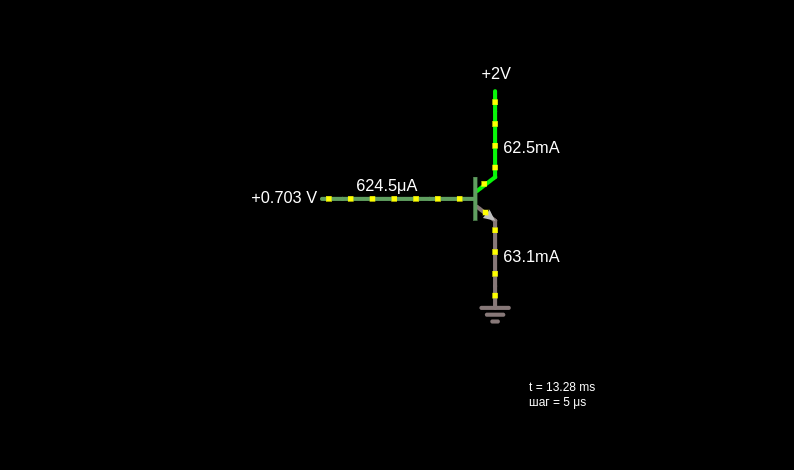
This is a NAND gate implemented using resistor-transistor logic, the earliest form of logic implemented with transistors. Click the inputs on the left to toggle their state. When all inputs are high, the output is low; otherwise the output is high. When all inputs are high (3.6 V), current flows from the base to the emitter of all transistors. Each transistor wants its collector-emitter current to be 100 times the base current, but this is not possible, because the collector is connected to the same voltage through a larger resistor. So the transistors are in saturation; they increase current to pull the output voltage down as far as possible. When any of the inputs is low (at ground), no current flows through the base of the corresponding transistor, so it turns off. With no path to ground, the output stays at 3.6 V.
This page is a utility for simulating rtl nand gate online with specified initial values.




Comments