
Lecture 3 min.
Atlas is a concept of differential geometry that makes it possible to introduce additional structures on a manifold, for example a smooth structure or a complex structure.
An atlas consists of individual charts, each of which describes a separate region of the manifold. If the manifold is taken to be the surface of the Earth, the words chart and atlas take on their ordinary meanings.
Atlases are a tool for endowing topological spaces with a differentiable structure, and they underlie the concepts of the differential geometry of manifolds.
Let  be a number field (for example
 or
 ), and
 a topological space.
 , where
 is an open set in
 is a homeomorphism from onto an open set in

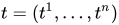
by assigning to a point  a set of numbers
 and
 intersect (
 ), then there are mutually inverse maps (homeomorphisms) between the sets
 and
 , called transition functions or gluing maps:

 ,
 , such that
 forms a cover of the space . Here
 is some index set. An atlas is called smooth (of class
 ) or analytic if the coordinate change functions
 for all charts are smooth (of class ) or analytic.
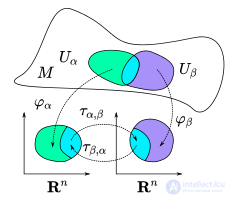
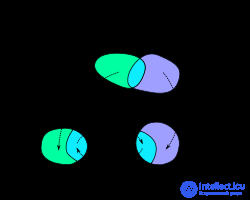
A transition map makes it possible to compare two charts of an atlas. To make this comparison, we consider the composition of one chart with the inverse of the other. This composition is not well defined unless we restrict both maps to the intersection of their domains. (For example, if we have a map of Europe and a map of Russia, we can compare the two maps on their intersection, namely the European part of Russia.)
To be more precise, suppose that  and
 are two charts for the manifold M such that
 is nonempty. The transition map
 is defined as
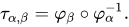
Note that since  and
 are both homeomorphisms, the transition map
 is also a homeomorphism.
Often more structure than a mere topological structure is required on a manifold. For example, if one wants an unambiguous notion of differentiation of functions on a manifold, one must construct an atlas whose transition functions are differentiable. Such a manifold is called differentiable. Given a differentiable manifold, one can unambiguously define the notion of tangent vectors, and then of directional derivatives.
If every transition function is a smooth map, then the atlas is called a smooth atlas, and the manifold itself is called smooth. Alternatively, one can require that the transition maps have only k continuous derivatives, in which case the atlas is called a atlas.
More generally, if every transition function belongs to a pseudogroup  of homeomorphisms of Euclidean space, then the atlas is called a -atlas. If the transition maps between the charts of an atlas preserve a local trivialization, then the atlas defines the structure of a fiber bundle.
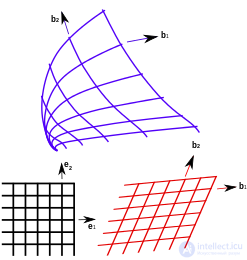
Curvilinear, affine and Cartesian coordinates in two-dimensional space.
Sign in and the lectures you have studied will be marked in this list.
Choose a course
Comments