
Lecture
Topology (from Ancient Greek τόπος — place and λόγος — word, study) — a branch of mathematics that studies:
Unlike geometry, topology does not consider the metric properties of objects (for example, the distance between a pair of points). For instance, from the point of view of topology a mug with a handle and a donut (solid torus) are indistinguishable. At the same time, topology is often applied to objects far removed from geometric ones.
The notions of homeomorphism and homotopy are of great importance for topology (in simplified terms: these are types of deformation that occur without tearing or gluing).
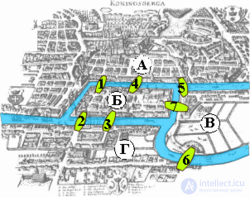
The Seven Bridges of Königsberg — a famous problem solved by Euler that contributed to the development of topology
The branch of mathematics now called topology traces its origins to the study of certain problems in geometry.
Various sources point to the first topological results in spirit in the works of Leibniz and Euler, however the term «topology» first appeared in 1847 in a work by Listing. Listing defined topology as follows:
«By topology we shall understand the study of the modal relations of spatial figures — or of the laws of connectedness, relative position, and sequence of points, lines, surfaces, bodies and their parts or their totality in space, independent of relations of measure and magnitude».
When topology was still only emerging (18th—19th centuries), it was called geometry of position (Latin geometria situs) or analysis of position (Latin analysis situs). From roughly 1925 to 1975, topology was one of the most rapidly developing branches of mathematics.
General topology arose at the end of the 19th century — and took shape as an independent mathematical discipline at the beginning of the 20th century. The foundational works belong to: Hausdorff, Poincaré (the series of papers Analysis situs), Alexandrov, Urysohn, Brouwer.
General topology, or set-theoretic topology, — is the branch of topology dealing with continuity in its pure form. Here the fundamental questions of topology are studied, as well as specific questions such as connectedness and compactness.
General topology (set-theoretic topology) — is the branch of topology in which the notions of continuity and limit are studied in the most general sense.
The traditional approach to general topology is set-theoretic. A set is called a topological space when a certain family of its open subsets is given, satisfying the axioms. There are many possible ways of defining a topological space structure on the same set: from the discrete topology to the non-Hausdorff antidiscrete (trivial) topology, which glues all points together.
Basic notions of set theory, such as set, function, ordinal numbers, cardinal numbers, the axiom of choice, Zorn's lemma, are not themselves subjects of general topology, but are actively used by it. General topology includes the following sections: properties of topological spaces and their mappings, operations on topological spaces and their mappings, classification of topological spaces. Dimension theory is a self-contained direction within general topology.
Unlike differential and algebraic topology, general topology is focused on studying the most general kind of continuous mappings of topological spaces into one another, rather than into spaces endowed with more complex structures, above all — algebraic ones.
The glossary of general topology includes such notions as neighborhoods, closures of sets (as well as interiors), compactness of sets, convergence of sequences and filters. The notion of the limit of a function, introduced in general topology, admits further generalization within the theory of pseudotopological spaces.
General topology arose at the end of the 19th century and took shape as an independent mathematical science at the beginning of the 20th century. The foundational works belong to Felix Hausdorff, Henri Poincaré, Pavel Alexandrov, Pavel Urysohn, Luitzen Brouwer. In particular, one of the main problems of general topology was solved — finding necessary and sufficient conditions for the metrizability of a topological space.
The most rapid development of general topology as an independent branch of knowledge took place in the middle of the 20th century; by the beginning of the 21st century it is more of an auxiliary discipline, «serving» many areas of mathematics: algebraic topology, functional analysis, complex analysis, graph theory.
Algebraic topology — is the branch of topology dealing with continuity through the use of algebraic objects, such as homotopy groups and homology.
Algebraic topology (older name: combinatorial topology) — is the branch of topology that studies topological spaces by associating algebraic objects to them (groups, rings, etc.), as well as the behavior of these objects under various topological operations.
The methods of algebraic topology are based on the assumption that general algebraic structures are simpler in nature than topological ones.
An important tool of algebraic topology is the so-called homology groups (for example, simplicial or singular). To each topological space  there corresponds, in each dimension n
 , its own abelian homology group
  , and to each continuous mapping
  there corresponds a homomorphism of groups
  , moreover to the composition of mappings
  there corresponds the composition of homomorphisms
  , and to the identity mapping
  there corresponds the identity homomorphism id∗
 . In the language of category theory this means that the n-th homology group is a covariant functor from the category of topological spaces to the category of abelian groups.
Besides various homology theories (nowadays extraordinary homology theories have acquired great importance, for example, bordism theory or K-theory), homotopy groups  are also important for algebraic topology. Among them the main one is
  — the so-called fundamental group, which, unlike the groups of all other dimensions, may be non-abelian.
Differential topology — is the branch of topology dealing with smooth manifolds up to diffeomorphism and their embeddings (placements) in other manifolds.
This branch includes low-dimensional topology, including knot theory and four-dimensional topology.
Differential geometry — is a branch of mathematics that studies smooth manifolds, usually with additional structures. They find numerous applications in physics, especially in general relativity.
The main subfields of differential geometry:
Differential geometry is often regarded as an indivisible branch together with differential topology. The differences between these branches may be the presence or absence of additional structures on the smooth manifold, but may also be the presence or absence of local invariants: in differential topology, structures on manifolds are considered such that any pair of points can be found to have identical neighborhoods, whereas in differential geometry, generally speaking, local invariants (such as curvature) may be present, which can differ from point to point. For example, a symplectic structure has no such invariants, and, alongside symplectic geometry, one speaks of «symplectic topology».
The Mathematics Subject Classification assigns differential geometry the top-level section 53, while placing differential topology as a second-level block 57Rxx within the section «Manifolds and cell complexes».
Differential geometry arose and developed in close connection with mathematical analysis, which itself grew to a large extent out of problems of geometry. Many geometric notions preceded the corresponding notions of analysis. For example, the notion of tangent line preceded the notion of derivative, and the notions of area and volume preceded the notion of integral.
The emergence of differential geometry dates back to the 18th century and is associated with the names of Euler and Monge. The first comprehensive work on the theory of surfaces was written by Monge («Application of analysis to geometry», 1795). In 1827 Gauss published the work «General investigations of curved surfaces», in which he laid the foundations of the theory of surfaces in its modern form. Since then differential geometry has ceased to be merely an application of analysis and has taken an independent place in mathematics.
The discovery of non-Euclidean geometry played an enormous role in the development of all geometry, including differential geometry. Riemann, in his lecture «On the hypotheses which lie at the foundations of geometry» (1854), laid the foundations of Riemannian geometry, the most developed part of modern differential geometry.
Klein's group-theoretic point of view, set forth in his «Erlangen Program» (1872), namely: geometry — is the study of invariants of transformation groups, was developed for differential geometry by Cartan, who constructed the theory of spaces of projective connection and affine connection.
Differential topology is a much younger branch of mathematics: it began to develop only at the beginning of the 20th century.
Computational topology — is a branch lying at the intersection of topology, computational geometry, and computational complexity theory. It is concerned with creating efficient algorithms for solving topological problems and with applying topological methods to solve algorithmic problems arising in other fields of science.
Algorithmic topology , or computational topology , is a subfield of topology , intersecting with areas of computer science , in particular, with computational geometry and computational complexity theory .
The main task of algorithmic topology, as its name suggests, is to develop efficient algorithms for solving problems that naturally arise in such fields as computational geometry , graphics , robotics , social sciences , structural biology and chemistry , using methods of computational topology .
Main algorithms by subject area
Algorithmic theory of 3-manifolds
A large family of algorithms concerning 3-manifolds revolves around the theory of normal surfaces , which is a term covering several methods for converting problems of 3-manifold theory into integer linear programming problems.
At present JSJ decomposition is not algorithmically implemented in computer software. Decomposition into compressed bodies is also not implemented. There exist some very popular and successful heuristics, such as SnapPea , which successfully computes approximate hyperbolic structures on triangulated 3-manifolds. It is known that a complete classification of 3-manifolds can be carried out algorithmically. In fact, it is known that deciding the question of equivalence (homeomorphism) of two closed oriented 3-manifolds given by a triangulation (simplicial complexes) is elementary recursive . This generalizes the result on 3-sphere recognition.
Algorithmic knot theory
It is known that determining whether a knot is trivial belongs to the complexity classes NP , as well as co-NP . The problem of determining the genus of a knot in a 3-manifold is NP-complete ; however, although NP remains an upper bound on the complexity of determining the genus of a knot in R 3 or S 3 , as of 2006 it was unknown whether the algorithmic problem of determining knot genus in these particular 3-manifolds was still NP-hard .
Computational homotopy
Computing the homology groups of cell complexes reduces to bringing boundary matrices to Smith normal form . Although this problem is completely solved algorithmically, there are various technical obstacles to efficient computation for large complexes. There are two main obstacles. First, the basic algorithm for Smith normal form has cubic complexity in the size of the matrix involved, since it uses row and column operations, which makes it unsuitable for large cell complexes. Second, the intermediate matrices obtained in applying the Smith normal form algorithm become filled in, even if it starts and ends with sparse matrices.
Low-dimensional topology — is a direction in topology that studies manifolds, or more generally topological spaces, of four or fewer dimensions. In particular, this direction includes the structural theory of 3-manifolds and 4-manifolds, knot theory, and braid theory. This direction can be regarded as part of geometric topology. (The study of one-dimensional topological spaces is also sometimes referred to low-dimensional topology, though it is more often considered part of continuum theory.)
A number of results from the 1960s underscored the special significance of small dimensions in topology. For example, the proof of the Poincaré conjecture in five or more dimensions (Smale, 1961) made dimensions three and four the most difficult; and indeed, they required new methods, whereas the freedom of higher dimensions meant that questions could be reduced to computational methods available in surgery theory. The Thurston conjecture, in the late 1970s, proposed a framework which suggested that geometry and topology are closely intertwined in small dimensions, and Thurston's proof of the geometrization of Haken manifolds used various tools from previously only loosely connected areas of mathematics. Vaughan Jones's discovery of the Jones polynomial in the early 1980s not only sent knot theory in a new direction, but also gave rise to still mysterious connections between low-dimensional topology and mathematical physics. In 2002 Grigori Perelman announced a proof of the three-dimensional Poincaré conjecture, using Richard Hamilton's Ricci flow — an idea belonging to the field of geometric analysis.
There are several theorems which in effect state that many of the main tools used to study higher-dimensional manifolds are inapplicable to low-dimensional manifolds.
Steenrod's theorem states that an orientable three-dimensional manifold has a trivial tangent bundle. In other words, the only characteristic class of a 3-manifold is the obstruction to orientability.
Any closed 3-manifold is the boundary of a 4-manifold; this result follows from the Dehn–Lickorish theorem via the Heegaard splitting of the 3-manifold, and also follows from René Thom's computations for the cobordism ring of closed manifolds.
Digital topology deals with properties and features of two-dimensional (2D) or three-dimensional (3D) digital images , which correspond to topological properties (for example, connectedness ) or topological features (for example, boundaries ) of objects.
Concepts and results of digital topology are used to define and justify important (low-level) image analysis algorithms , including thinning algorithms , boundary or surface tracing, counting of components or tunnels, or region filling.
Digital topology was first studied in the late 1960s by the computer image analysis researcher Azriel Rosenfeld (1931–2004), whose publications on this topic played an important role in the establishment and development of this field. The term «digital topology» itself was coined by Rosenfeld, who first used it in a 1973 publication.
Related work, called grid cell topology , which can be regarded as a reference to classical combinatorial topology , appeared in the book by Pavel Alexandrov and Heinz Hopf, Topologie I (1935). Rosenfeld and others proposed digital connectivity, such as 4-connectivity and 8-connectivity in two dimensions, as well as 6-connectivity and 26-connectivity in three dimensions. A labeling method for deriving connected components was studied in the 1970s. Theodosios Pavlidis (1982) proposed using graph algorithms, such as the depth-first search method, for finding connected components. Vladimir A. Kovalevsky (1989) extended the Alexandrov–Hopf 2D grid cell topology to three and more dimensions. He also proposed (2008) a more general axiomatic theory of locally finite topological spaces and abstract cell complexes, previously proposed by Ernst Steinitz (1908). This is Alexandrov topology . The 2008 book contains new definitions of topological balls and spheres, independent of any metric, as well as numerous applications to digital image analysis.
In the early 1980s digital surfaces were studied. David Morgenthaler and Rosenfeld (1981) gave a mathematical definition of surfaces in three-dimensional digital space. This definition includes a total of nine types of digital surfaces. Digital manifolds were studied in the 1990s. A recursive definition of a digital k-manifold was intuitively proposed by Chen and Zhang in 1993. Numerous applications have been found in image processing and computer vision.
A basic (early) result in the field of digital topology states that two-dimensional binary images require the alternating use of 4- or 8-element adjacency, or «pixel connectivity» (for «object» or «non-object» pixels), in order to ensure the basic topological duality of separation and connectedness. This alternation corresponds to open or closed sets in the cell topology of a two-dimensional grid, and the result generalizes to the three-dimensional world: the alternating use of 6- or 26-element adjacency corresponds to open or closed sets in the cell topology of a three-dimensional grid. Grid cell topology is also applicable to multilevel (for example, color) two- or three-dimensional images, for example based on a total ordering of possible image values and applying the «maximum label rule» (see the book by Klette and Rosenfeld, 2004).
Digital topology is closely related to combinatorial topology . The main differences between them are as follows: (1) digital topology mainly studies digital objects formed by grid cells (cells of integer lattices), rather than more general cell complexes , and (2) digital topology also deals with non-Jordan manifolds.
A combinatorial manifold — is a kind of manifold that is a discretization of a manifold. It usually refers to a piecewise-linear manifold formed by simplicial complexes . A digital manifold is a special kind of combinatorial manifold defined in a digital space, that is, a space of grid cells.
The digital form of the Gauss–Bonnet theorem is as follows: let M be a closed digital two-dimensional manifold under direct adjacency (i.e., a (6,26)-surface in three-dimensional space). The formula for the genus:
 ,
,
where denotes the set of surface points, each of which has i adjacent points (Chen and Rong, ICPR 2008). If M is simply connected, that is
 , then
 . (See also Euler characteristic .)

Comments