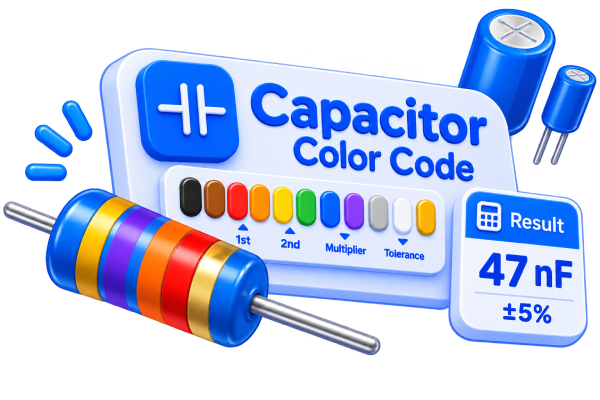
The capacitor color code calculator determines capacitance from the colored bands on the body of film (polyester "tropical fish"), tubular ceramic and other capacitors marked with the color code of the international IEC 60062 and EIA standards. The base unit of the capacitor color code is the picofarad (pF).
How to use:
Choose the marking type — 3 bands, 4 bands, 5 bands with voltage or 5 bands with temperature coefficient, click a band on the capacitor drawing and pick its color from the palette. After each choice the capacitance is calculated on the server: the value in pF, nF and µF, tolerance, the possible range of deviation from the nominal value, rated voltage or temperature coefficient, membership in the E6, E12, E24 series, the equivalent numeric code and capacitive reactance at different frequencies.
How to read the code:
The band closest to the top of the body (for radial capacitors — the farthest from the leads) is read first.
3 bands — two digits and a multiplier in picofarads, tolerance ±20%.
4 bands — two digits, multiplier and tolerance.
5 bands (voltage) — two digits, multiplier, tolerance and rated voltage (brown 100 V, red 250 V, yellow 400 V, blue 630 V).
5 bands (TC) — the first wide band is the temperature coefficient of capacitance, followed by two digits, multiplier and tolerance.
Colors and values:
Digits: black 0, brown 1, red 2, orange 3, yellow 4, green 5, blue 6, violet 7, grey 8, white 9.
Multiplier (pF): black ×1, brown ×10, red ×100, orange ×1000, yellow ×10000, green ×100000, blue ×1000000, grey ×0.01, white ×0.1, gold ×0.1, silver ×0.01.
Tolerance above 10 pF: black ±20%, brown ±1%, red ±2%, orange ±3%, green ±5%, grey +80% −20%, white ±10%, gold ±5%, silver ±10%.
Tolerance up to 10 pF (in picofarads): black ±2 pF, brown ±0.1 pF, red ±0.25 pF, green ±0.5 pF, white ±1 pF.
TC: black NP0 (0 ppm/°C), brown N33, red N75, orange N150, yellow N220, green N330, blue N470, violet N750.
How this calculator differs from similar services:
Many color code calculators are made for resistors, but capacitors have their own code: values in picofarads, grey and white multipliers ×0.01 and ×0.1, special tolerances for small capacitances and extra voltage and TC bands. All of this is taken into account here.
Pick colors right on the capacitor drawing. Click a band and choose a color — the drawing is repainted at once and looks like the part in your hand.
The palette shows only valid colors: digits, multiplier, tolerance, voltage and TC each have their own set, so an impossible combination cannot be entered.
Four marking variants: 3 bands, 4 bands, 5 bands with voltage and 5 bands with TC.
The tolerance for capacitances up to 10 pF is automatically calculated in picofarads, as the standard requires, and the asymmetric +80% −20% tolerance is taken into account in the range.
Reading direction hint: if the first band cannot be a digit, the service tells you the capacitor is read from the other end and calculates the reversed value.
Check against the standard E6, E12, E24 series and the nearest standard value.
Equivalent numeric code with a tolerance letter (e.g. 104K, 223J, 4R7) — handy when choosing a ceramic or SMD replacement.
Capacitive reactance XC = 1/(2πfC) at 50 Hz, 1 kHz, 100 kHz, 1 MHz and 10 MHz including tolerance — for filter, decoupling and power circuit calculations.
The calculation is done on the server and updates after each choice — no buttons and no page reloads. The service is free, works without registration, on phones and desktops, in English and Russian.


Comments