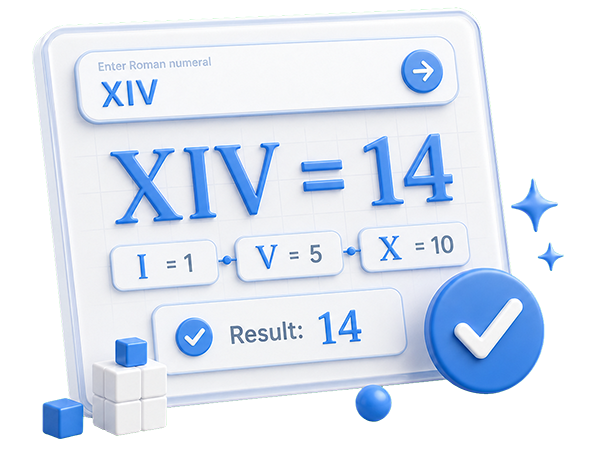
On this page you can easily and quickly convert numbers between Roman and Arabic number systems.
Our service is designed to make this process as convenient and accessible as possible for all users.
Whether you need to translate a page number in Roman notation, perform calculations in ancient Roman numerals, or simply find out,
how to write an Arabic number in Roman notation, our service will come to your aid.
Just enter the number in the appropriate field. The converter works with numbers from 0 to 1000000000:
up to 3999 the familiar notation is used (MMMCMXCIX), while larger numbers use the vinculum notation,
that is a bar above the numeral which multiplies its value by a thousand (V̅ = 5000, M̅ = 1000000),
and a double vinculum which multiplies it by a million (V̿ = 5000000, M̿ = 1000000000).
Since the vinculum cannot be typed on a keyboard, you may replace it with round brackets:
(V) = V̅ = 5000, ((V)) = V̿ = 5000000, and the three-sided frame with vertical bars: |X| = 1000000.
Also supported are zero, which the Romans wrote as the letter N (nulla), and fractional values in twelfths:
S = 1/2, a dot = 1/12, so 12.5 is written as XIIS. A fraction may be entered either as a vulgar one (1/2, 3/4, 5/12,
or mixed 1 1/2) or as a decimal (0.5, 12.5) - but note that not every fraction can be written in Roman numerals,
only those that are multiples of 1/12, so of the decimals just some are available: 0.5, 0.25, 0.75 and the like,
whereas 0.1 or 0.333 cannot be written at all. And when converting Roman numerals to Arabic ones the
service additionally reads the number out in Latin words: MCMXXXI is mille nongenti triginta unus
The online service "Roman Numerals to Arabic Converter" is a convenient tool for converting numbers from the Roman numeral system to Arabic and vice versa. Roman numerals are an ancient way of writing numbers that were used in Ancient Rome and can still be found in some areas, such as pagination in books, the founding years of companies, and many others. However, for many people, Roman numerals can be difficult to understand and use.
Main functions of the service:
Conversion from Roman to Arabic numerals: User can enter a number in Roman numeral system and the service will automatically convert it to Arabic numeral system, making the meaning of the number easy to understand and use.
Convert from Arabic to Roman numerals: The service also provides the option of entering an Arabic number and it will then do the conversion to Roman numerals. This is useful, for example, for creating Roman numerals for educational or decorative purposes.
Simple and clear interface: The service interface is usually extremely simple and intuitive, which makes it accessible even to users without special knowledge in the field of Roman notation.
Large numbers and the vinculum: Classical notation uses only seven symbols - I, V, X, L, C, D, M - and the largest number they can express is 3999 (MMMCMXCIX). Beyond that the numerals would simply run out: writing 4000 would require four M in a row, which breaks the rule of at most three repetitions. The Romans therefore used the vinculum - a horizontal bar above a numeral that multiplies its value by a thousand: V̅ = 5000, X̅ = 10000, C̅ = 100000, M̅ = 1000000. A single bar suffices up to 3999999, and beyond that a double vinculum is used, which multiplies the numeral by a million: V̿ = 5000000, X̿ = 10000000, M̿ = 1000000000. The arrangement is recursive: each level of bars repeats the ordinary 1..3999 notation, only counting thousands and millions instead of units. Our converter supports both notations and works with numbers from 0 to 1000000000. Numbers up to 3999 are printed in the familiar way, from 4000 with one bar, and from 4000000 with two: 4000 = I̅V̅, 12345 = X̅MMCCCXLV, 999999 = C̅M̅X̅C̅I̅X̅CMXCIX, 4000000 = I̿V̿, 1000000000 = M̿. Since ordinary fonts render the overline unevenly, the conversion result draws the bar as a real line using HTML, with a plain-text version alongside that you can copy.
Typing the vinculum: There is no barred character on a keyboard, so when entering a Roman numeral you may replace the vinculum with round brackets around the numeral: (V) means V̅ = 5000, (X)(C) is X̅C̅ = 90000, and (M) is M̅ = 1000000. The double vinculum is typed with double brackets: ((V)) = V̿ = 5000000, ((M)) = M̿ = 1000000000. A third historical notation is accepted as well - framing the numeral on three sides, which appears in tables of Roman numerals and multiplies the numeral by a hundred thousand: |I| = 100000, |X| = 1000000, |M| = 100000000. It is typed with vertical bars, and the service converts such notation into the equivalent vinculum form. Letter case does not matter, mcmxi is recognised just as MCMXXXI is. In the conversion result the vinculum is always printed as a real bar.
Zero and the letter N: Classical Roman notation had no zero - it grew out of a system for counting objects, where there was no need to count "none", and the Romans did not use positional notation, in which a zero is indispensable. Later, in medieval Latin texts, the letter N came to stand for a missing quantity - the first letter of nulla ("none", "nothing"). That is exactly how our converter handles zero: 0 becomes N, and N is recognised as 0.
Fractional numbers and the uncia: Roman fractions were duodecimal rather than decimal - the base unit was the uncia, that is 1/12 of the whole. Twelve is convenient because it divides by 2, 3, 4 and 6, so a half, a third and a quarter all come out as a whole number of unciae. A half was written with the letter S (semis), and each remaining uncia with a dot. Thus 12.5 is written XIIS, and 0.75 is S··· (semis plus three unciae). Every fraction had its own name: uncia (1/12), sextans (2/12), quadrans (1/4), triens (1/3), quincunx (5/12), semis (1/2), septunx (7/12), bes (2/3), dodrans (3/4), dextans (5/6), deunx (11/12). The converter accepts a fraction in two forms. A vulgar fraction is written with a slash - 1/2, 3/4, 5/12 - and a mixed form with a whole part is allowed as well: 1 1/2 or 1931 3/4. Ready-made fraction signs are understood too: ½, ⅓, ⅔, ¼, ¾, ⅙, ⅚. A decimal fraction is entered with either a comma or a dot: 12.5 or 12,5. It is important to understand that only some fractions can be written as decimals: Roman numerals can express only a fraction that is a multiple of 1/12, so 0.5 (S), 0.25 (···), 0.75 (S···) and the like are available, whereas 0.1, 0.2 or 0.333 cannot be written at all - in such cases the service reports it with a separate message. A vulgar fraction is more convenient in this respect: it expresses the duodecimal share directly, and 1/12 or 5/12 are entered without any rounding. The uncia dot may be typed with an ordinary keyboard full stop.
The number in Latin words: When converting Roman numerals to Arabic ones, the service also reads the number out in Latin, the way the Romans themselves would have pronounced it. The basis is the names of the seven numerals - I unus, V quinque, X decem, L quinquaginta, C centum, D quingenti, M mille - from which compound numerals are built: MCMXXXI reads as mille nongenti triginta unus. The peculiarities of Latin counting are respected too: numbers ending in 8 and 9 are formed by subtraction from the next ten (18 is duodeviginti, literally "two from twenty", 19 is undeviginti), thousands take the neuter form (3000 is tria milia), and Latin had no separate word for a million, so it is called decies centena milia after the classical model - "ten times a hundred thousand". Larger numbers follow the same pattern: 2000000 is vicies centena milia, and a billion is decies miliens centena milia. Zero reads as nulla, and a fractional part is joined with the conjunction et: XIIS is duodecim et semis.
Validation of the notation: The service accepts only correctly written Roman numerals. Forms such as IIII instead of IV, VV instead of X, or XIIX instead of XX are rejected with a clear error message rather than silently converted. The same rule governs the new features: SS instead of I, or six dots instead of S, likewise count as invalid notation. Arabic numbers outside the range from 0 to 1000000000 are rejected with a separate message.
Fast and reliable: Number conversion occurs instantly, and the user can be confident in the accuracy of the result.
Online Availability: The service is generally available online, which means that users can use it from any device that has access to the Internet.
This online service is useful for a wide range of users, from students studying Roman numerals for academic purposes to professionals who need to work with data using Roman notation.


Comments