
Lecture 57 min.
Это окончание невероятной информации про проблемы распознавания.
...
Birmingham) . However, this can be explained by the notion that when the public is regularly told that they are under constant video surveillance with advanced face recognition technology, this fear alone can reduce the crime rate, regardless of whether the face recognition system works technically or not. This became the basis for several other security systems based on face recognition, where the technology itself does not work particularly well, but the user's perception of the technology does.
An experiment conducted in 2002 by the local police department in Tampa , Florida , had similar results .
The system at Logan Airport in Boston was shut down in 2003 after it failed to make any matches during a two-year test period .
In 2014 Facebook stated that in a standardized two-dimensional face recognition test, its online system scored 97.25% accuracy compared with a human score of 97.5% .
In 2018 a report by the human rights campaigning organization Big Brother Watch found that two UK police forces , South Wales Police and the Metropolitan Police , used face recognition at public events and in public places, but with a low accuracy of 2% . Their report also warns of significant potential human rights violations . It received wide press coverage in the United Kingdom .
Systems are often advertised as having an accuracy of around 100%; this is misleading, because studies often use much smaller sample sizes than would be needed for large-scale applications. Because face recognition is not completely accurate, it produces a list of potential matches. A human operator is then required to review these potential matches, and studies show that operators pick the correct match from the list only about half of the time. This creates the problem of targeting the wrong suspect .
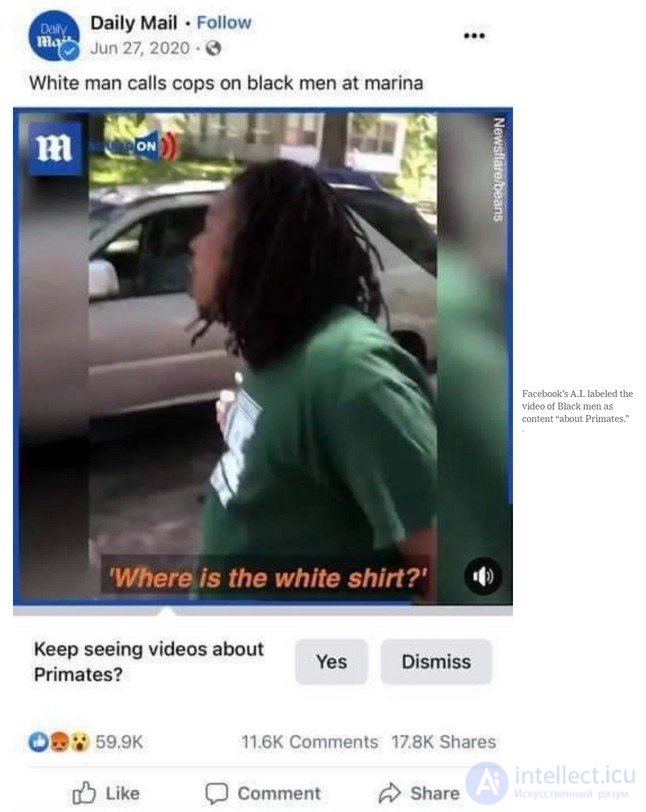
Simple recognition of visual images will not replace human eyes.
Image recognition algorithms are an auxiliary tool with a very narrow scope of application.
For a robot to begin not so much to think as merely to see in a human way, what is required is not only pattern recognition algorithms but also that same full-fledged and so far unattainable human thinking.
The problems and limitations of pattern recognition have been analyzed from general – methodological, philosophical and epistemological – positions. It is noted that most of these problems share a common origin with the problems of cybernetics and artificial intelligence. The primary causes of stagnation in these scientific fields are, on the one hand, the attempt to explain the operation of intellect within an automaton-based, algorithmic approach, and on the other, the extraordinary complexity of the object of study. The main limitations of the classical scheme of pattern recognition can be reduced to the following statements:
Pattern recognition is not an independent procedure but is included in the scheme of thinking. Without taking thinking and the individual component connected with it into account, we cannot in principle either understand the recognition process or use it to build artificial intelligence (or to explain the operation of the natural kind).
The classical recognition scheme is neither indisputable nor the only one possible. The concept of a "feature" is internally contradictory and insufficiently substantiated.
The existing concept of information is insufficient for an adequate description of how information is transformed during recognition.
There is no consistent theory for taking a priori information into account. The situation is especially poor for fragmentary, incomplete and inaccurate information.
Existing mathematical methods, and the information processing based on them, do not make it possible to carry out the computations for most practically interesting cases. A solution to this problem can be obtained in three complementary ways: within classical mathematics, based on Kolmogorov's theorem on representing a complex function through simpler ones; with neural networks that use the most important principles of how the brain works; and with quantum computers and similar devices that perform nonlocal information processing.
An optimal implementation of the recognition process should contain considerably more levels than the existing classical scheme, and the structure of the levels themselves and the procedures for transforming information between them should be much simpler and easier to understand.
Pattern recognition is closely connected with a whole range of disciplines: neurophysiology, information theory, mathematics, neural networks, artificial and natural intelligence, and a number of other scientific disciplines and fields. For this reason, major breakthroughs in pattern recognition should be expected only through the comprehensive and mutually coordinated development of these disciplines.
The human brain subconsciously divides the objects of the surrounding world into classes, but the mechanism of this process is unknown.
The recognition (classification) process is preceded by a learning process, except in cases of unsupervised recognition.
Thanks to the a priori property of similarity among objects within a pattern, it is not necessary to study all the objects of the pattern; a representative sample is enough.
Because of the vagueness of patterns and various errors (in sampling, measurement and the choice of properties), error-free recognition cannot be guaranteed.
Часть 1 Recognition Errors for Nested, Transparent, Mirrored and Other Objects
Часть 2 - Recognition Errors for Nested, Transparent, Mirrored and Other Objects

Comments