
Lecture
The Metasploit Project is a computer security project that provides information about security vulnerabilities and aids in penetration testing and IDS signature development. It is owned by Rapid7 , a security company based in Boston, Massachusetts .
Its best-known subproject is the open-source Metasploit Framework , a tool for developing and executing exploit code against a remote target machine. Other important subprojects include the Opcode Database, the shellcode archive, and related research.
The Metasploit Project includes anti-forensic and evasion tools, some of which are built into the Metasploit Framework. Metasploit comes preinstalled in the Kali Linux operating system.
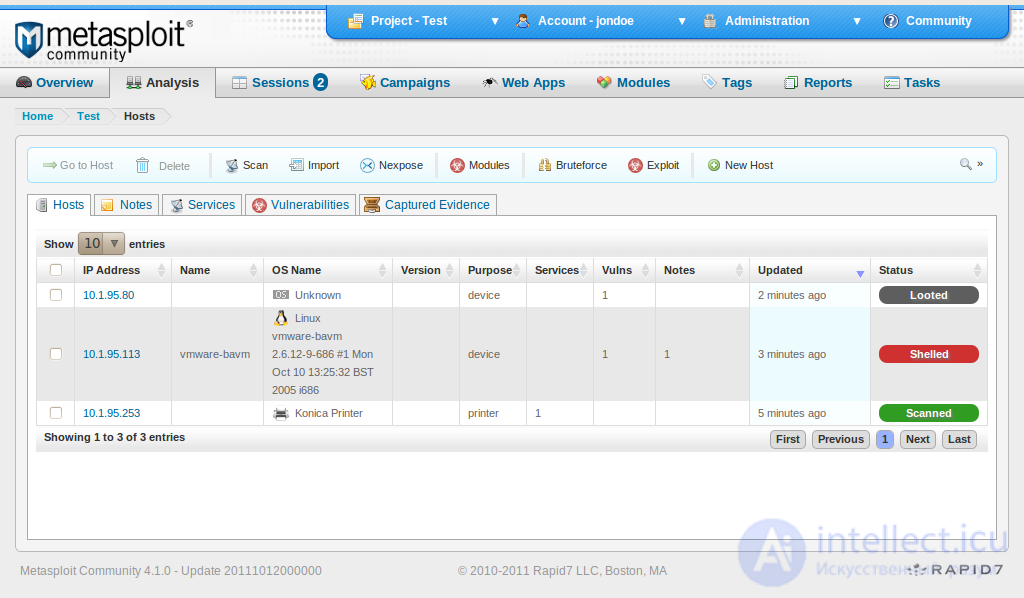
Metasploit Community showing three hosts, two of which have been compromised by an exploit
Metasploit was created by HD Moore in 2003 as a portable network tool written in Perl . By 2007, the Metasploit Framework had been completely rewritten in Ruby . On October 21, 2009, the Metasploit Project announced , that it had been acquired by Rapid7, a security company that provides unified vulnerability management solutions.
Like comparable commercial products such as Immunity's Canvas or Core Security Technologies' Core Impact, Metasploit can be used to test the vulnerability of computer systems or to break into remote systems. Like many information security tools, Metasploit can be used for both legitimate and unauthorized activities. Since the acquisition of the Metasploit Framework, Rapid7 has added two open-core proprietary editions, called Metasploit Express and Metasploit Pro.
Metasploit's emerging position as the de facto exploit development framework led to the release of software vulnerability advisories, often accompanied by a third-party Metasploit exploit module that highlights the exploitability, risk, and remediation of that particular bug. Metasploit 3.0 began to include fuzzing tools, used to discover software vulnerabilities, rather than just exploits for known bugs. This path can be seen in the integration of the lorcon wireless (802.11) toolset into Metasploit 3.0 in November 2006. Metasploit 4.0 was released in August 2011.
The basic steps for exploiting a system using the Framework include the following.
This modular approach, which allows any exploit to be combined with any payload, is the Framework's main advantage. It simplifies the tasks of attackers, exploit writers, and payload writers.
Metasploit runs on Unix (including Linux and macOS) and on Windows. The Metasploit Framework can be extended to use add-ons in multiple languages.
To choose an exploit and payload, some information about the target system is needed, such as the operating system version and the installed network services. This information can be gathered with port scanning and OS fingerprinting tools such as Nmap . Vulnerability scanners such as Nessus and OpenVAS can detect the target system's vulnerabilities. Metasploit can import vulnerability scanner data and compare the identified vulnerabilities against existing exploit modules for accurate exploitation.
Several interfaces are available for Metasploit. The most popular ones are from Rapid7 and Strategic Cyber LLC.
The free version. It contains a command-line interface, third-party import, manual exploitation, and manual brute forcing. This free version of the Metasploit project also includes Zenmap , a well-known security scanner, and a compiler for Ruby, the language in which this version of Metasploit was written.
In October 2010, Rapid7 added Metasploit Pro, an open-core commercial version of Metasploit for penetration testers. Metasploit Pro adds to Metasploit Express such features as Quick Start Wizards / MetaModules, creation and management of social engineering campaigns, web application testing, an advanced Pro console, dynamic payloads for evading antivirus software, integration with Nexpose for ad hoc vulnerability scanning, and VPN pivoting.
On July 18, 2019, Rapid7 announced the end of sales of Metasploit Community Edition. Existing users could continue to use it until their license expired.
The edition was released in October 2011 and included a free web-based user interface for Metasploit. Metasploit Community Edition was based on the commercial functionality of the paid editions with a reduced feature set, including network discovery, module browsing, and manual exploitation. Metasploit Community was included in the main installer.
On June 4, 2019, Rapid7 discontinued Metasploit Express Edition.
The edition was released in April 2010 and was an open-core commercial edition for security teams that need to verify vulnerabilities. It offers a graphical user interface, integrated nmap for discovery, and added smart brute forcing as well as automated evidence collection.
Armitage is a graphical cyber attack management tool for the Metasploit project that visualizes targets and recommends exploits. It is a free, open-source network security tool notable for its contributions to red team collaboration, allowing shared sessions, data, and communication through a single Metasploit instance.
Cobalt Strike is a threat emulation toolkit provided by Strategic Cyber LLC to work with the Metasploit Framework. Cobalt Strike includes all the features of Armitage and adds post-exploitation tools, in addition to reporting features.
Metasploit currently has more than two thousand exploits, organized under the following platforms: AIX , Android , BSD , BSDi , Cisco , Firefox , FreeBSD , HP-UX , Irix , Java , JavaScript , Linux , mainframe , multi (applicable to multiple platforms), NetBSD. , NetWare , nodejs , OpenBSD , macOS , PHP , Python , R , Ruby, Solaris , Unix and Windows .
Metasploit currently has more than 592 payloads. Some of them are:
The Metasploit Framework includes hundreds of auxiliary modules that can perform scanning, fuzzing, sniffing, and much more. There are three types of auxiliary modules: scanners, admin modules, and server modules.
The Metasploit Framework operates as an open-source project and accepts contributions from the community through GitHub.com pull requests. Submitted contributions are reviewed by a team made up of both Rapid7 employees and senior external contributors. Most contributions add new modules, such as exploits or scanners.
List of the original developers:

Comments