
Lecture 31 min.
The Banach–Tarski paradox (also called the ball doubling paradox and the Hausdorff–Banach–Tarski paradox) is a theorem in set theory stating that a three-dimensional ball is equidecomposable with two copies of itself.
The Banach–Tarski paradox is a theorem in set-theoretic geometry which states the following: given a solid ball in 3-dimensional space, there exists a decomposition of the ball into a finite number of disjoint subsets, which can then be put back together in a different way to yield two identical copies of the original ball. Indeed, the reassembly process involves only moving and rotating the pieces without changing their shape. However, the pieces themselves are not "solids" in the usual sense, but infinite scatterings of points. The reconstruction can work with as few as five pieces.

A stronger form of the theorem implies that for any two "reasonable" solid objects (such as a small ball and a huge ball), the cut-up pieces of one of them can be reassembled into the other. This is often stated informally as "a pea can be chopped up and reassembled into the Sun" and is called the "pea and the Sun paradox".
The Banach–Tarski theorem is called a paradox because it contradicts basic geometric intuition. "Doubling the ball" by dividing it into parts and moving them around by rotations and translations, without any stretching, bending, or adding of new points, seems to be impossible, since all of these operations should, intuitively speaking, preserve the volume. The intuition that such operations preserve volumes is not absurd from a mathematical point of view and is even included in the formal definition of volumes. However, it does not apply here, because in this case it is impossible to define the volumes of the subsets in question. Their reassembly produces a volume that differs from the volume at the start.
Unlike most theorems in geometry, the proof of this result depends critically on the choice of the axioms of set theory. It can be proved using the axiom of choice, which allows the construction of non-measurable sets, i.e. sets of points that do not have a volume in the usual sense and whose construction requires an uncountable number of choices.
In 2005 it was shown that the pieces in the decomposition can be chosen in such a way that they can be moved continuously into place without colliding with one another.
As Leroy and Simpson proved independently, , the Banach–Tarski paradox does not violate volumes if one works with locales rather than topological spaces. In this abstract setting, one can have subspaces without points that are nevertheless nonempty. The pieces of the paradoxical decomposition do indeed overlap strongly in the sense of locales, so much so that some of these intersections should be assigned positive mass. Taking this hidden mass into account, locale theory makes it possible to measure all subsets (and even all sublocales) of Euclidean space satisfactorily.
In a paper published in 1924, Stefan Banach and Tarski gave a construction of such a paradoxical decomposition, based on earlier work by Giuseppe Vitali on the unit interval and on the paradoxical partitions of the sphere by Hausdorff, and discussed a number of related questions concerning decompositions of subsets of Euclidean spaces in various dimensions. They proved the following more general statement, the strong form of the Banach–Tarski paradox:
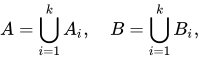
For any two bounded subsets A and B of a Euclidean space of at least three dimensions, both of which have a nonempty interior, there exist partitions of A and B into a finite number of disjoint subsets, ,
,  (for some integer k), such that for each (integer) i between 1 and K, the sets i and B i are congruent.
Now let A be the original ball and B be the union of two translated copies of the original ball. Then the statement means that you can divide the original ball A into a certain number of pieces and then rotate and translate these pieces so that the result is the whole set B, which contains two copies of A.
The strong form of the Banach–Tarski paradox is false in dimensions one and two, but Banach and Tarski showed that an analogous statement remains true if countably many subsets are allowed. The difference between dimensions 1 and 2, on the one hand, and 3 and higher, on the other hand, is due to the richer structure of the group E ( n ) of Euclidean motions in 3 dimensions. For n = 1, 2 the group is solvable, but for n ≥ 3 it contains a free group with two generators. John von Neumann studied the properties of the group of equivalences that make a paradoxical decomposition possible, and introduced the concept of amenable groups. He also found a form of the paradox in the plane, in which area-preserving affine transformations are used instead of the usual congruences.
Tarski proved that amenable groups are precisely those for which no paradoxical decompositions exist. Since only free subgroups are needed in the Banach–Tarski paradox, this led to the long-standing von Neumann conjecture, which was disproved in 1980.
The Banach–Tarski paradox states that a ball in ordinary Euclidean space can be doubled using only the operations of partitioning into subsets, replacing a set by a congruent set, and reassembling. Its mathematical structure has been considerably clarified, emphasizing the role played by the group of Euclidean motions and introducing the concepts of equidecomposable sets and of a paradoxical set. Suppose that G is a group acting on a set X. In the most important special case, X is n-dimensional Euclidean space (for integer n), and G consists of allisometries of X, i.e. transformations of X into itself that preserve distance, usually denoted E ( n ). Two geometric figures that can be transformed into each other are called congruent, and this terminology will be extended to the general G- action. Two subsets A and B of X are called G-equidecomposable or equidecomposable with respect to G, if A and B can be partitioned into the same finite number of respectively G-congruent pieces. This defines an equivalence relation among all subsets of X. Formally, if there exist nonempty sets ,
,  such that

and there are elements  such that
 ,
,
then one can say that A and B are G-equidecomposable using K pieces. If a set E has two disjoint subsets A and B such that A and E, as well as B and E, are G-equidecomposable, then E is called paradoxical.
Using this terminology, the Banach–Tarski paradox can be restated as follows:
A three-dimensional Euclidean ball is equidecomposable with two copies of itself.
In fact, there is a sharp result in this case, due to Raphael M. Robinson: doubling the ball can be accomplished with five pieces, and fewer than five pieces will not suffice.
The strong form of the paradox states:
Any two bounded subsets of three-dimensional Euclidean space with non-empty interiors are equidecomposable.
Although this statement seems more general, it is derived in a simple way from the doubling of a ball by using a generalization of the Banach version of the Bernstein–Schroeder theorem, which implies that if A is equidecomposable with a subset of B and B is equidecomposable with a subset of A, then A and B are equidecomposable.
The Banach–Tarski paradox can be put into context by pointing out that for two sets in the strong form of the paradox there is always a bijective function that can map the points of one shape onto the other in a one-to-one fashion. In the language of Georg Cantor's set theory, these two sets have equal cardinality. Thus, if the group is enlarged to allow arbitrary bijections of X, then all sets with non-empty interior become congruent. Likewise, one ball can be turned into a larger or smaller ball by stretching, or in other words, by applying similarity transformations. Hence, if the group G is large enough, G-equidecomposable sets can be found whose "sizes" differ. Moreover, since a countable set can be divided into two copies of itself, one might expect that using a countable number of pieces could somehow help.
On the other hand, in the Banach–Tarski paradox the number of pieces is finite, and the allowed equivalences are Euclidean congruences, which preserve volumes. Yet somehow they double the volume of the ball! Although this is certainly surprising, some of the pieces used in the paradoxical decomposition are non-measurable sets, so the notion of volume (more precisely, Lebesgue measure) is not defined for them, and the partition cannot be carried out in practice. In fact, the Banach–Tarski paradox shows that it is impossible to find a finitely additive measure (or a Banach measure) defined on all subsets of Euclidean space of three (and more) dimensions that is invariant under Euclidean motions and takes the value one on the unit cube. In his later work, Tarski showed that, conversely, the absence of paradoxical decompositions of this type implies the existence of a finitely additive invariant measure.
The essence of the proof of the paradox in the "doubling the ball" form presented below lies in the remarkable fact that by means of Euclidean isometries (and a renaming of elements) one can divide a certain set (essentially, the surface of the unit sphere) into four parts, then rotate one of them so that it becomes itself plus two of the other parts. This follows fairly easily from an F 2-paradoxical decomposition of F 2, the free group with two generators. The proof of Banach and Tarski relied on an analogous fact discovered by Hausdorff a few years earlier: the surface of the unit sphere in space is a disjoint union of three sets B, C, D and a countable set E such that, on the one hand, B, C, D are pairwise congruent, and on the other hand, B is congruent to the union of C and D. This is often called the Hausdorff paradox.
Banach and Tarski explicitly acknowledge Giuseppe Vitali's 1905 construction of the set bearing his name, Hausdorff's paradox (1914), and an earlier (1923) paper of Banach as precursors of their work. The constructions of Vitali and Hausdorff depend on Zermelo's axiom of choice ("AC"), which is also crucial to the Banach–Tarski paper, both for the proof of their paradox and for the proof of another result:
Two Euclidean polygons, one of which strictly contains the other, are not equidecomposable.
They remark:
Le rôle que joue cet axiome dans nos raisonnements nous semble mériter l'attention
(The role that this axiom plays in our reasoning seems to us to deserve attention)
They point out that, although the second result fully agrees with our geometric intuition, its proof uses AC in an even more essential way than the proof of the paradox. Thus Banach and Tarski imply that AC should not be rejected merely because it produces a paradoxical decomposition, since such an argument also undermines the proofs of geometrically intuitive statements.
However, in 1949 A. P. Morse showed that the statement about Euclidean polygons can be proved in ZF set theory and therefore does not require the axiom of choice. In 1964 Paul Cohen proved that the axiom of choice is independent of ZF, i.e., it cannot be proved from ZF. A weaker version of the axiom of choice is the axiom of dependent choice, DC, and it has been shown that DC is not sufficient to prove the Banach–Tarski paradox, i.e.,
The Banach–Tarski paradox is not a theorem of ZF or of ZF + DC.
A great deal of mathematics uses AC. As Stan Wagon notes at the end of his monograph, the Banach–Tarski paradox has been more significant for its role in pure mathematics than for foundational questions: it served as the stimulus for a new and fruitful direction of research, the amenability of groups, which has nothing to do with foundational questions.
In 1991, using recent results of Matthew Foreman and Friedrich Wehrung, Janusz Pawlikowski proved that the Banach–Tarski paradox follows from ZF and the Hahn–Banach theorem. [10] The Hahn–Banach theorem does not rely on the full axiom of choice, but can be proved using a weaker version of AC called the ultrafilter lemma. Thus Pawlikowski proved that the set theory needed to prove the Banach–Tarski paradox, while stronger than ZF, is weaker than full ZFC.
Here we sketch a proof that is similar to, but not identical with, that of Banach and Tarski. Essentially, the paradoxical decomposition of the ball is achieved in four steps:
These steps are discussed in more detail below.
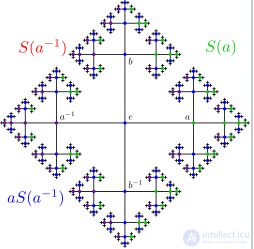
The free group with two generators a and b consists of all finite strings that can be formed from the four symbols a, a −1, b and b −1 such that a does not appear directly next to a −1, and b does not appear directly next to b −1. Two such strings can be concatenated and converted into a string of this type by repeatedly replacing the "forbidden" substrings with the empty string. For example: abab −1 a −1 concatenated with abab −1.a gives abab −1 a −1 abab −1 a, which contains the substring a −1 a, and so reduces to abab −1 bab −1 a, which contains the substring b −1 b, which reduces to abaab - 1 a. One can check that the set of these strings with this operation forms a group with the identity element being the empty string e. This group can be called F 2.
The group  can be "paradoxically decomposed" as follows: Let S(a) be the set of all non-forbidden strings that begin with a, and define S(a −1), S(b) and S(b −1) similarly. Clearly,

but also

and

where the notation aS(a −1) means taking all the strings in S(a −1) and concatenating them on the left with a.
This is the essence of the proof. For example, this could be the string in the set
  which, because of the rule that
  must not appear next to
  , reduces to the string
  . Similarly, contains all strings beginning with (for example, the string
  which reduces to ). Thus, contains all strings beginning with ,
  and .
and .
The group F 2 has been cut into four pieces (plus the singleton {e}), then two of them have been "shifted" by multiplying by a or b, then "reassembled" as two pieces to make one copy of and the other two to make another copy of . This is exactly what is needed to be done with the ball.
To find a free group of rotations of three-dimensional space, i.e., one that behaves exactly the same way as (or is "isomorphic to") the free group F 2, two orthogonal axes are taken (for example, the x and z axes). Then A is taken to be a rotation by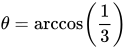 about the x axis, and B a rotation by
 about the z axis (there are many other suitable pairs of irrational multiples of π that could also be used here). [11]
The group of rotations generated by A and B will be called H. Let be an element of H that begins with a positive rotation about the z axis, that is, an element of the form
 with
with  . By induction it can be shown that maps the point
  to
to 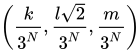 , for some
  . By analyzing
 and
and  modulo 3, it can be shown that
  . The same argument is repeated (by the symmetry of the problem) whenbegins with a negative rotation about the z axis or a rotation about the x axis. This shows that ifis given by a non-trivial word in A and B, then
 . Consequently, the group H is a free group isomorphic to F 2.
The two rotations behave just like the elements a and b in the group F 2: there is now a paradoxical decomposition of H.
This step cannot be carried out in two dimensions, since it involves rotations in three dimensions. If two rotations are performed about the same axis, the resulting group is the abelian circle group and does not have the property required in Step 1.
An alternative arithmetic proof of the existence of free groups in some special orthogonal groups, using integer quaternions, leads to paradoxical decompositions of the rotation group. [12]
The unit sphere S 2 is partitioned into orbits by the action of our group H: two points belong to the same orbit if and only if there is a rotation in H that moves the first point to the second. (Note that the orbit of a point is a dense set in S 2.) The axiom of choice can be used to pick exactly one point from each orbit; collect these points into a set M. The action of H on a given orbit is free and transitive, so each orbit can be identified with H. In other words, each point of S 2 can be reached in exactly one way by applying the appropriate rotation from H to the appropriate element of M. Because of this, the paradoxical decomposition of H yields a paradoxical decomposition of S 2 into four pieces A 1, A 2, A3, A4 as follows:


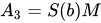
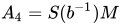
where we define

and the same for the other sets, and where we define

(The five "paradoxical" pieces of F 2 were not used directly, since they would leave M as an extra piece after doubling, because of the presence of the singleton {e}!)
(Most of) the sphere is now divided into four sets (each dense on the sphere), and when two of them are rotated, the result is twice what it was before:


Finally, connect each point of S 2 with a half-open segment to the origin; the paradoxical decomposition of S 2 leads to a paradoxical decomposition of the solid unit ball minus the point at the center of the ball. (This central point requires a little more care; see below.)
NB In this sketch some details are glossed over. One must be careful about the set of points on the sphere that happen to lie on the axis of some rotation in H. However, there are only countably many such points, and, as with the point at the center of the ball, the proof can be corrected to account for all of them. (See below.)
In Step 3, the sphere was partitioned into orbits of our group H. To simplify the proof, the discussion of points fixed by some rotation was omitted; since the paradoxical decomposition of F 2 is based on shifting certain subsets, the fact that some points are fixed may cause some problems. Since any rotation of S 2 (other than the null rotation) has exactly two fixed points, and since H, which is isomorphic to F 2, is countable, there is a countable set of points of S 2 fixed by some rotation in H. Denote this set of fixed points as D. Step 3 proves that S 2 - D admits a paradoxical decomposition.
It remains to show this claim: S 2 - D is equidecomposable with S 2.
Proof. Let λ be some line passing through the origin that does not intersect any point of D. This is possible since D is countable. Let J be the set of angles α such that for some natural number n and some P in D, r(nα)P is also in D, where r(nα) is the rotation about λ by nα. Then J is countable. Thus there exists an angle θ not in J. Let ρ be the rotation about λ by θ. Then ρ acts on S 2 without any fixed points in D, i.e., ρ n(D) is disjoint from D, and for natural m < n, ρ n(D) is disjoint from ρ m(D). Let E be the disjoint union of ρ n(D) over n = 0, 1, 2, .... Then S 2 = E ∪ (S 2 - E) ~ ρ(E) ∪ (S 2 - E) = (E- D) ∪ (S 2 - E) = S 2 - D, where ~ denotes "is equidecomposable to".
For Step 4, it has already been shown that a ball without a point admits a paradoxical decomposition; it remains to show that a ball without a point is equidecomposable with the ball. Consider a circle inside the ball containing the point at the center of the ball. Using an argument similar to the one used to prove the Claim, one can see that the full circle is equidecomposable with the circle minus the point at the center of the ball. (Essentially, a countable set of points on the circle can be rotated to give itself plus one more point.) Note that this involves rotation about a point other than the origin, so the Banach–Tarski paradox involves isometries of Euclidean 3-space rather than just SO(3).
Use is made of the fact that if A ~ B and B ~ C, then A ~ C. The decomposition of A into C can be done with a number of pieces equal to the product of the numbers needed to take A to B, and to take B to C.
The proof above requires 2 × 4 × 2 + 8 = 24 pieces - a factor of 2 to remove fixed points, a factor of 4 from Step 1, a factor of 2 to recreate fixed points, and 8 for the center point of the second ball. But in Step 1, when moving {e} and all strings of the form a n into S(a −1), do this for all orbits except one. Move {e} of this last orbit to the center of the second ball. Thus the total is 16 + 1 pieces. With more algebra, one can also decompose the fixed orbits into 4 sets as in Step 1. This gives 5 pieces, which is the best possible.
Using the Banach–Tarski paradox, it is possible to obtain k copies of a ball in Euclidean n-space from one, for any integers n ≥ 3 and k ≥ 1, i.e., a ball can be cut into k pieces so that each of them is equidecomposable to a ball of the same size as the original. Using the fact that the free group F 2 of rank 2 admits a free subgroup of countably infinite rank, a similar proof shows that the unit sphere S n −1 can be partitioned into a countably infinite number of pieces, each of which is equidecomposable (with two pieces) to S n −1using rotations. Using the analytic properties of the rotation group SO(n), which is a connected analytic Lie group, one can further prove that the sphere S n −1 can be partitioned into as many pieces as there are real numbers (i.e., pieces), so that each piece is equidecomposable with two pieces to S n −1 by means of rotations. These results are then extended to the unit ball deprived of the origin. A 2010 paper by Valeriy Churkin gives a new proof of the continuous version of the Banach–Tarski paradox. [13]
In the Euclidean plane, two figures that are equidecomposable with respect to the group of Euclidean motions necessarily have the same area, and therefore a Banach–Tarski-type paradoxical decomposition of a square or disk using only Euclidean congruences is impossible. A conceptual explanation of the difference between the planar and higher-dimensional cases was given by John von Neumann: unlike the group SO(3) of rotations in three dimensions, the group E(2) of Euclidean motions of the plane is solvable, which implies the existence of a finitely additive measure on E(2) and R 2which is invariant under translations and rotations and rules out paradoxical decompositions of non-negligible sets. Von Neumann then posed the following question: can such a paradoxical decomposition be constructed if a larger group of equivalences is allowed?
Clearly, if similarities are allowed, any two squares in the plane become equivalent even without further division. This motivates restricting attention to the group SA 2 of area-preserving affine transformations. Since area is preserved, any paradoxical decomposition of a square with respect to this group would be counterintuitive for the same reasons as the Banach–Tarski decomposition of a ball. In fact, the group SA 2 contains as a subgroup the special linear group SL(2, R), which in turn contains the free group F 2with two generators as a subgroup. This makes it plausible that the proof of the Banach–Tarski paradox can be imitated in the plane. The main difficulty here is that the unit square is not invariant under the action of the linear group SL(2, R), so one cannot simply transfer a paradoxical decomposition from the group to the square, as in the third step of the above proof of the Banach–Tarski paradox. Moreover, the fixed points of the group present difficulties (for example, the origin is fixed under all linear transformations). This is why von Neumann used the larger group SA 2including translations, and constructed a paradoxical decomposition of the unit square with respect to the enlarged group (in 1929). Applying the Banach–Tarski method, the paradox for the square can be strengthened as follows:
Any two bounded subsets of the Euclidean plane with non-empty interiors are equidecomposable with respect to area-preserving affine maps.
As von Neumann notes: [14]
«Infolgedessen gibt es bereits in der Ebene kein nichtnegatives adds Maß (wo das Einheitsquadrat das Maß 1 hat), das gegenüber allen Abbildungen von A 2 invariant wäre».
"Accordingly, already in the plane there is no non-negative additive measure (for which the unit square has measure 1) that is invariant under all transformations belonging to A 2 [the group of area-preserving affine transformations]."
To explain further, the question of whether a finitely additive measure (which is preserved under certain transformations) exists depends on which transformations are allowed. A Banach measure on sets in the plane that is preserved by translations and rotations is not preserved by non-isometric transformations, even if they preserve the area of polygons. The points of the plane (other than the origin) can be divided into two dense sets, which may be called A and B. If the A points of a given polygon are transformed by one area-preserving transformation and the B points by another, both sets can become subsets of the A points in two new polygons. The new polygons have the same area as the old polygon, but the two transformed sets cannot have the same measure as before (since they contain only part of the A points), and so there is no measure that "works".
The class of groups singled out by von Neumann in the course of studying the Banach–Tarski phenomenon turned out to be very important for many areas of mathematics: these are the amenable groups, or groups with an invariant mean, which include all finite groups and all solvable groups. Generally speaking, paradoxical decompositions arise when the group used for the equivalences in the definition of equidecomposability is not amenable.
-th part of H 2 . The requirement was satisfied by orientation-preserving isometries of H 2 . Similar results were obtained by John Frank Adams [19] and Jan Mycielski [20] , who showed that the unit sphere S 2 contains a set E that is a half, a third, a fourth, ... and a-th part of S 2 . Grzegorz Tomkowicz [21] showed that the Adams and Mycielski construction can be generalized to obtain a set E in H 2 with the same properties as in S 2 . , where denotes the symmetric difference of E and F .

Comments