
Lecture 14 min.
Failure is one of the main terms in reliability theory. It means a loss of operability of an object, in which a system or element stops performing its functions in whole or in part; otherwise a malfunction of the device, system or organ will occur.
A fault model is an engineering model of a design or piece of equipment that may operate incorrectly. Based on the model, a designer or user can predict the consequences of specific failures. Fault models can be used in virtually all kinds of engineering activity.
A failure is an event or process in which an object, piece of equipment, system or one of their components ceases to perform its prescribed function. The concept of failure is key in engineering, manufacturing, IT and many other fields, since failures can lead to significant consequences, including losses of productivity, safety and economic losses.
An accident is the destruction of structures and/or technical devices used at a hazardous production facility, or an uncontrolled explosion and/or release of hazardous substances.
An incident is a failure or damage of technical devices used at a hazardous production facility, or a deviation from the established mode of the technological process. Unlike an accident, an incident involves not destruction but only failure or damage of technical devices.
A breakdown is an event or process in which a device, mechanism, system or their components cease to function properly. It can occur for various reasons, including physical damage, wear, software errors, or external factors such as overload or environmental effects.
The essence of a failure is the inability of an object to perform its function in accordance with the specified requirements and standards. A failure can be partial or complete, temporary or permanent, random or predictable.
Structural integrity and failure is an aspect of engineering that deals with the ability of a structure to support its design load (weight, force, etc.) without breaking, and it includes the study of past structural failures in order to prevent failures in future designs.
Structural integrity is the ability of an item — a structural component or a structure made up of many components — to hold together under load, including its own weight, without breaking or deforming excessively. It ensures that the structure will perform its intended function under reasonable use throughout its expected service life. Items are designed with structural integrity in mind to prevent catastrophic failure, which can result in injury, severe damage, death and/or financial losses.
Structural failure refers to the loss of structural integrity or the loss of load-carrying capacity, either in a structural component or in the structure itself. Structural failure begins when a material is subjected to stress exceeding its strength limit, leading to cracks or excessive deformation; one limit state that must be considered in structural design is ultimate tensile strength. In a well-designed system, a localized failure should not cause immediate, or even progressive, collapse of the entire structure.
Structural integrity is the ability of a structure to withstand its intended load without failing due to cracks, deformation or fatigue. It is a concept often used in engineering to produce items that will serve their intended purposes and remain functional over a desired service life.
To create an item with structural integrity, an engineer must first consider the mechanical properties of the material, such as toughness, strength, weight, hardness and elasticity, and then determine the size and shape necessary for the material to withstand the desired load over a long service life. Because items must neither break nor bend excessively, they must be both stiff and strong. A very stiff material can resist bending, but if it is not strong enough, it may have to be very large to bear the load without breaking. On the other hand, a highly elastic material will bend under load, even if its high toughness prevents fracture.
Moreover, the integrity of each component must suit its individual application in any load-bearing structure. Bridge supports must have a high yield strength, whereas the bolts holding them must have good shear and tensile strength. Springs must have good elasticity, and a turning tool must have high hardness. In addition, the whole structure must be able to bear its load without its weakest links failing, since that could increase the load on other elements of the structure and lead to cascading failures.

The Meidum pyramid was the second one built by the Egyptians, around 2600 BC. It suffered from numerous structural defects, which caused it to collapse during construction and left the inner core standing in a pile of rubble, which became one of the earliest known lessons of large-scale construction.
The need to build structures with integrity goes back to the times of written history. Houses had to support their own weight as well as the weight of their occupants. Castles had to be fortified to withstand attacks by invaders. Tools had to be strong and stiff enough to do their job.
In ancient times there were no mathematical formulas for predicting structural integrity. Builders, blacksmiths, carpenters and masons relied on trial and error (the study of past failures), experience and apprenticeship to create safe and durable structures. Historically, safety and durability were ensured through overcompensation, for example using 20 tons of concrete when 10 tons would have been sufficient. Galileo was one of the first to take the strength of materials into account, in 1638, in his treatise "Dialogues Concerning Two New Sciences". However, mathematical methods for calculating such material properties only began to develop in the 19th century. The science of fracture mechanics as it exists today was not developed until the 1920s, when Alan Arnold Griffith studied the brittle fracture of glass.
Beginning in the 1940s, the notorious failures of several new technologies made a more scientific method of analyzing structural failures necessary. During World War II, more than 200 welded steel ships broke in half due to brittle fracture caused by stresses created during welding, temperature changes and stress concentration at the right-angle corners of bulkheads. In the 1950s, several De Havilland Comet aircraft exploded in flight because of stress concentrations at the corners of their square windows, which led to cracks and the bursting of the pressurized cabins. Boiler explosions, caused by failures in pressurized boiler tanks, were another common problem of that era and did serious damage. The growing size of bridges and buildings led to even greater disasters and loss of life. This need to build structures with structural integrity led to major advances in materials science and fracture mechanics.
Mechanical: physical damage to components. Mechanical failures involve physical damage to equipment. These may be cracks, deformations, wear of parts and other mechanical defects. For example, a crack in an engine housing or worn bearings can bring a machine to a complete stop.
Electrical: faults in the operation of electrical circuits. Electrical failures involve disruption of the operation of electrical circuits and components. These may be short circuits, overheating of wires, malfunctions of electronics, and so on. For example, a blown fuse or a faulty transformer can cause interruptions in the power supply.
Thermal: overheating and damage to materials. Thermal failures arise from the overheating of components. This may be caused by insufficient cooling, thermal degradation of materials, or overload. For example, an overheated processor in a computer can cause it to shut down or break.
Corrosion: destruction of materials by chemical reactions. Corrosion failures are caused by chemical reactions that destroy materials. This is especially relevant for metal structures and pipelines, which can corrode under the influence of moisture and chemicals.
Software: errors or bugs in software. Software failures arise from errors in software. These may be bugs, incorrect algorithms or program crashes. For example, an operating system crash can lead to data loss or the inability to perform certain tasks.
Basic fault models of digital circuits include:
Evolutionarily, research initially considered the stuck-at fault model, and only methods for determining the fact of a fault were used. Such approaches are considered classical. This model is one of the most frequently used in practice. There are two types of faults: stuck at 0 and stuck at 1. Such faults are denoted SA0 and SA1 respectively (stuck-at).
This model has the following assumptions:
Thanks to its simplicity, this fault model allows fault detection to be performed efficiently, and for this reason it is one of the most widely used in industry. The model has the following advantages:
It is now known that using the stuck-at fault model alone cannot be adequately translated to the bridging fault model.
Depending on the logic used in the circuit, the result of a fault is a "wired-AND" or a "wired-OR", that is, both data lines are in the state of the result of the logical function 'AND' or 'OR'. Thus, when considering n outputs, there can be O(n2) potential bridging fault variants. Usually their number is limited on the basis of the given physical design, and only data lines adjacent to each other are considered.
A short circuit between circuit elements is one of the main defects of electronic circuit manufacturers.
A distinction is made between bridging faults with and without feedback (feedback and non-feedback). The latter have no memory effects, and most of them can be detected using the stuck-at fault model. The former may have memory effects and accordingly do not obey combinational logic.
The model assumes that signal propagation occurs more slowly than specified by design considerations. Such models cover a number of physical properties of materials, including temperature changes, the effects of energy noise, crosstalk, load changes, and so on.
A fault model is built on certain assumptions. The following assumptions are usually considered, and violating them makes the fault model inoperable:
There are two main ways to reduce a set of faults to a set of smaller size. Such a reduction makes it possible to check the whole original set of faults with fewer tests.
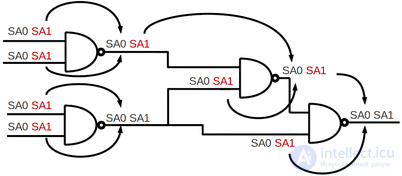
Example of fault list reduction based on equivalence
It is possible that two or more faults have the same behavior, as reflected on the output lines. Such faults are called equivalent. Each single equivalent fault can be represented as a whole set. In that case, far fewer than k×n tests are needed to detect the presence of a fault. Removing equivalent faults in this way is called fault list reduction based on equivalence.
As an example, in the diagram the red faults are equivalent, and they can be collapsed. In this circuit the fault list reduction ratio is 12 to 20.
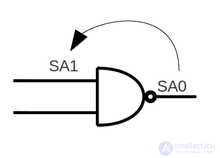
Example of a dominant fault
A fault F is said to dominate a fault F' if all tests for F' detect the fault F. In this case F can be removed from the list to be checked. If F dominates F', and F' dominates F, then the two faults are equivalent.
The example shows a NAND gate and the set of all output values testing SA0, {00,01,10}. The set of input values can be checked with the element 01 to determine SA1. In that case the output SA0 is dominant and can be removed from the list.
Two faults are functionally equivalent if they lead the system to the same functions. In this case we can say that the faults are functionally equivalent and we cannot distinguish them by the output values for a given test vector of input values.
Three main categories are considered here:

Comments