
Lecture
"Why not pull it out? It can be pulled out. Only here one must understand — it cannot be done without some notion of the matter… Teeth come in different kinds. One you pull with forceps, another with a goat's foot, a third with a key… Depends which."
A. P. Chekhov
Streams of textual and numerical information are generated daily and settle into data warehouses. How fully, in practice, are all the patterns hidden within this data – patterns that may well be of great value – actually used? One might assume that the share of "raw" data converted into practically useful knowledge is still quite modest. Even the rich arsenal of classical statistics is far from fully used, to say nothing of more modern methods of nonlinear analysis. "Where one is obliged to worship the sun, the laws of heat will be but poorly understood." The point is that in our country, although statistics was never branded a "venal wench of the bourgeoisie", for a long time there was a rejection of formal statistics. What statistics could there be, when the data themselves had to conform to the state's ideological guidelines. The situation is compounded by the fact that new methods of data analysis and knowledge extraction have recently been developing actively, based on approaches other than the traditional integro–differential paradigm. These are the methods of evolutionary modelling and machine learning. The term "evolutionary modelling" is now fairly well established, and it is generally understood to mean genetic algorithms and artificial neural networks. The term "machine learning" leaves more room for debate about which methods it covers; in particular, decision trees belong here.
How does one find one's bearings amid this variety of tools? Which of them should be chosen to solve a particular problem? In this situation the comparatively new term – "ontology" – comes in very handy. An ontology is a precise specification of a given domain. It provides a vocabulary for representing and exchanging knowledge about that domain, together with a set of relations established between the terms in that vocabulary. In the simplest case, building an ontology comes down to:
One of the advantages of using ontologies as a tool of cognition is a systemic approach to studying the domain. This achieves:
Data analysis — a field of mathematics and computer science concerned with the construction and study of the most general mathematical methods and computational algorithms for extracting knowledge from experimental (in the broad sense) data; the process of investigating, filtering, transforming and modelling data with a view to extracting useful information and making decisions.
Put a little more simply, I would propose to understand data analysis as the set of methods and applications associated with algorithms for processing data that do not have a strictly fixed answer for every incoming object. This is what distinguishes them from classical algorithms, for example those implementing sorting or a dictionary. The execution time and memory footprint of a classical algorithm depend on its particular implementation, but the expected result of applying it is strictly fixed. By contrast, we expect a neural network recognising digits to answer 8 when shown a handwritten eight, but we cannot require this result. Moreover, any (in a reasonable sense of the word) neural network will occasionally err on some correct variants of input data or other. Let us call this formulation of the problem, and the methods and algorithms applied in solving it, non-deterministic (or fuzzy) as opposed to classical (deterministic, crisp) ones.
Since knowledge is personal in character, one and the same domain can be described by different ontologies. This is especially true of poorly formalisable domains, or where there are a great many contentious issues.
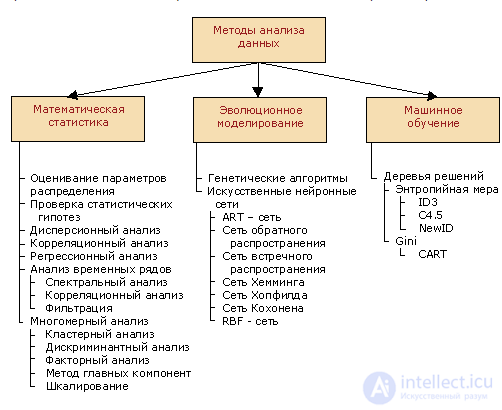
To solve problems involving the analysis of data in the presence of random and unpredictable influences, mathematicians and other researchers have, over the past two hundred years, developed a powerful and flexible arsenal of methods known collectively as mathematical statistics. Over this time a great deal of experience has accumulated in the successful application of these methods in various spheres of human activity, from economics to space research. And under certain conditions these methods make it possible to obtain optimal solutions. For example, one of the problems solved in radar – detecting a known signal against a background of additive interference in the form of white noise. Methods of mathematical statistics solve this problem in an optimal way, and it is difficult to imagine the need for other approaches to solving it. At the same time, the problem of resolving closely spaced targets under more complex interference conditions is solved less successfully by linear statistical methods.
Nowadays, when speaking of evolutionary modelling, one usually means genetic algorithms and artificial neural networks. The term "evolutionary modelling" owes its origin to the source from which the ideas underlying this paradigm were borrowed. Whereas classical approaches are based on a human's knowledge of the domain, formalised in some way, for a neural network an analytical form of representing knowledge is unavailable; all it can do is memorise and generalise the empirical dependencies between input factors and resulting values presented to it during training. That is, a neural network builds a model of some process and subsequently reproduces its behaviour. This gives some researchers grounds to claim that artificial neural networks model modes of thought characteristic of humans. In our view, for the practical use of neural-network technologies it is enough that neural networks are capable of building complex nonlinear models of processes, while how human brains are actually arranged is a secondary matter. What matters is something else – the quality of a model depends on the quality of the training data (here it is much the same as with people).
Genetic algorithms use the mechanisms of genetic evolution, which can in general be formulated as follows: the higher an individual's fitness, the higher the probability that in its offspring this fitness will be expressed even more strongly. Treating the process of adaptation as an optimisation process leads to the idea of using genetic algorithms when training neural networks. Moreover, whereas gradient training methods guarantee finding a local minimum, a genetic algorithm provides global optimisation.
Methods of evolutionary modelling solve a wide class of problems: pattern classification, clustering, approximation, data forecasting, optimisation, associative memory, control of dynamic objects. Moreover, for all the reasons given above, neural networks cope with the tasks listed more successfully than methods of mathematical statistics do, the less formalisable the task is.
The goal of machine learning methods is to obtain simple classifying expressions that would be easy for a human to understand. The advantage of such methods is that human involvement is not required while the method is running.
In a study conducted within the European StatLog project, an analysis was carried out of statistical methods (discriminant analysis, cluster analysis, etc.), decision trees (C4.5, AC2, CART, NewID, CN2, Itrule, etc.) and neural networks (multilayer networks, RBF networks, Kohonen maps) for solving classification problems. The data were taken from various domains: pattern recognition (handwritten text, vehicles), medical diagnosis (diabetes, head injuries, heart disease), molecular biology (recognising DNA structure), credit granting, and so on.
The study found that decision trees produced the best results in solving the following problems:
On our forum one can sometimes come across rather irritated remarks about all these clevernesses. For some reason neural networks are held in particular dislike. We would like to call on these commenters to show a little more restraint, and to say the following.
First, if one looks around soberly, it turns out that a few magic words, such as neural network, perceptron, factor analysis, regression analysis… , cannot solve all unsolved problems. "It is very rarely that one succeeds in unlocking several of nature's secrets at once with the same key." (C. Shannon).
Second, the effectiveness of nonlinear estimation techniques (meaning neurocomputing) can be increased by combining them with already familiar linear statistical methods. An example – RBF networks, in which the hidden-layer weights are tuned with the help of a genetic algorithm, while the output-layer weights are computed by the good old method of pseudo-inverse matrices.
It is merely a tool. How to use it is, in the end, for the person to decide. Incidentally, the story told by Chekhov in his tale "Surgery" (from which the epigraph is taken) happened only because, instead of the doctor, who had gone off to get married, patients were being seen by the feldsher Kuryatin.

Comments