Indefinite Integral and Antiderivative: Properties, Table of Integrals, Rules and Methods of Integration

Lecture 10 min.


The Indefinite Integral. The Concept of an Antiderivative, Basic Concepts and Definitions

Definition

Antiderivative (sometimes also called a primitive function or primitive) is one of the most important concepts of mathematical analysis of a real variable (there are also generalizations of this concept for complex functions).

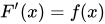
A function Indefinite Integral and Antiderivative: Properties, Table of Integrals, Rules and Methods of Integration is called an antiderivative of a function Indefinite Integral and Antiderivative: Properties, Table of Integrals, Rules and Methods of Integration on an interval Indefinite Integral and Antiderivative: Properties, Table of Integrals, Rules and Methods of Integration, finite or infinite, if the function Indefinite Integral and Antiderivative: Properties, Table of Integrals, Rules and Methods of Integration is differentiable at every point of this interval and its derivative satisfies the following equality:

Indefinite Integral and Antiderivative: Properties, Table of Integrals, Rules and Methods of Integration

The last equality can be written in terms of differentials:

Indefinite Integral and Antiderivative: Properties, Table of Integrals, Rules and Methods of Integration or Indefinite Integral and Antiderivative: Properties, Table of Integrals, Rules and Methods of Integration

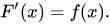
An antiderivative of a given function Indefinite Integral and Antiderivative: Properties, Table of Integrals, Rules and Methods of Integration is a function Indefinite Integral and Antiderivative: Properties, Table of Integrals, Rules and Methods of Integration whose derivative is equal to Indefinite Integral and Antiderivative: Properties, Table of Integrals, Rules and Methods of Integration (on the entire domain of Indefinite Integral and Antiderivative: Properties, Table of Integrals, Rules and Methods of Integration), that is, Indefinite Integral and Antiderivative: Properties, Table of Integrals, Rules and Methods of Integration. Finding an antiderivative is the operation inverse to differentiation: differentiation finds the derivative of a given function, whereas by finding an antiderivative we, conversely, recover the original function from its given derivative.

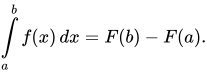
Antiderivatives are important because they allow us to compute definite integrals. If Indefinite Integral and Antiderivative: Properties, Table of Integrals, Rules and Methods of Integration is an antiderivative of an integrable continuous function Indefinite Integral and Antiderivative: Properties, Table of Integrals, Rules and Methods of Integration, then:

Indefinite Integral and Antiderivative: Properties, Table of Integrals, Rules and Methods of Integration

This relation is called the Newton–Leibniz formula.

Technically, finding an antiderivative amounts to computing the indefinite integral of Indefinite Integral and Antiderivative: Properties, Table of Integrals, Rules and Methods of Integration, and the process itself is called integration. For applications of this theory in geometry, see Integral calculus.

Example: the function Indefinite Integral and Antiderivative: Properties, Table of Integrals, Rules and Methods of Integration is an antiderivative of Indefinite Integral and Antiderivative: Properties, Table of Integrals, Rules and Methods of Integration because Indefinite Integral and Antiderivative: Properties, Table of Integrals, Rules and Methods of Integration

Example

The function Indefinite Integral and Antiderivative: Properties, Table of Integrals, Rules and Methods of Integration is an antiderivative of the function Indefinite Integral and Antiderivative: Properties, Table of Integrals, Rules and Methods of Integration, since

Indefinite Integral and Antiderivative: Properties, Table of Integrals, Rules and Methods of Integration

The antiderivative Indefinite Integral and Antiderivative: Properties, Table of Integrals, Rules and Methods of Integration has a finite derivative and is therefore a continuous function.

Theorem

(On the infinite set of antiderivatives of a function)

If a function Indefinite Integral and Antiderivative: Properties, Table of Integrals, Rules and Methods of Integration is an antiderivative of a function Indefinite Integral and Antiderivative: Properties, Table of Integrals, Rules and Methods of Integration on some interval, then the function Indefinite Integral and Antiderivative: Properties, Table of Integrals, Rules and Methods of Integration, where Indefinite Integral and Antiderivative: Properties, Table of Integrals, Rules and Methods of Integration is an arbitrary constant, is also an antiderivative of the function Indefinite Integral and Antiderivative: Properties, Table of Integrals, Rules and Methods of Integration on the interval under consideration.

Example

It is known that an antiderivative of the function Indefinite Integral and Antiderivative: Properties, Table of Integrals, Rules and Methods of Integration is the function Indefinite Integral and Antiderivative: Properties, Table of Integrals, Rules and Methods of Integration, and therefore all functions of the form Indefinite Integral and Antiderivative: Properties, Table of Integrals, Rules and Methods of Integration are also antiderivatives, since the equality Indefinite Integral and Antiderivative: Properties, Table of Integrals, Rules and Methods of Integration holds:

Indefinite Integral and Antiderivative: Properties, Table of Integrals, Rules and Methods of Integration

Thus, if a function Indefinite Integral and Antiderivative: Properties, Table of Integrals, Rules and Methods of Integration has an antiderivative, then it has infinitely many antiderivatives.

Theorem

(On the general form of an antiderivative of a function)

If the functions Indefinite Integral and Antiderivative: Properties, Table of Integrals, Rules and Methods of Integration and Indefinite Integral and Antiderivative: Properties, Table of Integrals, Rules and Methods of Integration are any two antiderivatives of the function Indefinite Integral and Antiderivative: Properties, Table of Integrals, Rules and Methods of Integration, then their difference is equal to some constant, that is,

Indefinite Integral and Antiderivative: Properties, Table of Integrals, Rules and Methods of Integration

The last theorem can be stated differently: every function that is an antiderivative of the function Indefinite Integral and Antiderivative: Properties, Table of Integrals, Rules and Methods of Integration can be represented in the form Indefinite Integral and Antiderivative: Properties, Table of Integrals, Rules and Methods of Integration.

Properties of the Antiderivative

  • An antiderivative of a sum is the sum of the antiderivatives.
  • An antiderivative of the product of a constant and a function is the product of the constant and an antiderivative of the function.
  • Every function that is continuous on a closed interval has both an antiderivative and a Riemann integral. In general, however, the existence of an antiderivative and the integrability of a function are unrelated :
    • The sign function (sgn) is Riemann integrable but has no antiderivative (because of the discontinuity at zero).
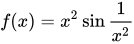
    • The function Indefinite Integral and Antiderivative: Properties, Table of Integrals, Rules and Methods of Integration (with Indefinite Integral and Antiderivative: Properties, Table of Integrals, Rules and Methods of Integration also set) has a finite derivative Indefinite Integral and Antiderivative: Properties, Table of Integrals, Rules and Methods of Integration on the interval Indefinite Integral and Antiderivative: Properties, Table of Integrals, Rules and Methods of Integration, so the function Indefinite Integral and Antiderivative: Properties, Table of Integrals, Rules and Methods of Integration has an antiderivative (namely, Indefinite Integral and Antiderivative: Properties, Table of Integrals, Rules and Methods of Integration), but Indefinite Integral and Antiderivative: Properties, Table of Integrals, Rules and Methods of Integration is unbounded on Indefinite Integral and Antiderivative: Properties, Table of Integrals, Rules and Methods of Integration and therefore is not Riemann integrable.

The Indefinite Integral

Definition

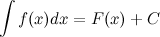
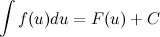
The set of all antiderivatives of a function Indefinite Integral and Antiderivative: Properties, Table of Integrals, Rules and Methods of Integration defined on a given interval is called the indefinite integral of the function Indefinite Integral and Antiderivative: Properties, Table of Integrals, Rules and Methods of Integration and is denoted by the symbol Indefinite Integral and Antiderivative: Properties, Table of Integrals, Rules and Methods of Integration. That is,

Indefinite Integral and Antiderivative: Properties, Table of Integrals, Rules and Methods of Integration

The sign Indefinite Integral and Antiderivative: Properties, Table of Integrals, Rules and Methods of Integration is called the integral sign, Indefinite Integral and Antiderivative: Properties, Table of Integrals, Rules and Methods of Integration is the integrand expression, Indefinite Integral and Antiderivative: Properties, Table of Integrals, Rules and Methods of Integration is the integrand, and Indefinite Integral and Antiderivative: Properties, Table of Integrals, Rules and Methods of Integration is the variable of integration.

The operation of finding an antiderivative or the indefinite integral of a function Indefinite Integral and Antiderivative: Properties, Table of Integrals, Rules and Methods of Integration is called integration of the function Indefinite Integral and Antiderivative: Properties, Table of Integrals, Rules and Methods of Integration. Integration is the operation inverse to differentiation.

Geometric Interpretation of the Indefinite Integral

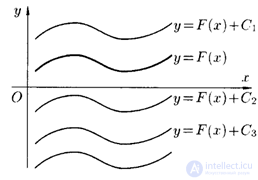
The indefinite integral is a family of parallel curves Indefinite Integral and Antiderivative: Properties, Table of Integrals, Rules and Methods of Integration, where each specific numerical value of the constant Indefinite Integral and Antiderivative: Properties, Table of Integrals, Rules and Methods of Integration corresponds to a particular curve of this family.
Indefinite Integral and Antiderivative: Properties, Table of Integrals, Rules and Methods of Integration

The graph of each curve in the family is called an integral curve.

Theorem

Every function that is continuous on an interval Indefinite Integral and Antiderivative: Properties, Table of Integrals, Rules and Methods of Integration has an antiderivative on this interval.

Properties of the Indefinite Integral

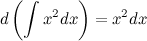
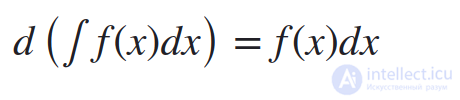
1. The differential of an indefinite integral is equal to the integrand expression
Indefinite Integral and Antiderivative: Properties, Table of Integrals, Rules and Methods of Integration

Example

Indefinite Integral and Antiderivative: Properties, Table of Integrals, Rules and Methods of Integration

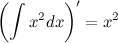
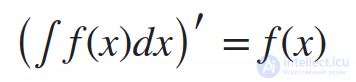
2. The derivative of an indefinite integral is equal to the integrand
Indefinite Integral and Antiderivative: Properties, Table of Integrals, Rules and Methods of Integration

Example

Indefinite Integral and Antiderivative: Properties, Table of Integrals, Rules and Methods of Integration

3. The indefinite integral of the differential of a function is equal to that function plus an arbitrary constant

Indefinite Integral and Antiderivative: Properties, Table of Integrals, Rules and Methods of Integration

Example

Indefinite Integral and Antiderivative: Properties, Table of Integrals, Rules and Methods of Integration

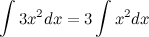
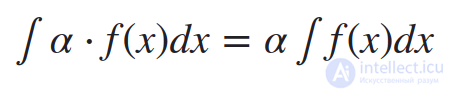
4. A constant factor can be taken out of the indefinite integral sign or brought under the integral sign
Indefinite Integral and Antiderivative: Properties, Table of Integrals, Rules and Methods of Integration

Example

Indefinite Integral and Antiderivative: Properties, Table of Integrals, Rules and Methods of Integration

5. The indefinite integral of the sum/difference of two or more functions is equal to the sum/difference of the indefinite integrals of those functions

Indefinite Integral and Antiderivative: Properties, Table of Integrals, Rules and Methods of Integration

Example

Indefinite Integral and Antiderivative: Properties, Table of Integrals, Rules and Methods of Integration

6. If Indefinite Integral and Antiderivative: Properties, Table of Integrals, Rules and Methods of Integration, then Indefinite Integral and Antiderivative: Properties, Table of Integrals, Rules and Methods of Integration as well, where the function Indefinite Integral and Antiderivative: Properties, Table of Integrals, Rules and Methods of Integration is an arbitrary function with a continuous derivative.

Example

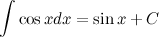
It is known that Indefinite Integral and Antiderivative: Properties, Table of Integrals, Rules and Methods of Integration, and then
Indefinite Integral and Antiderivative: Properties, Table of Integrals, Rules and Methods of Integration

Integration Techniques Methods of Integration List of Integrals of Elementary Functions

Finding antiderivatives is considerably harder than finding derivatives. There are several methods for it:

  • the linearity of integration allows complex integrals to be broken into parts,
  • integration by substitution, often used together with trigonometric identities or the natural logarithm,
  • integration by parts for handling products of functions,
  • the reverse chain rule method, a special case of integration by parts,
  • the method of integrating rational fractions makes it possible to integrate any rational function (fractions with polynomials in the numerator and denominator),
  • the Risch algorithm, an algorithm for integrating any elementary functions,
  • some integrals can be found in a table of integrals,
  • for multiple integration, additional techniques can be used; for example, see the double integral and polar coordinates, the Jacobian and Stokes' theorem,
  • computer algebra systems help automate some of the symbolic operations above (in particular the Risch algorithm), which is very convenient when algebraic computations become too cumbersome,
  • if a function has no elementary antiderivative (such as, for example, Indefinite Integral and Antiderivative: Properties, Table of Integrals, Rules and Methods of Integration), its integral can be computed approximately using numerical integration.

Table of Integrals, Table of Indefinite Integrals

In the table of integrals we have tried to gather the most complete collection of formulas, which will help you solve any integral. The constant companions of the table of integrals are the table of derivatives and the derivative formulas, which are also presented in full on our website.
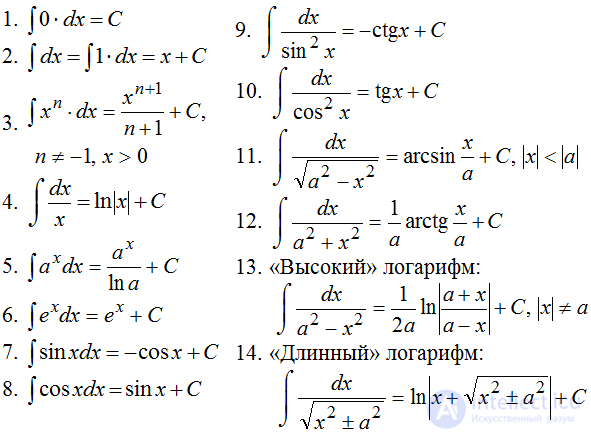
Basic Formulas

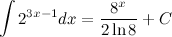
Indefinite Integral and Antiderivative: Properties, Table of Integrals, Rules and Methods of Integration

Methods for Solving Indefinite Integrals

1. The Method of Direct Integration

Reduction to tabular form or the method of direct integration. Using identity transformations of the integrand, the integral is reduced to one to which the basic rules of integration apply and the table of basic integrals can be used.

Example

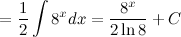
Problem. Find the integral Indefinite Integral and Antiderivative: Properties, Table of Integrals, Rules and Methods of Integration

Solution. We will use the properties of the integral and reduce the given integral to tabular form.

Indefinite Integral and Antiderivative: Properties, Table of Integrals, Rules and Methods of Integration

Indefinite Integral and Antiderivative: Properties, Table of Integrals, Rules and Methods of Integration

Answer. Indefinite Integral and Antiderivative: Properties, Table of Integrals, Rules and Methods of Integration

The Method of Direct Integration

Definition

An integration method in which, by means of identity transformations of the integrand and application of the properties of the integral, the integral is reduced to one or several tabular integrals is called direct integration.

Thus, the algorithm is as follows:

  1. identity transformation of the integrand;
  2. application of the properties of the indefinite integral: taking the constant out of the integral sign, and representing the integral of a sum of functions as a sum of integrals;
  3. use of the table of integrals.

In the simplest examples, to apply direct integration it is enough to decompose the integrand into terms and take the constant quantities out of the integral sign.

With some practice in integration, these steps are usually carried out mentally, writing down only the result of the integration.

2. Introducing a Function Under the Differential Sign

In the formula for the indefinite integral, the quantity Indefinite Integral and Antiderivative: Properties, Table of Integrals, Rules and Methods of Integration means that the differential of the variable Indefinite Integral and Antiderivative: Properties, Table of Integrals, Rules and Methods of Integration is taken. Some properties of the differential can be used to complicate the expression under the differential sign and thereby simplify finding the integral itself. The following formula is used for this

Indefinite Integral and Antiderivative: Properties, Table of Integrals, Rules and Methods of Integration

If the required function Indefinite Integral and Antiderivative: Properties, Table of Integrals, Rules and Methods of Integration is absent, it can sometimes be produced by algebraic transformations.

Integration by Introducing a Function Under the Differential

Suppose we need to find the indefinite integral Indefinite Integral and Antiderivative: Properties, Table of Integrals, Rules and Methods of Integration. Assume that there exist differentiable functions Indefinite Integral and Antiderivative: Properties, Table of Integrals, Rules and Methods of Integration and Indefinite Integral and Antiderivative: Properties, Table of Integrals, Rules and Methods of Integration such that

Indefinite Integral and Antiderivative: Properties, Table of Integrals, Rules and Methods of Integration

Then

Indefinite Integral and Antiderivative: Properties, Table of Integrals, Rules and Methods of Integration

This transformation of the integrand expression is called introducing a function under the differential sign.

Then, if Indefinite Integral and Antiderivative: Properties, Table of Integrals, Rules and Methods of Integration and Indefinite Integral and Antiderivative: Properties, Table of Integrals, Rules and Methods of Integration, the following equality holds:

Indefinite Integral and Antiderivative: Properties, Table of Integrals, Rules and Methods of Integration

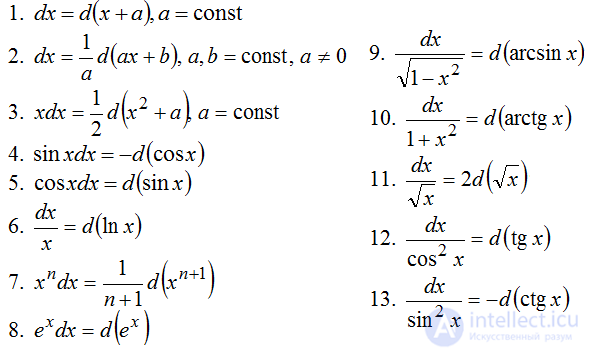
Remark. When integrating by introducing a function under the differential sign, the following differential equalities are useful:
Indefinite Integral and Antiderivative: Properties, Table of Integrals, Rules and Methods of Integration

Example

Problem. Using the introduction of a function under the differential, find the indefinite integral Indefinite Integral and Antiderivative: Properties, Table of Integrals, Rules and Methods of Integration

Solution. We introduce Indefinite Integral and Antiderivative: Properties, Table of Integrals, Rules and Methods of Integration under the differential sign, thereby reducing the original integral to a tabular one.

Indefinite Integral and Antiderivative: Properties, Table of Integrals, Rules and Methods of Integration

Indefinite Integral and Antiderivative: Properties, Table of Integrals, Rules and Methods of Integration

Answer. Indefinite Integral and Antiderivative: Properties, Table of Integrals, Rules and Methods of Integration

In general form, the following equality holds:

Indefinite Integral and Antiderivative: Properties, Table of Integrals, Rules and Methods of Integration

Example

Problem. Find the integral Indefinite Integral and Antiderivative: Properties, Table of Integrals, Rules and Methods of Integration

Solution. We introduce Indefinite Integral and Antiderivative: Properties, Table of Integrals, Rules and Methods of Integration under the differential sign, thereby reducing the original integral to a tabular one.

Indefinite Integral and Antiderivative: Properties, Table of Integrals, Rules and Methods of Integration

Indefinite Integral and Antiderivative: Properties, Table of Integrals, Rules and Methods of Integration

Answer. Indefinite Integral and Antiderivative: Properties, Table of Integrals, Rules and Methods of Integration

3. Integration by Change of Variable

Integration by change of variable, or the substitution method. Let Indefinite Integral and Antiderivative: Properties, Table of Integrals, Rules and Methods of Integration, where the function Indefinite Integral and Antiderivative: Properties, Table of Integrals, Rules and Methods of Integration has a continuous derivative Indefinite Integral and Antiderivative: Properties, Table of Integrals, Rules and Methods of Integration, and there is a one-to-one correspondence between the variables Indefinite Integral and Antiderivative: Properties, Table of Integrals, Rules and Methods of Integration and Indefinite Integral and Antiderivative: Properties, Table of Integrals, Rules and Methods of Integration. Then the following equality holds

Indefinite Integral and Antiderivative: Properties, Table of Integrals, Rules and Methods of Integration

An integral depends on the variable of integration, so if a change of variables has been made, it is essential to return to the original variable of integration.

Integration by Change of Variable

The essence of this method is that a new variable of integration is introduced or, equivalently, a substitution is made. After that, the integral given in the problem is reduced either to a tabular integral or to one that reduces to it.

If in the indefinite integral Indefinite Integral and Antiderivative: Properties, Table of Integrals, Rules and Methods of Integration we make the substitution Indefinite Integral and Antiderivative: Properties, Table of Integrals, Rules and Methods of Integration, where the function Indefinite Integral and Antiderivative: Properties, Table of Integrals, Rules and Methods of Integration is a function with a continuous first derivative, then Indefinite Integral and Antiderivative: Properties, Table of Integrals, Rules and Methods of Integration and, by property 6 of the indefinite integral, we have:

Indefinite Integral and Antiderivative: Properties, Table of Integrals, Rules and Methods of Integration

This formula is called the formula for change of variable in an indefinite integral.

Remark

After finding the integral in the new variable Indefinite Integral and Antiderivative: Properties, Table of Integrals, Rules and Methods of Integration, it is necessary to return to the original variable Indefinite Integral and Antiderivative: Properties, Table of Integrals, Rules and Methods of Integration.

Remark

In some cases it is advisable to make the substitution Indefinite Integral and Antiderivative: Properties, Table of Integrals, Rules and Methods of Integration, and then

Indefinite Integral and Antiderivative: Properties, Table of Integrals, Rules and Methods of Integration

Example

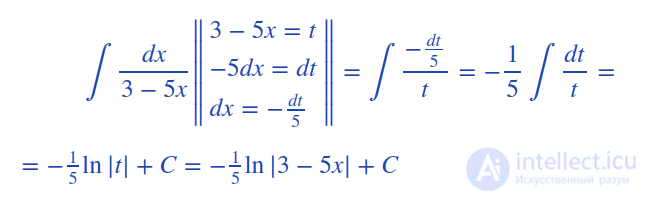
Problem. Find the integral Indefinite Integral and Antiderivative: Properties, Table of Integrals, Rules and Methods of Integration

Solution. We replace the denominator with the variable Indefinite Integral and Antiderivative: Properties, Table of Integrals, Rules and Methods of Integration and reduce the original integral to a tabular one.

Indefinite Integral and Antiderivative: Properties, Table of Integrals, Rules and Methods of Integration

Indefinite Integral and Antiderivative: Properties, Table of Integrals, Rules and Methods of Integration

Answer. Indefinite Integral and Antiderivative: Properties, Table of Integrals, Rules and Methods of Integration

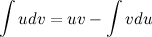
4. Integration by Parts Is Integration Using the Formula

Indefinite Integral and Antiderivative: Properties, Table of Integrals, Rules and Methods of Integration

When finding the function Indefinite Integral and Antiderivative: Properties, Table of Integrals, Rules and Methods of Integration from its differential Indefinite Integral and Antiderivative: Properties, Table of Integrals, Rules and Methods of Integration, any value of the constant of integration Indefinite Integral and Antiderivative: Properties, Table of Integrals, Rules and Methods of Integration can be taken, since it does not appear in the final result. Therefore, for convenience, we will take Indefinite Integral and Antiderivative: Properties, Table of Integrals, Rules and Methods of Integration .

Using the integration by parts formula is advisable in cases where differentiation simplifies one of the factors, while integration does not complicate the other.

The Method of Integration by Parts

Consider the functions Indefinite Integral and Antiderivative: Properties, Table of Integrals, Rules and Methods of Integration and Indefinite Integral and Antiderivative: Properties, Table of Integrals, Rules and Methods of Integration, which have continuous derivatives. By the properties of differentials, the following equality holds:

Indefinite Integral and Antiderivative: Properties, Table of Integrals, Rules and Methods of Integration

Integrating the left and right sides of the last equality, we obtain:

Indefinite Integral and Antiderivative: Properties, Table of Integrals, Rules and Methods of Integration

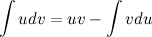
We rewrite the resulting equality in the form:
Indefinite Integral and Antiderivative: Properties, Table of Integrals, Rules and Methods of Integration

This formula is called the integration by parts formula. With its help, the integral Indefinite Integral and Antiderivative: Properties, Table of Integrals, Rules and Methods of Integration can be reduced to finding the integral Indefinite Integral and Antiderivative: Properties, Table of Integrals, Rules and Methods of Integration, which may be simpler.

Example

Problem. Find the integral Indefinite Integral and Antiderivative: Properties, Table of Integrals, Rules and Methods of Integration

Solution. In the original integral we identify the functions Indefinite Integral and Antiderivative: Properties, Table of Integrals, Rules and Methods of Integration and Indefinite Integral and Antiderivative: Properties, Table of Integrals, Rules and Methods of Integration, and then perform integration by parts.

Indefinite Integral and Antiderivative: Properties, Table of Integrals, Rules and Methods of Integration

Indefinite Integral and Antiderivative: Properties, Table of Integrals, Rules and Methods of Integration

Answer. Indefinite Integral and Antiderivative: Properties, Table of Integrals, Rules and Methods of Integration

See Also

  • Derivative
  • Differential
  • Integral
created: 2014-08-16
updated: 2026-09-29
1041


Was this answer useful?
Choose a quick rating so we can improve the next answer for you.
How satisfied are you?


Comments

To leave a comment

If you have any suggestion, idea, thanks or comment, feel free to write. We really value feedback and are glad to hear your opinion.
To reply

Lectures and tutorial on "Mathematical analysis. Integral calculus"

Terms: Mathematical analysis. Integral calculus