
Lecture 24 min.
A thought experiment is a mental exercise in which a person imagines a situation, event or problem and analyzes it within their mind, without actually carrying out an experiment in reality. It is a powerful tool for exploring hypothetical situations, analyzing problems, and even creating art. Thought experiments can be useful for solving a variety of tasks and for developing creativity.
A thought experiment in biology, physics, philosophy and some other fields of knowledge is a kind of cognitive activity in which a situation key to a given scientific theory is played out not in a real experiment but in the imagination. A thought experiment in physics often resembles a proof of a theorem by contradiction in mathematics, when some proposition of a physical model or scheme is first rejected, and then, by transforming the model, we arrive at a contradiction with some principle that is considered unconditionally true. For example, the principle of insufficient reason in a situation of mirror or some other geometric symmetry, the principle of Galilean invariance, the principle of the impossibility of a perpetual motion machine, the principle of causality, and so on.
In the scientific world, thought experiments are an important part of the scientific method. Scientists often use them to develop hypotheses and test theories before carrying out actual experiments. For example, Albert Einstein used thought experiments in his theory of relativity to investigate the behavior of light and gravity under various conditions. These experiments in the mind helped him arrive at revolutionary discoveries in physics.
Examples of a thought experiment include Darwin's demon, proposed by Isaac Asimov, and Levinthal's paradox.
The history of mechanics in modern times begins with several classic thought experiments of Galileo Galilei. These include the thought experiment with a room on a ship (while in a room on a ship, we cannot by any means determine whether the ship is moving or standing still); thought experiments with a pendulum and the so-called "Galileo's hills" (inclined planes); and the thought experiment with falling bodies (if a heavy body A falls faster than a light body B, as Aristotle believed, how will a body composed of these two bodies fall? The light body should slow down the heavy one, so the body A+B will lag behind body A. But on the other hand, body A+B is heavier than body A, so it will overtake it: a contradiction).
Brilliant thought experiments in mechanics were invented by Simon Stevin (equilibrium on an inclined plane, hydrostatic equilibrium) and Christiaan Huygens (the motion of bodies under the influence of impact, the determination of the reduced length of a physical pendulum).
The history of thermodynamics is also rich in thought experiments, beginning with Sadi Carnot's work Reflections on the Motive Power of Fire and on Machines Fitted to Develop That Power. In this treatise, thought experiments with an ideal Carnot heat engine were considered, which showed that the maximum efficiency of a heat engine does not depend on the working substance used in it and is determined only by the temperatures of the heater and the cooler.
The thought experiments of Gustav Kirchhoff and Wilhelm Wien, related to the thermodynamics of radiation, are also well known.
A number of thought experiments underlie relativistic electrodynamics and general relativity. In particular, there is the thought experiment with "Einstein's elevator", which postulates the impossibility of a local experiment that would allow us to establish whether we are in an accelerating reference frame or in an external gravitational field (essentially illustrating the principle of equivalence of inertial and gravitational mass in general relativity), and Ehrenfest's paradox with a rotating disk.
In some cases a thought experiment reveals contradictions between a theory and "common sense", which is by no means always evidence that the theory is wrong. Many thought experiments are known in the form of so-called paradoxes. Thus, the famous twin paradox is, in essence, a thought experiment demonstrating the inapplicability of "common sense" in relativistic physics. In turn, the grandfather paradox is intended to show clearly the impossibility of time travel.
Among the well-known thought experiments in modern physics are the Boltzmann brain, Laplace's demon, Maxwell's demon and Schrödinger's cat.
In philosophy, thought experiments are used to analyze moral dilemmas, ethical questions and conceptual problems. For example, the well-known Trolley thought experiment is a situation in which a participant must decide whether to let a tram continue in order to save five people, or to switch the tracks and save five while killing one. This experiment helps philosophers explore ethical dilemmas and principles of justice.
In philosophy, thought experiments have been used since its very beginnings, being closely intertwined with forecasting. In particular, when a student asked Confucius what he would do if he were called upon to govern a state, he answered with the idea of the rectification of names. Socrates also used thought experiments, for example in the famous dilemma about death in the Apology of Socrates (let us imagine that death is eternal rest, but then it is not an evil; let us imagine that death is arriving where all people arrive, which means one can meet there many famous people with whom it would be extremely interesting to talk, but then it is not an evil either, and therefore death should not be feared) or in the reasoning about the idea of beauty in the Greater Hippias (imagine that you are one of the gods: would a woman seem more beautiful to you than a female ape seems to any human?).
Well-known examples of thought experiments in ancient philosophy also include Zeno's aporias ("Stadium", "Achilles and the Tortoise", "Arrow"), which demonstrate the logical inconsistency of notions of the continuity of space and time.
The best-known argument of modern times built on thought experiments is Pascal's wager. Also having great influence on the subsequent development of philosophy and science, and still retaining it, are Roko's basilisk, the Chinese room, Mary's room, the brain in a vat, the infinite monkey theorem, the philosophical zombie, and Russell's teapot.
In the 20th century, thought experiments that assess possible behavioral choices within a given situation became extremely popular in philosophy, psychology and behavioral economics. The best-known such experiment became the ethical trolley problem, to which many other tasks involving the choice of optimal behavior are in fact reducible. Today, thought experiments of this kind, in the form of multiple-choice tests, are used for research in the creation of software for self-driving cars.
Literature and art are also saturated with thought experiments. Writers and artists create worlds, characters and stories using their imaginative potential. The reader or viewer enters the author's world, exploring it mentally, traveling through time and space, and experiencing the emotions and feelings of the characters. This allows us to delve into diverse lives and worlds that we might never experience in reality.
Developing creativity: Thought experiments can develop creativity and imagination. They help improve the ability to solve problems and to find alternative solutions.
Testing hypotheses: In scientific work, thought experiments allow scientists to assess the potential results of research in advance, saving time and resources.
Ethics and morality: Thought experiments help people analyze ethical questions and situations, which contributes to the development of a sense of responsibility and empathy.
Developing intellect: Regular practice of thought experiments promotes the development of cognitive skills such as analysis, logic and abstract thinking.
Thought experiments can lead to very important and varied views on previously unknown or unrecognized theories. However, they can also make those theories themselves irrelevant and possibly create new problems that are just as hard, and possibly even harder, to solve.
In terms of practical application, thought experiments are usually created in order to:
Generally speaking, there are seven types of thought experiments, in which one reasons from causes to effects or from effects to causes:
Prefactual (before-the-fact) thought experiments – the term "prefactual" was coined by Lawrence J. Sanna in 1998 – reflect on possible future outcomes given the present, and ask: "What will the outcome be if event E occurs?"
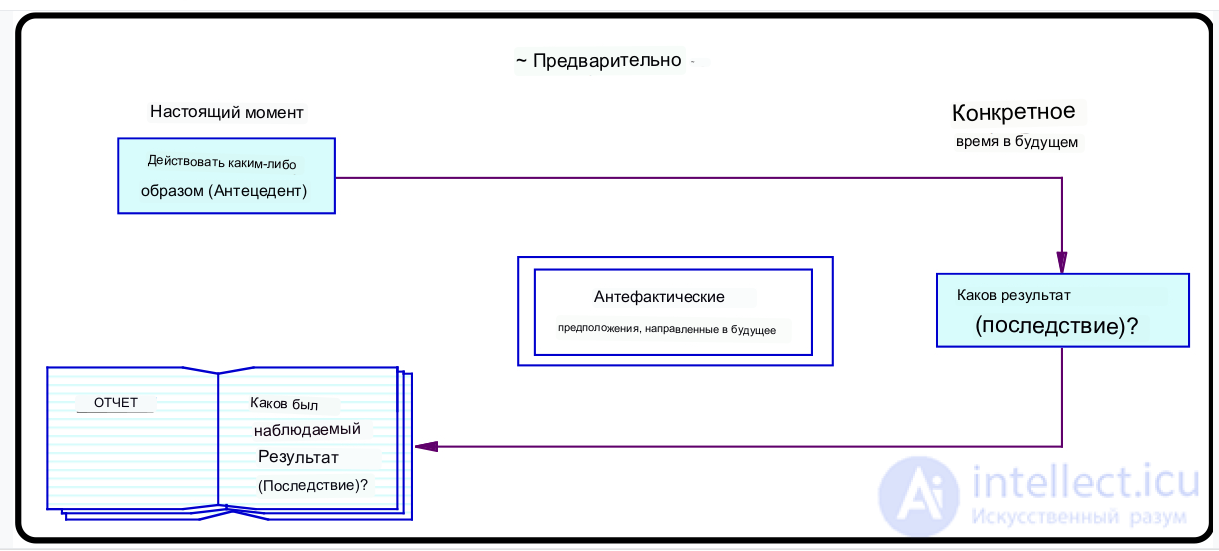
Timeline representation of a prefactual thought experiment.
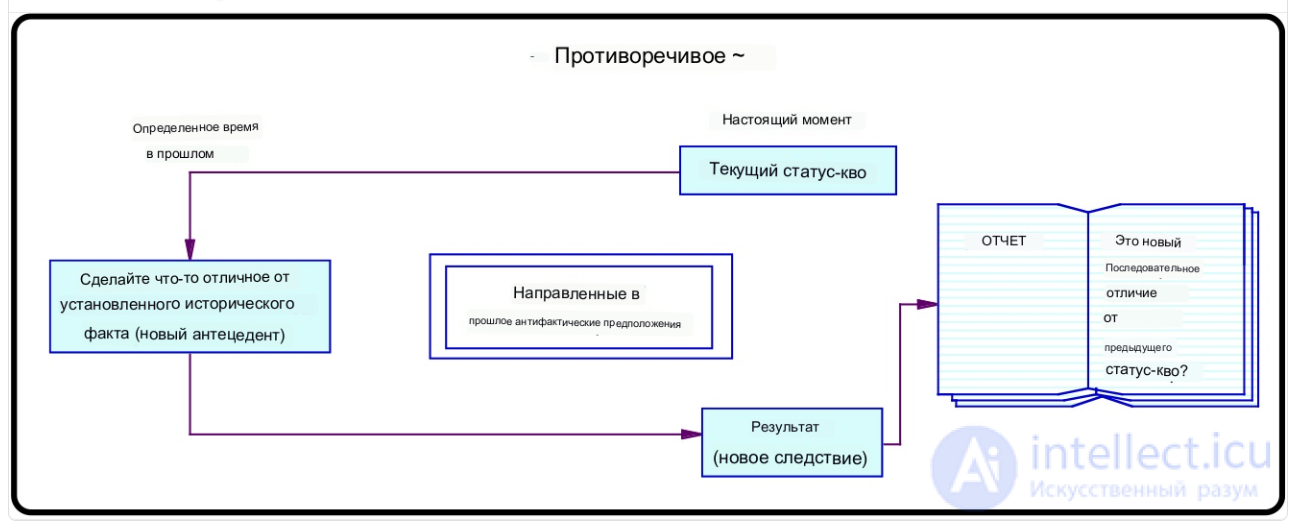
Timeline representation of a counterfactual thought experiment.
Counterfactual (contrary-to-established-fact) thought experiments – the term "counterfactual" was coined by Nelson Goodman in 1947, extending Roderick Chisholm's (1946) notion of a "contrary-to-fact conditional" – reflect on the possible outcomes of a different past; and ask: "What might have happened if A had occurred instead of B?" (for example: "If Isaac Newton and Gottfried Leibniz had collaborated with each other, what would mathematics look like today?").
The study of counterfactual speculation is attracting growing interest from scholars in a wide range of fields, such as philosophy, psychology, cognitive psychology, history, political science , economics , social psychology, law, organizational theory, marketing, and epidemiology.
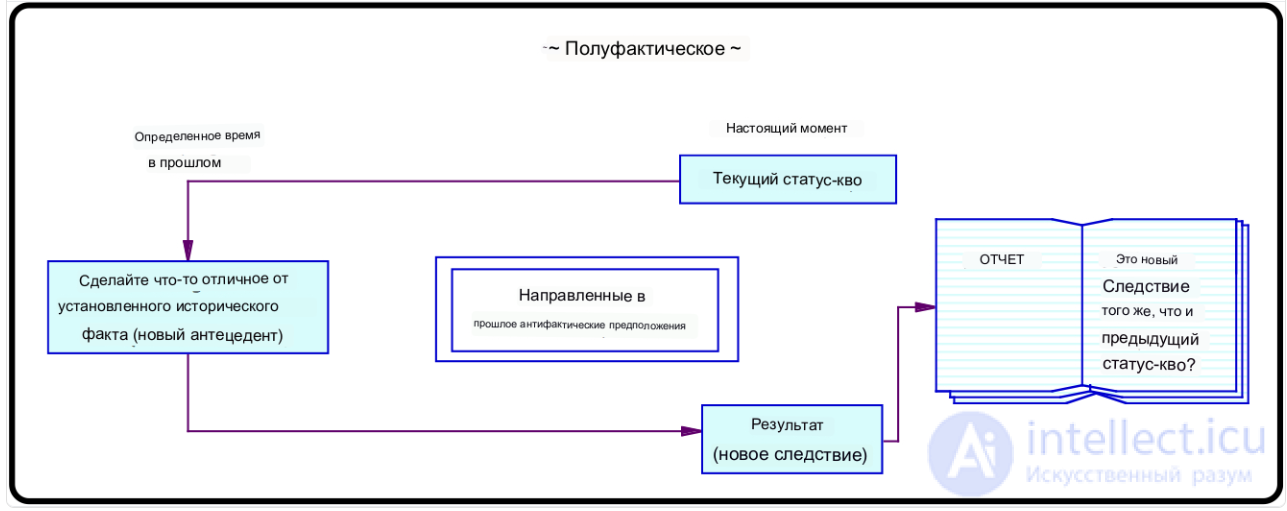
Timeline representation of a semifactual thought experiment.
Semifactual thought experiments – the term "semifactual" was coined by Nelson Goodman in 1947 – reflect on the extent to which things could have remained the same despite the past having been different; and ask: Even if X had occurred instead of E, would Y have occurred? (for example, even if the goalkeeper had moved to the left rather than the right, could he have intercepted a ball flying at such a speed?).
Semifactual suppositions are an important part of clinical medicine.
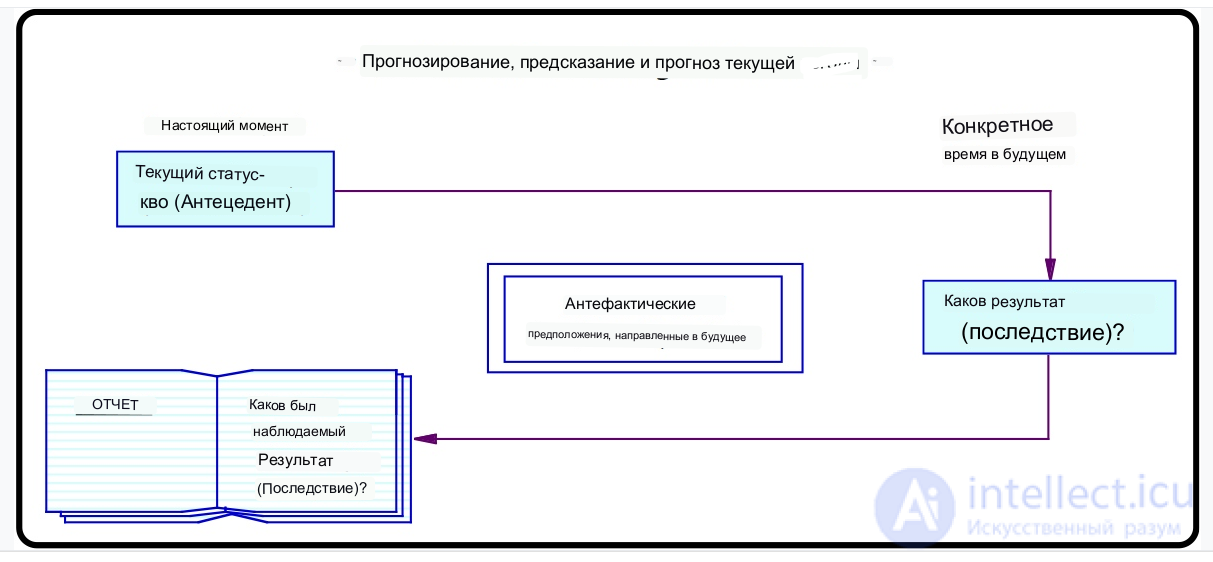
Timeline representation of predictions, forecasts and nowcasts of current weather.
Predictive activity attempts to project the circumstances of the present into the future. According to David Sarewitz and Roger Pielke (1999, p. 123), scientific prediction takes two forms:
Although they serve different social and scientific functions, the only difference between the qualitatively identical activities of prediction , forecasting and nowcasting is the distance of the envisaged future from the present moment occupied by the user. Although nowcasting, defined as "a detailed description of the current weather along with forecasts obtained by extrapolation up to 2 hours ahead", is essentially concerned with describing the current state of affairs, it is common practice to extend the term "to cover very-short-range forecasting up to 12 hours ahead" (Browning, 1982, ).
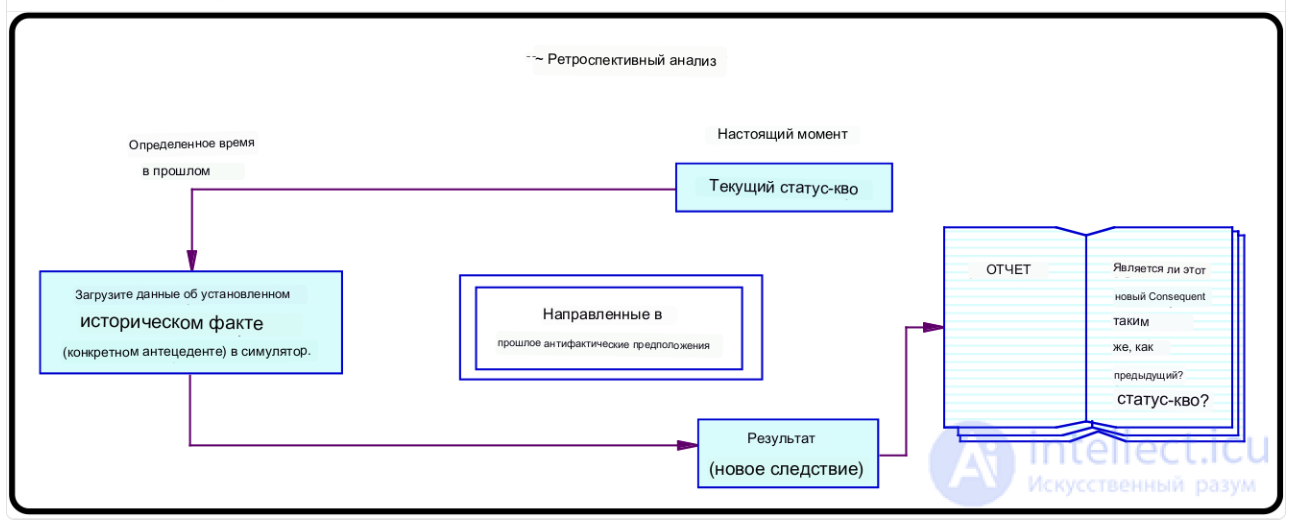
Timeline representation of hindcasting.
Hindcasting activity involves running a forecast model after an event has occurred, in order to test whether the model's simulation is valid.
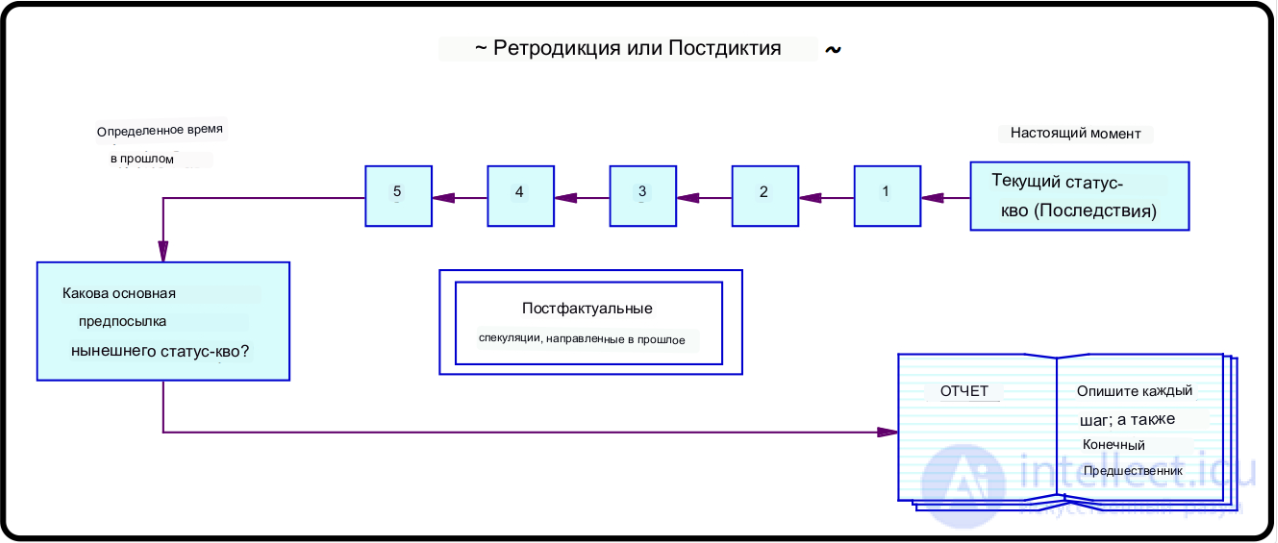
Timeline representation of retrodiction or postdiction.
The activity of retrodiction (or postdiction ) involves moving backward in time, step by step, through as many stages as are considered necessary, from the present to a supposed past, in order to establish the ultimate cause of a particular event (for example, reverse engineering . and forensics ).
Given that retrodiction is a process in which "past observations, events, additions and data are used as evidence to infer the process(es) that produced them", and that diagnosis "involves such visible effects as symptoms, signs and the like in their antecedent causes", the essential balance between prediction and retrodiction can be characterized as:
whether it is a prognosis of the course of a disease in the absence of treatment or of the application of a specific treatment regimen for a specific disorder in a specific patient.
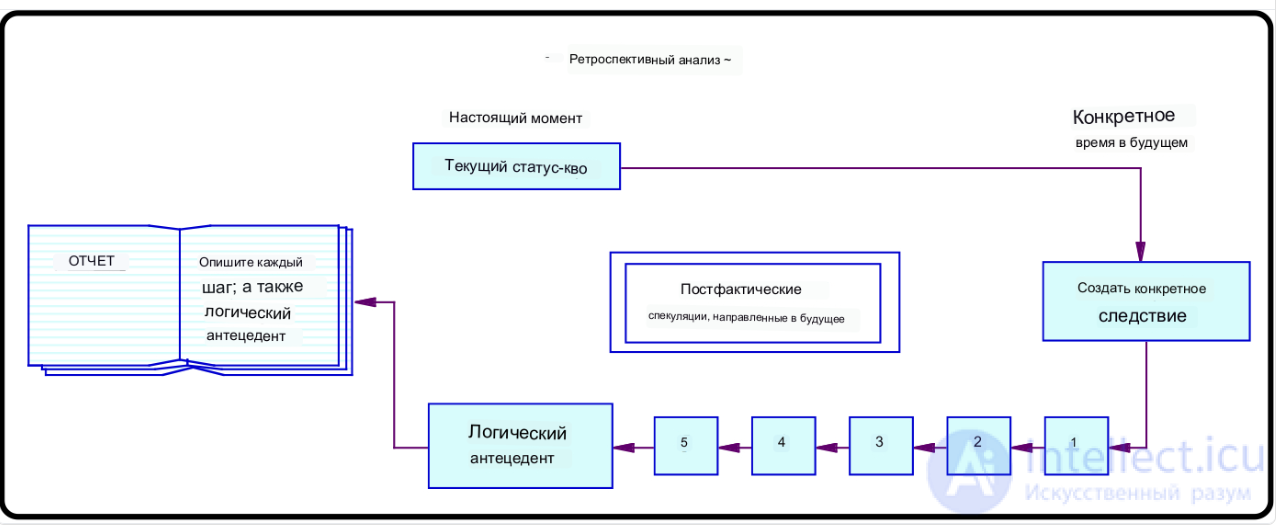
The temporal representation of backcasting.
The activity of backcasting (the term "backcasting" was coined by John Robinson in 1982 ) involves creating a description of a very definite and very specific future situation. It then involves imaginatively moving backward in time, step by step, through as many stages as are considered necessary, from the future to the present, to reveal the mechanism by which that particular future could be reached from the present.
Backcasting is not concerned with predicting the future:
The main distinguishing feature of backcasting analysis is a concern not with the likely future of energy, but with how a desired future can be attained. It is thus explicitly a normative approach , involving "working backward" from a particular future end point to the present in order to determine what policy measures would be required to reach that future.
According to Jansen
In technological development, "forecasting" is concerned with extrapolating events into the future and investigating the achievements that technology could make possible in the long term. Conversely, the case for "backcasting" is this: on the basis of a coherent picture of the requirements that technology must meet in the future – "sustainability criteria" – to guide and define the process that technological development must go through, and possibly also the pace at which this development process must begin to take effect. Backcasting [is] both an important aid in determining the direction of technological development and in defining the goals that need to be set for this purpose. As such,
The ancient Greek δείκνυμι , deiknymi , "thought experiment", "was the most ancient pattern of mathematical proof " and predated Euclidean mathematics , where the emphasis was on the conceptual, rather than the experimental, part of thought experiment.
Johannes Witt-Hansen established that Hans Christian Ørsted was the first to use the term Gedankenexperiment (from German : "thought experiment") around 1812. Ørsted was also the first to use the equivalent term Gedankenversuch in 1820.
By 1883, Ernst Mach was using the term "thought experiment" in a different way, to denote exclusively the imaginary conduct of a real experiment that would subsequently be performed by his students as a real physical experiment . One could then contrast physical and mental experiments: Mach asked his students to give him explanations whenever the results of their subsequent real physical experiment differed from those of the earlier imaginary experiment.
The English term "thought experiment" was coined (as a calque ) from Mach's "Gedankenexperiment" and first appeared in the English translation of one of Mach's papers in 1897. Before its appearance, the activity of posing hypothetical questions using subjunctive reasoning had existed for a very long time (among both scientists and philosophers). Counterfactual conditionals are ways of classifying it or talking about it. This helps explain the extremely broad and varied range of application of the term "thought experiment" after its appearance in English.
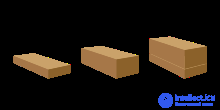
Galileo's thought experiment concerned the result (c) of attaching a small stone (a) to a larger one (b).
Galileo's demonstration that falling objects must fall at the same rate regardless of their mass was a significant step forward in the history of modern science. It is widely believed that this was a simple physical demonstration involving climbing the Leaning Tower of Pisa and dropping two weights from it, whereas in fact it was a logical demonstration using the technique of the "thought experiment". The "experiment" is described by Galileo in the "Discorsi e dimostrazioni matematiche" (1638) (from Italian "Discourses and Mathematical Demonstrations") as follows:
Salviati . If then we take two bodies whose natural speeds are different, it is clear that on uniting the two, the more rapid one will be partly held back by the slower, and the slower will be somewhat hastened by the swifter. Do you not agree with me in this opinion?
Simplicio . You are unquestionably right.
Salviati . But if this is true, and if a large stone moves with a speed of, say, eight while a smaller one moves with a speed of four, then when they are united, the system will move with a speed of less than eight; but the two stones when tied together make a stone larger than that which previously moved with a speed of eight. Hence the heavier body moves with less speed than the lighter; an effect which is contrary to your supposition. Thus you see how, from your assumption that the heavier body moves faster than the lighter one, I infer that the heavier body moves more slowly.
Further categorization of thought experiments can be made according to specific properties.
In many thought experiments, the scenario will be nomologically possible, or possible according to the laws of nature. John Searle's Chinese room is nomologically possible .
Some thought experiments present scenarios that are nomologically impossible. In his Twin Earth thought experiment, Hilary Putnam asks us to imagine a scenario in which there is a substance with all of the observable properties of water (for example, taste, color, boiling point), but which is chemically different from water . It has been argued that this thought experiment is nomologically impossible, although it may be possible in some other sense, such as metaphysically . Whether the nomological impossibility of a thought experiment renders intuitions about it dubious remains a matter of dispute.
In some cases, the hypothetical scenario may be regarded as metaphysically impossible, or impossible in any sense at all. David Chalmers says that we can imagine zombies, or people who are physically identical to us in every respect but who lack consciousness. This is supposed to show that physicalism is false. However, some argue that zombies are inconceivable: we can no more imagine a zombie than we can imagine that 1+1=3. Others have argued that the conceivability of a scenario does not necessarily entail its possibility.
The first characteristic pattern that thought experiments display is their orientation in time. It is either:
The second characteristic pattern is their movement in time relative to the "point of view of the present moment" of the person conducting the experiment; namely, in terms of:
The relation to real experiments can be quite complex, as is again seen in an example going back to Albert Einstein. In 1935, together with two colleagues, he published a paper on a newly emerging topic, later called the EPR effect ( EPR paradox ). In this paper, starting from certain philosophical assumptions, on the basis of a rigorous analysis of a certain, complicated, but nevertheless purportedly realizable model, he arrived at the conclusion that quantum mechanics should be called "incomplete" . Niels Bohr immediately produced a rebuttal of Einstein's analysis, and his view prevailed. Several decades later, it was claimed that feasible experiments could prove the EPR paper wrong. These experiments tested Bell's inequalities , published in 1964 in a purely theoretical paper. The above-mentioned philosophical starting assumptions of EPR were considered falsified by empirical facts (for example, the real optical experiments of Alain Aspect ).
Thus, thought experiments belong to a theoretical discipline, usually theoretical physics , but often also theoretical philosophy . In any case, they should be distinguished from a real experiment, which naturally belongs to an experimental discipline and has the "final decision as to the truth or falsity ", at least in physics.
Thought experiments can also be interactive, when the author invites people into their thought process by offering alternative paths with alternative outcomes in the narrative, or through interaction with a programmed machine, such as a computer program.
With the advent of the Internet, digital space has become a new medium for a new type of thought experiment. For example, the philosophical work of Stefano Gualeni focuses on using virtual worlds to materialize thought experiments and to discuss philosophical ideas in a playful way. His arguments were originally presented in his book "Virtual Worlds as Philosophical Tools" .
Gualeni's argument is that the history of philosophy until recently has been simply the history of written thought, and that digital media can supplement and enrich the limited and almost exclusively linguistic approach to philosophical thought. He considers virtual worlds philosophically viable and advantageous in contexts such as thought experiments, where the recipients of a particular philosophical notion or point of view are expected to objectively test and evaluate different possible courses of action, or in cases where they face questions concerning non-actual or nonhuman phenomenologies.
Thought experiments are a powerful means of cognition and development. They allow us to explore new ideas, understand the world around us, and expand the horizons of our minds. Whether you use them to solve complex scientific problems, analyze ethic

Comments