
Lecture 12 min.
A mathematical object is an abstract concept arising in mathematics. A mathematical object is an abstract object defined and studied in mathematics (or in the philosophy of mathematics).
Examples: a number, a set, a function, a triangle, a group, a cube, an order relation.
As a rule, a mathematical object can be a value that can be assigned to a symbol , and therefore can be included in formulas . Commonly encountered mathematical objects include numbers , expressions , shapes , functions and sets . Mathematical objects can be very complex; for example, theorems , proofs and even theories are treated as mathematical objects in proof theory .
In the philosophy of mathematics, the notion of "mathematical objects" touches on the topics of existence , identity and the nature of reality . In metaphysics, objects are often regarded as entities that have properties and can stand in various relations to one another. Philosophers debate whether mathematical objects exist independently of human thought ( realism ) or whether their existence depends on mental constructions or language ( idealism and nominalism ). Objects can range from concrete ones : for example, physical objects, usually studied in applied mathematics , to abstract ones studied in pure mathematics . What constitutes an "object" is fundamental to many areas of philosophy, from ontology (the study of being) to epistemology (the study of knowledge). In mathematics, objects are often regarded as entities that exist independently of the physical world , which raises questions about their ontological status. There are various schools of thought that offer different points of view on this question, and many well-known mathematicians and philosophers hold different opinions about which of them is more correct.
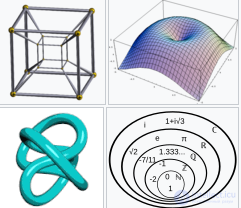
From left to right, top to bottom: a tesseract, or four-dimensional hypercube, the graph of a binary function , a trefoil ( a type of mathematical knot ) and the general hierarchy of number sets
In modern mathematics the following conventions are accepted:
The origin of mathematical objects can vary.
In applied mathematics, the main task is to create an adequate mathematical model of the natural object under study. A model is a set of mathematical objects whose properties and interrelations should reflect the real behavior of the natural object .
The Quine-Putnam indispensability argument is an argument for the existence of mathematical objects, based on their unreasonable effectiveness in the natural sciences . Every branch of science relies heavily on large and often quite different areas of mathematics. From physics' use of Hilbert spaces in quantum mechanics and differential geometry in general relativity, to biology's use of chaos theory and combinatorics (see mathematical biology ), mathematics not only helps with predictions , it gives these fields an elegant language for expressing these ideas. Moreover, it is hard to imagine how fields such as quantum mechanics and general relativity could have developed without help from mathematics, and so it can be argued that mathematics is indispensable to these theories. It is because of this unreasonable effectiveness and indispensability of mathematics that the philosophers Willard Quine and Hilary Putnam argue that we should believe that the mathematical objects on which these theories depend really exist, that is, we should have an ontological commitment to them. The argument is described by the following syllogism :
( Premise 1) We ought to have ontological commitment to all and only the entities that are indispensable to our best scientific theories.
(Premise 2) Mathematical entities are indispensable to our best scientific theories.
( Conclusion ) We ought to have ontological commitment to mathematical entities.
This argument resonates with a philosophy of applied mathematics called naturalism (or sometimes predicativism) , which holds that the only authoritative standards of existence are those of science .
Plato, as depicted in Raphael Santi's painting "The School of Athens".
Platonism holds that mathematical objects are regarded as real, abstract entities that exist independently of human thought , often in some Platonic realm . Just as there are physical objects , such as electrons and planets, so there are numbers and sets. And just as statements about electrons and planets are true or false because these objects have completely objective properties , so there are statements about numbers and sets. Mathematicians discover these objects rather than invent them. (See also: Mathematical Platonism )
Some well-known Platonists include:
Nominalism denies the independent existence of mathematical objects. Instead, it holds that they are merely convenient fictions or shorthand for describing relations and structures in our language and theories. According to this view, mathematical objects do not exist beyond the symbols and concepts that we use.
Some well-known nominalists include:
Logicism holds that all mathematical truths can be reduced to logical truths , and that all the objects that make up the subject matter of these branches of mathematics are logical objects. In other words, mathematics is essentially a branch of logic , and all mathematical concepts, theorems and truths can be derived from purely logical principles and definitions. Logicism ran into problems, especially with Russell's axioms, the axiom of multiplicativity (now called the axiom of choice ) and his axiom of infinity , and later with the discovery of Gödel's incompleteness theorems , which showed that any sufficiently powerful formal system (like those used to express arithmetic ) cannot be both complete and consistent . This meant that not all mathematical truths could be derived solely from a logical system, which undermined the logicist program.
Some well-known logicists include:
Mathematical formalism treats objects as symbols in a formal system . The main attention is paid to manipulating these symbols according to given rules, rather than to the objects themselves. One common understanding of formalism regards mathematics not as a body of propositions representing an abstract part of reality, but as something much more like a game, bringing with it no more ontological commitment to objects or properties than playing ludo or chess . From this point of view, mathematics is concerned with the consistency of formal systems, rather than the discovery of already existing objects. Some philosophers consider logicism a variety of formalism.
Some well-known formalists include:
Mathematical constructivism holds that in order to prove that an example exists, it is necessary to find (or "construct") a specific example of the mathematical object. In contrast, in classical mathematics one can prove the existence of a mathematical object without explicitly "finding" that object, by assuming its non-existence and then deriving a contradiction from that assumption. Such a proof by contradiction can be called non-constructive, and a constructivist may reject it. The constructive point of view includes a verificationist interpretation of the existential quantifier , which contradicts its classical interpretation. There are many forms of constructivism. These include the program of intuitionism founded by Brouwer , the finitism of Hilbert and Bernays , the constructive recursive mathematics of the mathematicians Shanin and Markov , and Bishop's program of constructive analysis . Constructivism also includes the study of constructive set theories, such as constructive Zermelo–Fraenkel theory, as well as the study of philosophy.
Structuralism holds that mathematical objects are defined by their place in a structure or system. The nature of a number, for example, is not connected with any particular thing, but with its role in the system of arithmetic . In a sense, the thesis is that mathematical objects (if such objects exist) simply have no intrinsic nature.
Some well-known structuralists include:
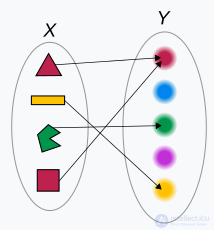
In mathematics, a map or mapping is a function in the general sense; here it is like the association of each of the four colored shapes in X with its color in Y.
Frege drew a famous distinction between functions and objects . According to his view, a function is a kind of "incomplete" entity that maps arguments to values and is denoted by an incomplete expression, whereas an object is a "complete" entity and can be denoted by a singular term. Frege reduced properties and relations to functions, and therefore these entities are not included among objects. Some authors use Frege's notion of "object" when discussing abstract objects. But although understanding Frege's "object" is important, it is not the only way this term is used. Other philosophers include properties and relations among abstract objects. And when the background context for a discussion of objects is type theory , properties and relations of higher type (for example, properties of properties and properties of relations) can all be counted as "objects". This latter use of "object" is interchangeable with "entity". It is this broader interpretation that mathematicians have in mind when they use the term "object".

Comments