
Lecture
Cryptographic methods of information protection are a powerful weapon in the fight for information security.
Cryptography (from Ancient Greek κρυπτος – hidden and γραϕω – I write) – the science of methods for ensuring the confidentiality and authenticity of information.
Cryptography is a set of methods for transforming data aimed at making that data useless to an attacker. Such transformations make it possible to solve two main problems concerning information security:
The problems of protecting the confidentiality and integrity of information are closely related, so methods for solving one of them are often applicable to solving the other.
Various approaches to classifying methods of cryptographic information transformation are known. By the type of effect on the original information, methods of cryptographic information transformation can be divided into four groups:
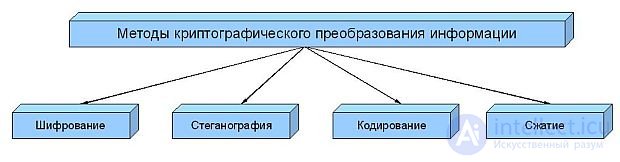
Fig. 2.1. Classification of methods of cryptographic information transformation
The process of encryption consists in performing reversible mathematical, logical, combinatorial and other transformations of the original information, as a result of which the encrypted information becomes a chaotic set of letters, digits, other characters and binary codes.
Encrypting information requires a transformation algorithm and a key. As a rule, the algorithm for a given encryption method remains unchanged. The input data for the encryption algorithm are the information to be encrypted and the encryption key. The key contains control information that determines the choice of transformation at certain steps of the algorithm and the values of the operands used in implementing the encryption algorithm. An operand – is a constant, variable, function, expression or other programming-language object on which operations are performed.
Unlike other methods of cryptographic information transformation, steganography methods make it possible to hide not only the meaning of the stored or transmitted information but also the very fact that closed information is being stored or transmitted. All steganography methods are based on masking closed information among open files, i.e. secret data are hidden while realistic data are created that cannot be distinguished from genuine data. The processing of multimedia files in information systems has opened up practically unlimited possibilities for steganography.
Graphic and audio information are represented in numeric form. Thus, in graphic objects the smallest picture element can be coded by a single byte. Bits of the hidden file are placed in the low-order bits of certain image bytes in accordance with the cryptographic transformation algorithm. If the transformation algorithm and the image in which the hidden file is placed are chosen correctly, it is practically impossible for the human eye to distinguish the resulting image from the original one. Steganographic tools can be used to mask text, images, speech, digital signatures, and encrypted messages.
The hidden file can also be encrypted. If someone happens to discover the hidden file, the encrypted information will be perceived as a system malfunction. The combined use of steganography and encryption multiplies the difficulty of detecting and uncovering confidential information.
The content of the coding process is replacing the original meaning of a message (words, sentences) with codes. Combinations of letters, digits, and symbols can be used as codes. Coding and the reverse transformation use special tables or dictionaries. In information networks, coding of the original message (or signal) by hardware and software means is used to increase the reliability of the transmitted information.
Coding and encryption are often mistakenly treated as one and the same thing, forgetting that recovering a coded message requires only knowledge of the replacement rule, whereas decrypting a message requires, besides knowledge of the encryption rules, a key to the cipher.
Compression of information can be classed among the methods of cryptographic information transformation, with certain reservations. The purpose of compression is to reduce the volume of information. At the same time, compressed information cannot be read or used without the reverse transformation. Given the availability of compression and decompression tools, these methods cannot be regarded as reliable means of cryptographic information transformation. Even if the algorithms are kept secret, they can be comparatively easily uncovered by statistical processing methods. Therefore, compressed files of confidential information are subjected to subsequent encryption. To reduce data transmission time, it is advisable to combine the processes of compression and encryption of information.
The main type of cryptographic information transformation in computer networks is encryption. Encryption is understood as the process of transforming open information into encrypted information (ciphertext), or the reverse process of transforming encrypted information into open information. The process of transforming open information into closed information is called encipherment, and the process of transforming closed information into open information – decipherment.
Over the centuries-long history of using encryption of information, humanity has devised a great many encryption methods, or ciphers. A method of encryption (a cipher) is a set of reversible transformations of open information into closed information in accordance with an encryption algorithm. Most encryption methods have not stood the test of time, while some are still used today. The advent of computers and computer networks initiated the development of new ciphers that take into account the possibilities of using computer technology both for encrypting/decrypting information and for attacking a cipher. An attack on a cipher (cryptanalysis, a crypto-attack) – is the process of recovering closed information without knowledge of the key and, possibly, without any information about the encryption algorithm.
Modern encryption methods must satisfy the following requirements:
The cryptographic strength of a cipher is its main performance indicator. It is measured by the time or the cost of the resources a cryptanalyst needs to obtain the original information from the ciphertext, given that the key is unknown to them.
It is practically impossible to keep a widely used encryption algorithm secret. Therefore, the algorithm must not have hidden weaknesses that cryptanalysts could exploit. If this condition is met, the cryptographic strength of the cipher is determined by the key length, since the only way to break the encrypted information – is to search through key combinations and run the decryption algorithm. Thus, the time and resources spent on cryptanalysis depend on the key length and the complexity of the encryption algorithm.
The operation of a simple cryptosystem is illustrated in Fig. 2.2.
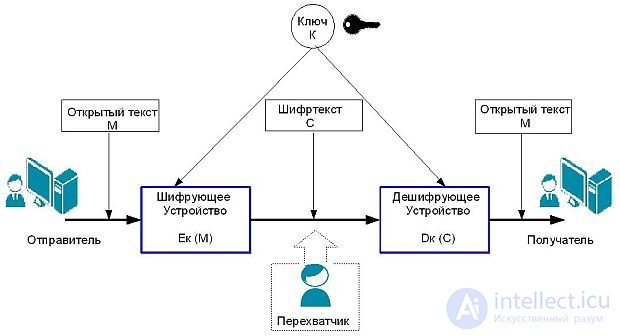
Fig. 2.2. Generalized diagram of a cryptographic system
The sender generates the plaintext of the original message M, which must be transmitted to the legitimate recipient over an unsecured channel. The channel is monitored by an interceptor whose aim is to intercept and disclose the transmitted message. So that the interceptor cannot learn the content of message M, the sender encrypts it using the reversible transformation Ek and obtains the ciphertext (or cryptogram) C=Ek(M) , which is sent to the recipient.
The legitimate recipient, upon receiving the ciphertext C, decrypts it using the inverse transformation Dk(C) and obtains the original message in the form of plaintext M.
The transformation Ek is chosen from a family of cryptographic transformations called crypto-algorithms. The parameter used to select a particular transformation is called the cryptographic key K.
A cryptosystem can be implemented in various ways: as a set of instructions, hardware, or a suite of programs that allow plaintext to be encrypted and ciphertext to be decrypted in various ways, one of which is selected by means of a specific key K.
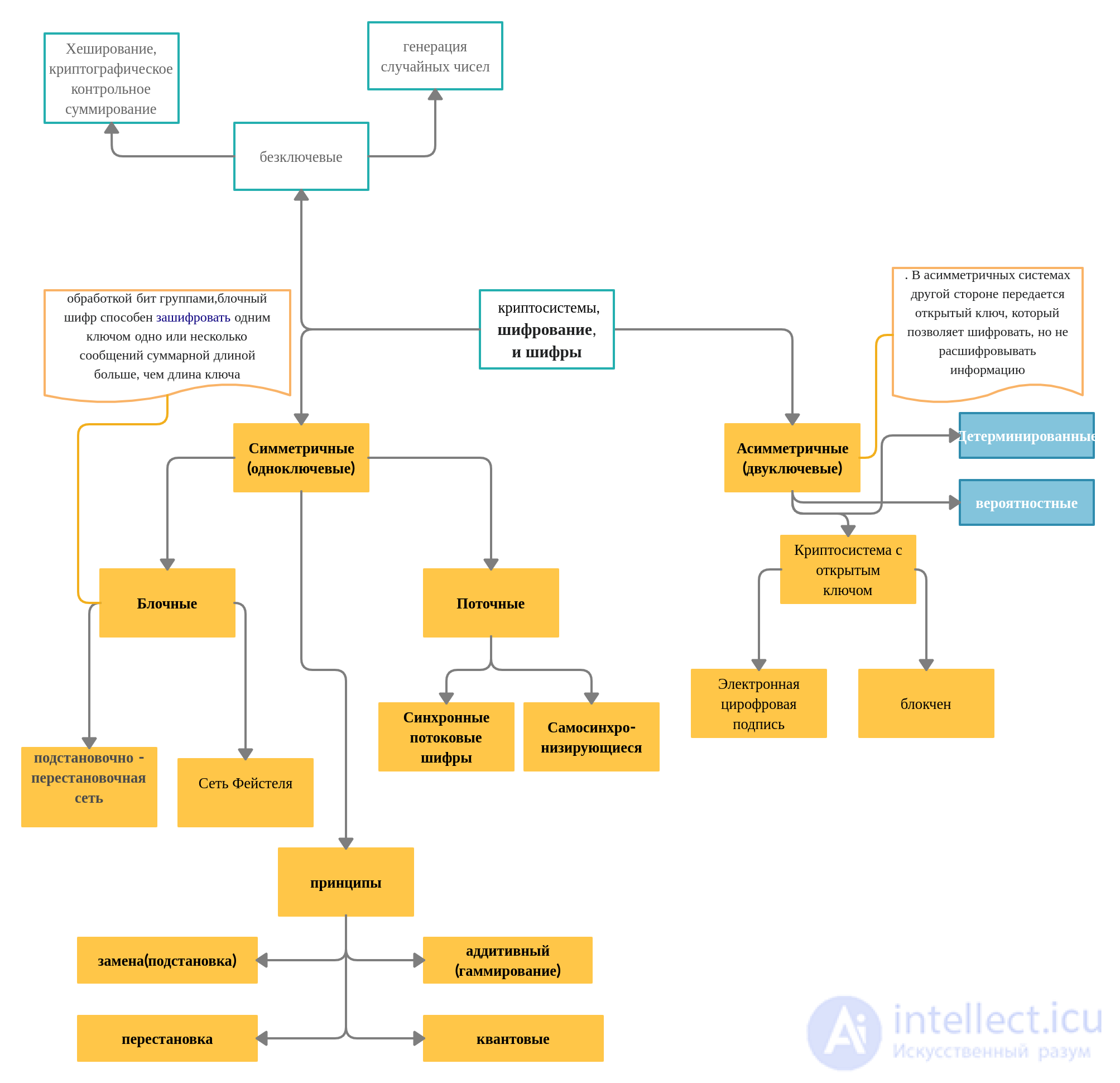
The encryption transformation can be symmetric or asymmetric with respect to the decryption transformation. This important property defines two classes of cryptosystems:
I. By field of application, ciphers are divided into limited-use and general-use ciphers.
The strength of limited-use ciphers is based on keeping the cryptographic transformation algorithm secret, owing to its vulnerability, the small number of keys, or the absence of keys altogether (secret code systems).
The strength of general-use ciphers is based on the secrecy of the key and the difficulty of guessing it faced by a potential adversary.
II. By the features of the encryption algorithm, general-use ciphers can be divided into the following types.
In single-key systems, the same key is used for encryption and decryption.
In transposition ciphers, all the letters of the plaintext remain in the cryptogram but change their positions. In substitution ciphers, conversely, the positions of the letters in the cryptogram remain the same as in the plaintext, but the plaintext characters are replaced with characters from another alphabet.
In additive ciphers, the letters of the alphabet are replaced with numbers, to which numbers from a secret random (pseudorandom) numeric sequence (the keystream) are then added, after which the remainder of division modulo a number is taken (the mod operation). If the original message and the keystream are represented in bit form, the logical operation “Exclusive OR” (XOR, addition modulo 2) is used for encryption and decryption.
Quantum cryptography introduces natural uncertainty of the quantum world into the encryption process. The sending and receiving of information is carried out by means of objects of quantum mechanics (for example, using electrons in an electric current or photons in fiber-optic communication lines). The most valuable property of this type of encryption is that, when a message is sent, the sending and receiving parties can, with fairly high probability, establish the fact that an adversary has intercepted the encrypted message.
In two-key systems, two completely different keys are used for encryption and decryption. In deterministic ciphers, encrypting the same message with the same key will always produce the same ciphertext. In probabilistic ciphers, an additional random quantity (number) is used in the encryption procedure - as a result, encrypting the same original message with the same key can produce different ciphertexts, which upon decryption yield the same result (the original message).
Combined (composite) methods involve using several methods at once to encrypt a message (for example, first replacing symbols and then permuting them).
III. By the number of message symbols (or their code replacement) encrypted or decrypted by a single-type transformation procedure, a distinction is made between:
- stream ciphers – the transformation procedure is applied to an individual symbol of the message;
- block ciphers – the transformation procedure is applied to a set (block) of message symbols.
A stream cipher can be distinguished from a block cipher by the following criterion - if, as a result of splitting the original message into individual elementary symbols and applying a single-type transformation procedure to them, the resulting cryptogram is equivalent to the one obtained by applying the transformation “as if to the entire original message at once”, then the cipher is a stream cipher; otherwise it is a block cipher.
IV. By strength, ciphers are divided into three groups:
- perfect (unconditionally secure, theoretically secure) – ciphers that are known in advance to be unbreakable (when used correctly). Cryptanalysis of the secret message leads to several equally probable meaningful plaintext messages;
- practically (computationally, sufficiently) secure – ciphers that cannot be broken in an acceptable time given the current or foreseeable level of computing technology. The practical strength of such systems is based on complexity theory and is assessed exclusively at a given point in time from two standpoints:
- the computational complexity of exhaustive search;
- currently known weaknesses (vulnerabilities) and their effect on computational complexity;
- weak ciphers.
There are several classifications of ciphers. Let us consider some of them.
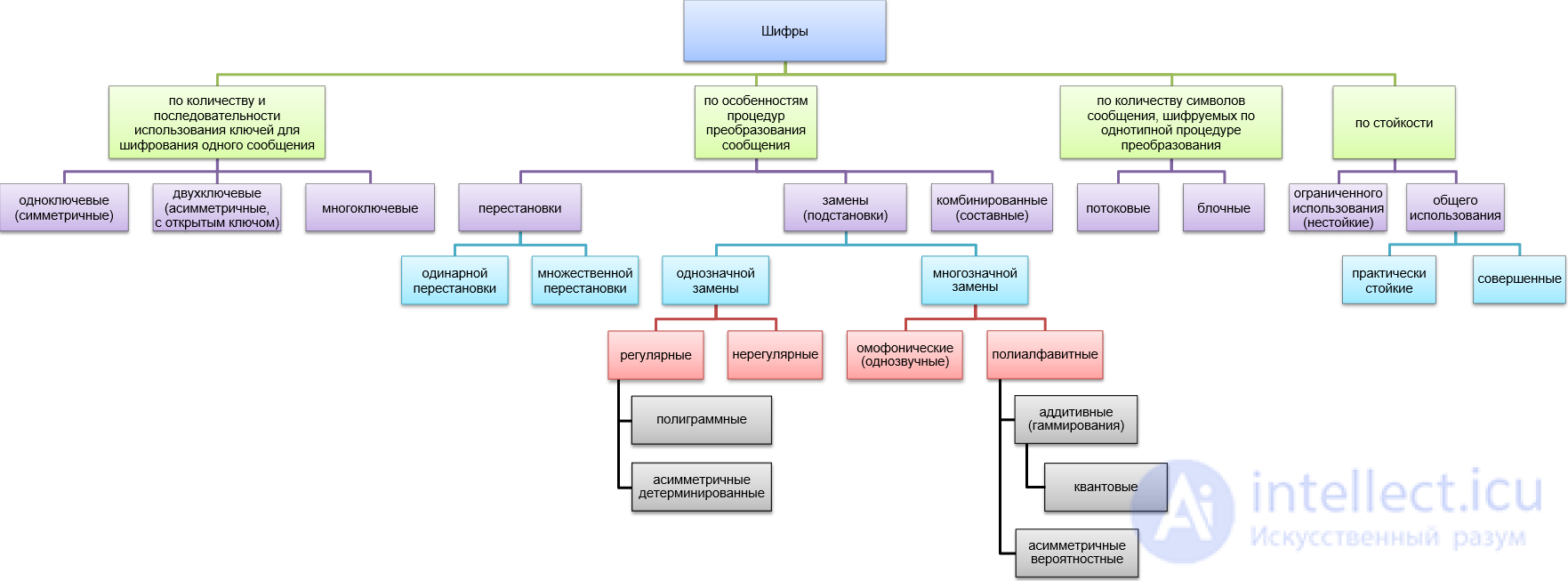
Fig. 3.1. Classification of ciphers
The figure shows, against a gray background, subgroups of ciphers that do not form a complete overlying group of ciphers but have found wide practical application and are described in this course of lectures.
The following table gives a brief description of the types of ciphers.
Table 3.1. Types of ciphers
| Type of cipher | Brief description | Examples of ciphers | |
| by the number and sequence of use of keys for encrypting a single message | |||
| single-key (symmetric) |
One (secret) key is used to encrypt and decrypt a single message. | Caesar cipher, keystream ciphers, DES-ECB, GOST 34.12-2015 |
|
| two-key (asymmetric, with a public key) |
One (public) key is used to encrypt a single original message, and another (private) key is used for decryption. When solving certain specific tasks (for example, generating and verifying a digital signature), the order of key use can be reversed. The public and private keys are related to each other through mathematical relations (functions). | RSA, ElGamal scheme |
|
| multi-key | Several independent transformation procedures are used to encrypt and decrypt a single message, each requiring the use of a separate independent (i.e. not logically or mathematically related to the others) key. During decryption, the order of the transformation procedures and key use is the reverse of that used for encryption. As a rule, multi-key ciphers are combined ciphers. | ADFGVX, 3DES |
|
| by the features of the message transformation procedures | |||
| transposition | To obtain the cryptogram, the symbols of the open message are moved to new positions. The alphabets for writing open messages and cryptograms coincide. | ||
| transposition | single transposition | During encryption, the symbols of the message are moved from their original positions to new ones a single time. | simple single transposition cipher, Scytale, columnar transposition cipher |
| multiple transposition | During encryption, the symbols of the message are moved from their original positions to new ones several times. | double transposition cipher | |
| substitution (replacement) |
During encryption, the positions of the symbols of the open message are preserved in the cryptogram, but they are replaced with symbols from another alphabet (letters, numbers, pictures, etc.). The alphabets for writing open messages and cryptograms may differ. | ||
| substitution | single-valued substitution (monoalphabetic, simple substitution) |
The number of cipher-substitutes M for each symbol or block of symbols of the original alphabet is equal to 1 (| Mi | = 1 for a given i-th symbol or block of symbols). | |
| single-valued substitution |
regular | Cipher-substitutes consist of an equal number of symbols or are separated from one another by a delimiter (a space, a period, a dash, etc.). | Caesar cipher, keyword cipher, prison cipher |
| regular | polygram | A cipher-substitute corresponds to a block of symbols of the original alphabet (| Mi | = 1 for a given i-th block of symbols). | Porta bigram cipher, Hill cipher |
| asymmetric deterministic |
Encrypting the same open message with the same public key will always produce the same cryptogram. That is, for a given public key, the same symbol (block of symbols) of the open message will always be represented by the same cipher-substitute. | RSA, knapsack-problem-based cipher |
|
| irregular | Cipher-substitutes consist of varying numbers of symbols written without delimiters. | combined cipher | |
| multi-valued substitution | The number of cipher-substitutes M for individual symbols or a block of symbols of the original alphabet is greater than 1 (| Mi | ≥ 1 for a given i-th symbol or block of symbols). | ||
| multi-valued substitution |
homophonic (same-sounding) |
Cipher-substitutes for different symbols or blocks of symbols of the original alphabet do not repeat (MI ∩ MJ = Ø for two different, i-th and j-th, symbols or blocks of symbols). | homophone system, book cipher |
| polyalphabetic (multi-alphabetic) |
Several alphabets of cipher-substitutes correspond to the original alphabet used for writing open messages. The choice of which cipher-substitute alphabet to use for encrypting a given symbol or block of symbols depends on the features of the cipher. The same cipher-substitute can be used for different symbols or blocks of symbols of the original alphabet (MI ∩ MJ ≠ Ø for two different, i-th and j-th, symbols or blocks of symbols). | Alberti disk, Vigenere system |
|
| polyalphabetic | additive (keystream-based) |
During encryption, the symbols of the original alphabet in the open message are replaced with numbers, to which numbers from a secret random numeric sequence (the keystream) are added, after which the remainder of division modulo a number is taken (the mod operation). | encryption by addition modulo N, Vernam cipher |
| quantum | A variety of keystream ciphers in which elementary particles (beams of elementary particles) are used as information carriers. | ||
| asymmetric probabilistic |
Encrypting the same open message with the same public key can produce different cryptograms. That is, for a given public key, the same symbol (block of symbols) of the open message can be represented by different cipher-substitutes. This is achieved through the use of a random quantity when encrypting a symbol (block of symbols), which is equivalent to switching among the cipher-substitute alphabets. | ElGamal scheme, elliptic-curve-based cipher |
|
| combined (composite) |
Several transformation procedures are used at once to encrypt a message (for example, substitution, transposition, and keystream XOR-ing are used simultaneously for encryption). | ADFGVX, AES, GOST 34.12-2015 |
|
| by the number of message symbols (or their code replacement) encrypted by a single-type transformation procedure (encryption or decryption) | |||
| stream | The transformation procedure is applied to an individual elementary symbol of the message. That is, if, as a result of splitting the original message into individual elementary symbols and applying a single-type encryption procedure to them, the individual resulting parts of the cryptogram can be assembled (“glued together”) into a single decryptable cryptogram, then the cipher is a stream cipher; otherwise it is a block cipher. | Caesar cipher, keystream ciphers, asymmetric ciphers*) |
|
| block | The transformation procedure is applied to a block of message symbols, including cases where the block is the entire message (for example, in some transposition ciphers). | transposition ciphers, DES, AES, GOST 34.12-2015, asymmetric ciphers*) |
|
| by strength | |||
| limited use | The strength of the cipher is based on keeping the cryptographic transformation algorithm secret, owing to its vulnerability or the small number of keys. Breaking the cipher (an individual cryptogram) is possible in an acceptable time. | Caesar cipher, columnar transposition cipher, DES-ECB |
|
| general use | The strength of the cipher is based on the secrecy of the key and the infeasibility of guessing it within an acceptable time for a potential adversary. | ||
| general use |
practically (computationally, sufficiently) secure |
Breaking the cipher (an individual cryptogram) in an acceptable time is impossible given the current or foreseeable level of computing technology. Practical strength is assessed exclusively at a given point in time from two standpoints: • the computational complexity of exhaustive or targeted search of the key space; • currently known weaknesses (vulnerabilities) and their effect on computational complexity. |
AES, GOST 34.12-2015, RSA |
| perfect (unconditionally secure, theoretically secure) |
Ciphers that are known in advance to be unbreakable (when used correctly). Cryptanalysis of the secret message leads to several equally probable meaningful plaintext messages. | keystream ciphers |
*) Some ciphers (asymmetric ones in particular) allow the transformation procedures to be carried out in either stream or block mode.

Comments