
Lecture
A quantum computer is a computing device that uses phenomena of quantum mechanics (quantum superposition, quantum entanglement) to transmit and process data. A quantum computer (unlike an ordinary one) operates not on bits (which can take the value of either 0 or 1), but on qubits, which have the values 0 and 1 simultaneously. In theory, this makes it possible to process all possible states at once, achieving a substantial advantage over ordinary computers in a number of algorithms.
A full-fledged universal quantum computer is still a hypothetical device, the very possibility of building which depends on serious development of quantum theory in the area of many-particle systems and complex experiments; work in this field is tied to the latest discoveries and achievements of modern physics. As of the end of the 2010s, only isolated experimental systems had been implemented in practice, executing fixed algorithms of low complexity.
The first practical high-level programming language for this type of computer is considered to be the language Quipper[en], based on Haskell).
In May 2017, as part of the IBM-Q project, IBM opened access to a new 16-qubit quantum processor.
IBM-Q is a commercial project that allows
third-party developers to work with a quantum
computer in the "cloud" through a special programming interface.
In the same year, at the International Conference
on Quantum Technologies in Moscow (ICQT-2017),
the creation of a 51-qubit quantum computer by a group from Harvard (USA)
University was announced.
In March 2018, Google announced the creation of a 72-qubit quantum chip,
Bristlecone.
Scientists from the University of Science and Technology of China
(Shanghai) have developed a new prototype of a quantum computing machine. In addition,
they promised to create a 30-qubit
quantum system in 2019 that will be able to compete with the most powerful "ordinary" computers. China is working on creating a quantum computer that surpasses modern counterparts in computing
speed. The news is
of great importance for the military sphere, where the possible use of quantum computers is discussed more and more often. And all the leading countries strive
to be the first to build such machines.
What is a quantum computer? What are the physical resources on which the high computational efficiency of a quantum computer is based? In what form does it manifest itself?
To answer these questions, let us turn to
the relevant information presented in modern scientific and technical publications devoted to the problems of designing and building quantum computing devices.
In a broad sense, a quantum computer is a
physical system whose states are described by the laws of the branch of physics called quantum mechanics.
A quantum computer is a device that implements quantum computation, by which is understood procedures of parallel multiple
operations that use specific properties of
states of quantum objects, such as:
An ion (qubit) can simultaneously take on certain percentage shares of the two values "0" and "1" — for example, 30% and 70%. When the result is read out, in this case the qubit has the value "1" with a probability of 70 percent. Advantage: quantum computers represent several binary values at the same time, although only with a certain probability.
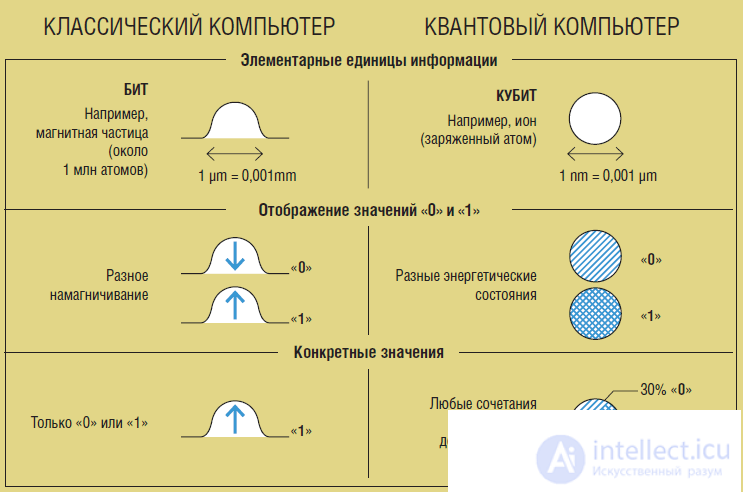 Entanglement
Several qubits can be, as it were, "locked" into a state common to all of them. In the example with three qubits, any combination of all possible combinations from "000" to "111" is possible, which is likewise represented only with a certain probability. Thus, as a rule, there cannot be a pure state "100" — it merely has a higher probability than all the others. Advantage: N qubits can process 2^N values simultaneously, so with 10 qubits there will already be 1024 of them.
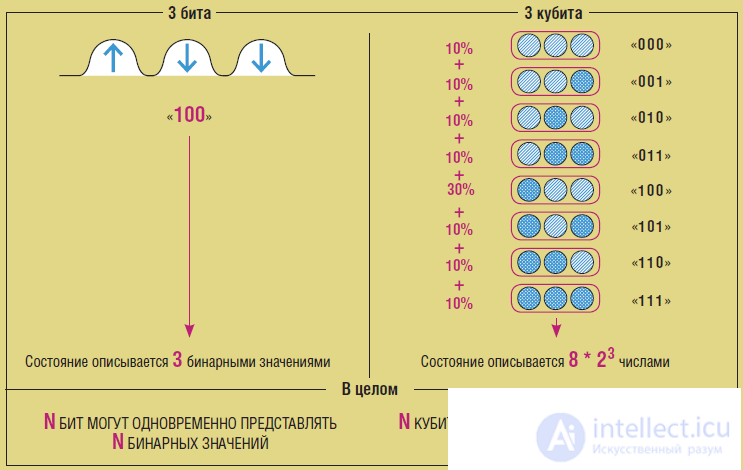
To induce the quantum phenomena of superposition and entanglement and to sustain them for as long as possible, the system must be shielded from external influences. For computation, the ion (qubit) is controlled by a directed laser pulse, which changes the state of all the entangled qubits.
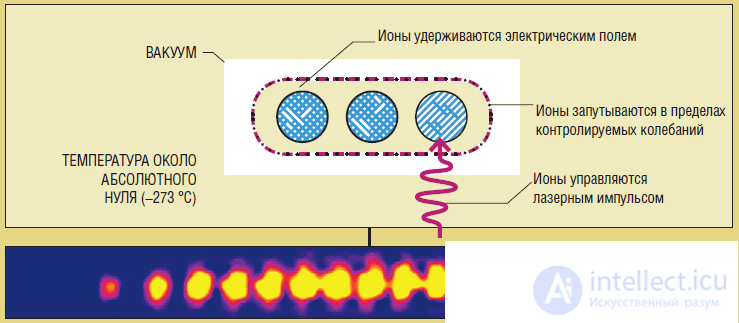
These properties define the physical resources of the same names on which the high computational efficiency of a quantum computer is based.
The high computational efficiency of a quantum computer manifests itself as the ability to perform unlimited parallel execution of
operations (the property of quantum parallelism) on
all admissible values of the parameters of the problem being solved. For example, if the task is to compute the values of some function for
all given values of the argument, then the solution of
this task for all values of the argument is carried out by a quantum computer in a single action
in the sense that one sequence of computational operations is applied at the same time to all values of the argument regardless of
their number. And as a result, one obtains
all possible values of the function. This is
a manifestation of the property of quantum parallelism in
the operation of quantum computing devices, leading to a substantial speedup of the computational process.
 in time
  .
. particles in almost linear time using
  qubits.
It has been shown that "quantum speedup" is not possible for every algorithm. Moreover, the possibility of obtaining a quantum speedup for an arbitrary classical algorithm is a great rarity.
The presence of the property of quantum parallelism constitutes one of the main advantages of quantum computers over classical
computers. What has been said may seem "overly scientific". This raises a natural question: is it possible, in principle, to get an idea of a quantum computer without presenting hard-to-grasp formulations of definitions of technical and abstract concepts and statements?
Indeed, the property of quantum parallelism, and hence the quantum computer, can be imagined by turning to the experiment with two slits, well known in
quantum mechanics, increasing in the reasoning the number of slits from two to the number needed in the case of the above example of computing the value of a function, up to the number of all admissible values of the argument).
In a certain approximation acceptable in the present situation, this experiment can be described as follows. Suppose we have a source of single photons (a "photon gun"), a screen (photographic film), and between them a barrier (a foil that reflects photons).
At first the barrier has no slits. We "fire one photon". There are no traces on the screen. In the second case we make one slit in the barrier, the screen has no traces, and we "fire one photon". As a result there is "one trace" on the screen. So the scientists say. The third time we make two slits in the barrier, the screen has no traces, and we "fire one photon" so that the slits are in front of the photon's wave front (let us recall the well-known principle of wave-particle duality, according to which a photon exhibits both the properties of a particle and the properties of a wave). One can say, according to the scientists, that there are "two traces" on the screen.
The fourth time there are three slits in the barrier, the screen has no traces, and we "fire one photon" so that the slits are in front of the photon's wave front.
One can say, according to the scientists, that there are "three traces" on the screen. And so on. The one thousand and first time there are a thousand slits in the barrier, the screen has no traces, and we "fire one photon" so that the slits are in front of the photon's wave front. And as a result one can say, according to the scientists, that there are "a thousand traces" on the screen.
From the above it follows, as the scientists say, that "the photon passes through all the slits simultaneously".
It should be noted that it is not by chance that we "nod" toward the scientists when speaking "about traces on the screen" and use quotation marks "liberally". In fact, the conclusions about the "traces" and their number are not the result of their direct observation and counting, but the result of analyzing the interference pattern on the screen, obtained after a "statistically significant" number of "bombardments" of the screen with single photons. That is one side of the matter. On the other side, the experiment described in scientific sources on quantum mechanics concerns only two slits.
Nevertheless, the model of a "photon passing through all the slits simultaneously" seems suitable for explaining the property of quantum parallelism.
What is the essence of the potential threat to the security of cryptographic information protection tools (CIPT) from the emergence of a quantum computer?
By analogy with a photon "passing through all the slits simultaneously", a quantum computer computes the values of a function for all admissible values of the argument at the same time, that is, to put it simply, "in one pass". The possibility of practical realization of such an event is vividly demonstrated, for example, by Shor's quantum algorithm for factoring natural numbers. Let us explain this statement. To do so, note that one of the first variants of the factorization problem, used in constructing asymmetric cryptographic systems, is as follows: a natural number n is known, equal to the product of two unknown prime numbers p and q; it is necessary to find the divisors p and q. The security of, for example, the asymmetric cryptographic system RSA is based on the difficulty of solving this problem. The stated difficulty of solving it with the best classical algorithm (the so-called number field sieve) on modern computers (called classical computers) is estimated as
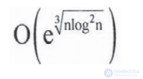
operations .
Shor's quantum algorithm makes it possible to solve the problem of factoring the number n with polynomial complexity
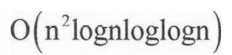 .
.
Therefore, with Shor's quantum algorithm and a quantum computer, it is potentially possible to "break" those cryptographic
systems (including RSA) whose security is based on the difficulty of factoring natural numbers.
At the same time, it must be taken into account that until recently the number of different general-purpose applied problems that can be solved on a quantum computer was somewhat over fifty. It might seem that this circumstance (that is, the small scope and slow growth of the field of application of quantum computers) could serve as a factor neutralizing to a certain degree (at least in the medium term) the possible threats from the emergence of a quantum computer. And such an assumption would seem justified to a certain extent, were it not for the
following alarming trend. Namely: recently, with each passing day, the number of applied problems that can be
solved on a quantum computer is growing. Scientists predict a real breakthrough in this direction in the near future, just as water, flowing over an overfilled dam, at first erodes only its upper edge slightly, and then, after a certain time has passed,
growing ever stronger, breaks and splits the dam's barrier, sweeping away everything else in its path. And this is the potential threat, arising from the emergence of a quantum computer, to all cryptographic information protection tools without exception that have a limited key length but are not theoretically secure.
The practical security of CIPT with a limited key length that are not theoretically secure is based on the practical impossibility of "breaking" them (unauthorized access to information materials protected by these CIPT) using modern computing technology, which, in contrast to quantum computers, is called classical computers. As an example, consider one of the
best-known and most universal methods of attacking cryptographic systems — the method of exhaustive key search (in the West this method is called the "brute-force method"). This method is simple to implement in hardware or software, but is computationally expensive to carry out in its classical form on classical computing devices when the key space of the attacked CIPT is sufficiently large.
However, this approach to ensuring security is useless when a quantum computer is used to attack CIPT that have a limited key length but are not theoretically secure. The reason for this is, first of all, the effective possibility of implementing the above-considered method of exhaustive key search on a quantum computer. This possibility is due to the fact that a quantum computer allows (in principle) all keys, all elements of the key space of the CIPT, to be tried simultaneously. And here we have the same analogy with a photon "passing through all the slits simultaneously". This is the potential threat to the security of CIPT from the emergence of a quantum computer.
In accordance with the above, the first and most obvious consequences of one country's creating a truly working quantum
computer would be the almost instantaneous breaking of an adversary's military and infrastructure encryption systems with a limited key length (and not theoretically secure). Moreover, in the opinion of American analysts, other countries are already actively stealing encrypted data from the United States. For now they simply store it without doing anything with it, since they expect that a quantum computer will be built in 5-10 years — and then they will gain access to secret
American information.
The speed of computation and data processing will also make it possible to significantly improve the operation of unmanned and robotic autonomous military machines, which will be entrusted with the mission of directly conducting combat operations in the foreseeable future. Put simply, the military robots of the country that first builds a quantum computer will make decisions faster, act more precisely, "work" on more
targets, "see" the whole battlefield better, and calculate "moves" further ahead than the adversary's robots. Which means they will win.
Against this background, the problem of decoherence of physical qubits looks like child's play, and the efforts aimed at solving it have been largely wasted.
There are also theoretical difficulties associated with emulating entangled states of a virtual register. To determine entanglement in the states of fermionic chains, researchers resort to tricks that do not fully solve the problem. One consequence was, for example, that the fermionic state |10⟩−|01⟩ was denied the right to be considered entangled on the grounds that this state is supposedly unphysical!
Conclusions
Quantum computers can also be used to design new types of weapons, new materials and new structures, to create artificial intelligence, to model space objects, and even to develop new strategies of warfare.
Forecasting is certainly within the scope of quantum computer applications. Ray Johnson, former chief technology officer of Lockheed Martin,
once said that "a quantum computer will
make it possible to predict how satellite
software will behave during a solar flare or
after a nuclear explosion."
The benefits of a possible implementation of quantum
computing for the military are obvious. That is why Russia, the USA, China, Canada, Japan, Israel and the countries of Europe are increasingly striving to take the lead in these developments.

Comments