
Lecture 24 min.
Cybernetics (from the Ancient Greek κυβερνητική, "the art of steering" ) is the science of the general laws governing the receipt, storage, transformation and transmission of information in complex control systems, whether machines, living organisms or society .
The term "cybernetics" was originally introduced into scientific use by Ampère, who in his fundamental work "Essay on the Philosophy of the Sciences, or an Analytical Exposition of a Natural Classification of All Human Knowledge" (the first part of which appeared in 1834 and the second in 1843) defined cybernetics as the science of governing the state, which should provide citizens with a variety of benefits. In the modern sense, as the science of the general laws of control processes and of information transmission in machines, living organisms and society, the term was first proposed by Norbert Wiener in 1948 .
Cybernetics includes the study of feedback, black boxes and derived concepts such as control and communication in living organisms, machines and organizations, including self-organization. It focuses on how something (digital, mechanical or biological) processes information, reacts to it, and changes or can be changed, in order to better accomplish the first two tasks . Stafford Beer called it the science of effective organization, and Gordon Pask broadened the definition to include information flows "from any source", ranging from the stars to the brain.
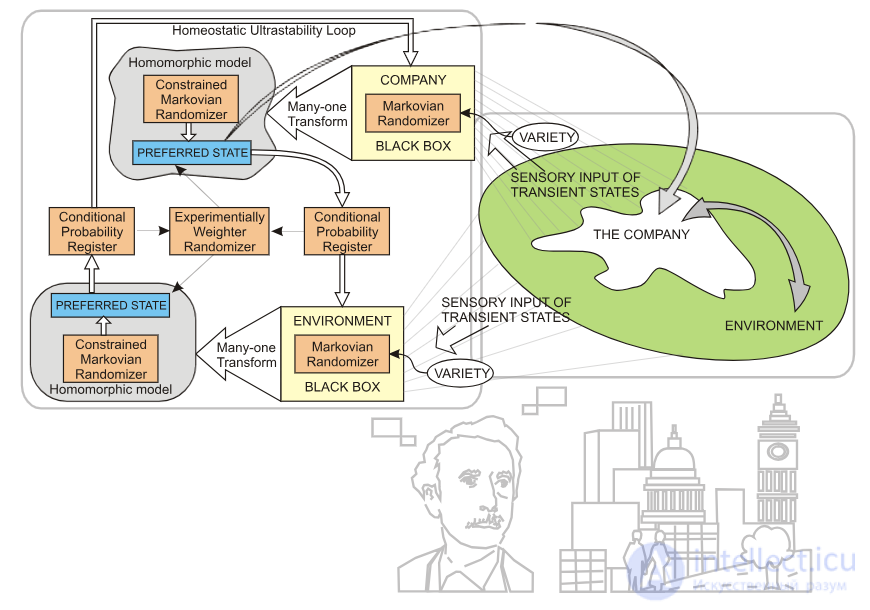
An example of cybernetic thinking. On the one hand, a company is viewed as a system within an environment. On the other hand, cybernetic management can itself be represented as a system.
According to another definition of cybernetics, proposed in 1956 by L. Couffignal , one of the pioneers of cybernetics, cybernetics is "the art of ensuring the efficacy of action" .
Another definition was proposed by Louis Kauffman : "Cybernetics is the study of systems and processes that interact with themselves and produce themselves from themselves."
According to Ozhegov's dictionary: "Cybernetics is the science of the general laws of control processes and information transmission in machines, living organisms and society" .
Cybernetic methods are applied when studying the case in which the action of a system in its environment causes some change in the environment, and this change is reflected back on the system through feedback, which causes changes in the system's mode of behavior. The study of these "feedback loops" is what the methods of cybernetics consist of.
Modern cybernetics arose by incorporating research in various fields of control systems, electrical circuit theory, mechanical engineering, mathematical modeling, mathematical logic, evolutionary biology, neurology and anthropology. This research appeared in the 1940s, mainly in the works of scientists at the so-called Macy conferences .
Other fields of study that influenced the development of cybernetics or came under its influence are: control theory, game theory, systems theory (the mathematical counterpart of cybernetics), psychology (especially neuropsychology, behaviorism and cognitive psychology) and philosophy.
The object of cybernetics is all controllable systems. Systems that cannot in principle be controlled are not objects of study in cybernetics. Cybernetics introduces such concepts as the cybernetic approach and the cybernetic system. Cybernetic systems are considered abstractly, regardless of their material nature. Examples of cybernetic systems are automatic regulators in engineering, computers, the human brain, biological populations and human society. Each such system is a set of interconnected objects (system elements) capable of perceiving, storing and processing information, as well as exchanging it. Cybernetics develops general principles for building control systems and systems for automating mental work. The main technical means for solving the problems of cybernetics are computers. Therefore the emergence of cybernetics as an independent science (N. Wiener, 1948) is connected with the creation of these machines in the 1940s, and the development of cybernetics in its theoretical and practical aspects is connected with the progress of electronic computing technology.
In addition to means of analysis, cybernetics uses powerful tools for the synthesis of solutions, provided by the apparatus of mathematical analysis, linear algebra, the geometry of convex sets, probability theory and mathematical statistics, as well as more applied areas of mathematics such as mathematical programming, econometrics, computer science and other derived disciplines.
The role of cybernetics is especially great in occupational psychology and in such of its branches as engineering psychology and the psychology of vocational and technical education. Cybernetics is the science of optimal control of complex dynamic systems, studying the general principles of control and communication underlying the operation of systems of the most varied nature, from homing missiles and high-speed computers to a complex living organism. Control is the transfer of a controlled system from one state to another by means of purposeful action by the controller. Optimal control is the transfer of a system to a new state while satisfying some optimality criterion, for example minimizing the expenditure of time, labor, materials or energy. A complex dynamic system is any real object whose elements are studied in such a high degree of interconnection and mobility that a change in one element leads to changes in the others.
Cybernetics is an earlier, but still used, general designation for many subjects. These subjects also extend into the fields of many other sciences, but are united by the study of the control of systems.
Pure cybernetics studies control systems as a concept, trying to discover its basic principles.
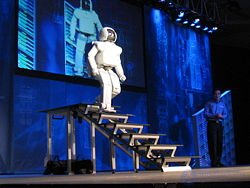
ASIMO uses sensors and intelligent algorithms to avoid obstacles and to move up and down stairs
Cybernetics in biology is the study of cybernetic systems in biological organisms, examining how animals adapt to their environment and how information in the form of genes can be passed from generation to generation. There is also a second direction: cyborgs.
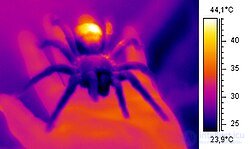
A thermal image of a poikilothermic tarantula on the hand of a homeothermic human
Complex systems theory analyzes the nature of complex systems and the reasons underlying their unusual properties.
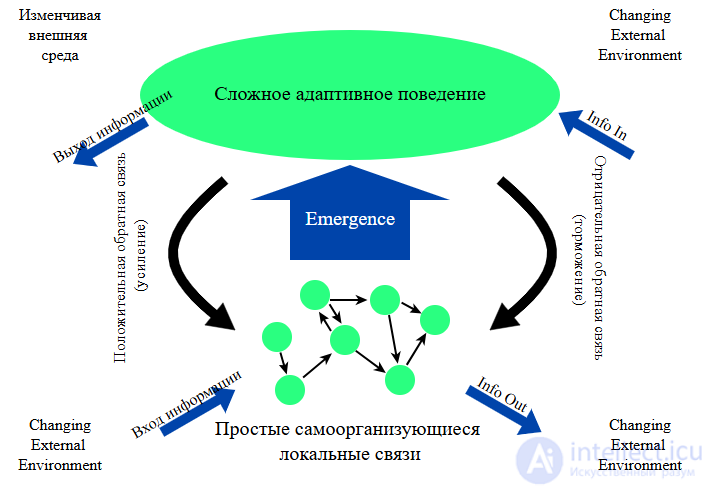
A way of modeling a complex adaptive system
In computing, the methods of cybernetics are applied to control devices and analyze information.
In engineering, cybernetics is used to analyze failures of systems in which small errors and flaws can lead to the breakdown of the whole system.

An artificial heart, an example of biomedical engineering.
In Ancient Greece the term "cybernetics", which originally denoted the art of the helmsman, came to be used figuratively to denote the art of the statesman governing a city. In this sense it is used, in particular, by Plato in the "Laws".
The French word "cybernétique" was used in practically its modern meaning in 1834 by the French physicist and systematizer of the sciences André-Marie Ampère (1775-1836), to denote the science of government in his system of classification of human knowledge:
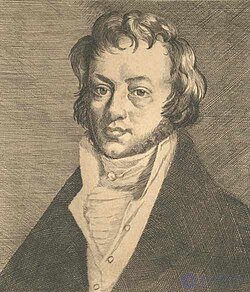
André-Marie Ampère
"CYBERNETICS. The relations of one people to another, studied in the preceding sciences <…>, are only a small part of the objects that a government must look after; its attention is also continuously required by the maintenance of public order, the execution of the laws, the fair distribution of taxes, the selection of the people it must appoint to offices, and everything that contributes to the improvement of the public condition. It must constantly choose among the various measures best suited to achieving the goal; and only through deep study and comparison of the different elements offered to it for this choice by knowledge of everything relating to the nation is it able to govern in accordance with the nation's character, customs and means of subsistence, with an organization and laws that can serve as general rules of conduct and by which it is guided in each particular case. So it is only after all the sciences dealing with these various objects that one must place the one now under discussion, which I call cybernetics, from the Ancient Greek word κυβερνητιχη; this word, adopted at first in the narrow sense of denoting the art of steering ships, came into use among the Greeks themselves in an incomparably broader meaning, the art of governing in general" .
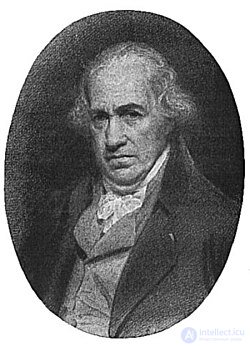
James Watt
The first artificial automatic regulating system, a water clock, was invented by the ancient Greek mechanic Ctesibius. In his water clock, water flowed from a source such as a stabilizing tank into a basin, and then from the basin to the mechanisms of the clock. Ctesibius's device used a cone-shaped float to monitor the water level in its reservoir and adjust the flow rate of the water accordingly, in order to maintain a constant water level in the reservoir, so that it was neither overfilled nor drained. This was the first artificial, truly automatic self-regulating device that required no external intervention between the feedback and the controlling mechanisms. Although they naturally did not refer to this concept as the science of cybernetics (they considered it a field of engineering), Ctesibius and other craftsmen of antiquity, such as Hero of Alexandria or the Chinese scholar Su Song, are considered among the first to study cybernetic principles. The study of mechanisms in machines with corrective feedback dates back as far as the end of the 18th century, when James Watt's steam engine was equipped with a control device, a centrifugal feedback governor, to control the speed of the engine[significance of the fact?]. A. Wallace described feedback as "necessary to the principle of evolution" in his famous 1858 work. In 1868 the great physicist J. Maxwell published a theoretical paper on governors, one of the first to consider and refine the principles of self-regulating devices. J. von Uexküll applied a feedback mechanism in his model of the functional cycle (German: Funktionskreis) to explain animal behavior.
Modern cybernetics began in the 1940s as an interdisciplinary field of study uniting control systems, electrical circuit theory, mechanical engineering, logical modeling, evolutionary biology and neurology. Electronic control systems trace their origin to the work of Bell Labs engineer Harold Black in 1927 on the use of negative feedback to control amplifiers. The ideas are also related to the biological work of Ludwig von Bertalanffy in general systems theory.
Early applications of negative feedback in electronic circuits included the control of gun mounts and radar antennas during the Second World War. Jay Forrester, a graduate student at the Servomechanisms Laboratory at the Massachusetts Institute of Technology, who worked during the Second World War with Gordon S. Brown on improving electronic control systems for the US Navy, later applied these ideas to social organizations such as corporations and cities, as the original organizer of the MIT School of Industrial Management, now the MIT Sloan School of Management. Forrester is also known as the founder of system dynamics.
W. Deming, the guru of total quality management, in whose honor Japan established its main industrial award in 1950, was a young specialist at Bell Telephone Labs in 1927 and may then have come under the influence of work in network analysis. Deming made "appreciation of a system" one of the four pillars of what he described as profound knowledge in his book "The New Economics".
Numerous works appeared in related fields. In 1935 the Soviet physiologist P. K. Anokhin published a book in which the concept of feedback ("reverse afferentation") was studied. Research continued, especially in the mathematical modeling of regulatory processes, and two key papers were published in 1943. These works were "Behavior, Purpose and Teleology" by Norbert Wiener and J. Bigelow[in English], and "A Logical Calculus of the Ideas Immanent in Nervous Activity" by W. McCulloch and W. Pitts.
Cybernetics as a scientific discipline was founded on the work of Wiener, McCulloch and others, such as W. R. Ashby and W. G. Walter.
Walter was one of the first to build autonomous robots to aid the study of animal behavior. Along with Britain and the USA, an important geographic location of early cybernetics was France.
In the spring of 1947 Wiener was invited to a congress on harmonic analysis held in Nancy, France. The event was organized by the group of mathematicians Nicolas Bourbaki, in which the mathematician S. Mandelbrojt played a large role.
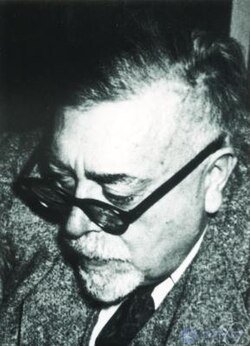
Norbert Wiener
During this stay in France Wiener received an offer to write a work on the theme of unifying that part of applied mathematics found in the study of Brownian motion (the so-called Wiener process) and in the theory of telecommunications. The following summer, already in the United States, he used the term "cybernetics" as the title of a scientific theory. The name was intended to describe the study of "purposeful mechanisms" and was popularized in the book "Cybernetics: Or Control and Communication in the Animal and the Machine" (Hermann & Cie, Paris, 1948). In Britain the Ratio Club[in English] formed around this in 1949.
In the early 1940s John von Neumann, better known for his work in mathematics and computer science, made a unique and unusual contribution to the world of cybernetics: the concept of the cellular automaton and the "universal constructor" (a self-reproducing cellular automaton). The result of these deceptively simple thought experiments was a precise notion of self-reproduction, which cybernetics adopted as a fundamental concept. The idea that the same properties of genetic reproduction applied to the social world, to living cells and even to computer viruses is further evidence of the universality of cybernetic research.
Wiener popularized the social implications of cybernetics by drawing analogies between automatic systems (such as a regulated steam engine) and human institutions in his bestseller "Cybernetics and Society" (The Human Use of Human Beings: Cybernetics and Society, Houghton-Mifflin, 1950).
One of the main research centers of the time was the Biological Computer Laboratory at the University of Illinois, which was headed by H. Foerster for almost 20 years, starting in 1958.
The development of cybernetics in the USSR began in the 1940s.
The 1954 edition of the "Philosophical Dictionary" described cybernetics as a "reactionary pseudoscience". The criticism was aimed specifically at the statements of Wiener (a mathematician not competent in the biological sciences), which contradicted the work of I. Sechenov and I. Pavlov. Wiener also rejected in his cybernetics the very possibility of a science of society as such, which of course immediately struck at Marx's work on political economy (as well as at the classics of Western sociology). Meanwhile, the USSR was developing both computing technology (BESM-1, BESM-2, etc.) and the mathematics of control processes (the most striking example being L. S. Pontryagin's work on optimal control). As can be seen, the foreign word "cybernetics" was not needed at all for their development.
The rehabilitation of cybernetics in the USSR can be dated to 1955, when the article "The Main Features of Cybernetics" by Academician S. L. Sobolev, A. I. Kitov and A. A. Lyapunov appeared in the journal "Voprosy Filosofii" (Problems of Philosophy, No. 4).
A quotation from "Voprosy Filosofii" (No. 4):
In the USSR one of the main fighters for the rehabilitation of cybernetics, the "bourgeois pseudoscience", was A. I. Kitov, who was the author of the first positive publications about it and a convinced propagandist of its ideas. His scientific works and articles, written by him alone and jointly with A. I. Berg, A. A. Lyapunov and S. L. Sobolev, dating from the period 1952—1961, played an enormous role in the recognition of cybernetics as a science and in the development of informatics in the Soviet Union and in several other countries. In 1951-52, having become acquainted, in the restricted-access archive of the secret computer design bureau SKB-245, with the original of the book "Cybernetics" by the American scientist Norbert Wiener, A. I. Kitov immediately appreciated the great benefit that this new science could bring to society. He not only appreciated it but also wrote a detailed positive article, "The Main Features of Cybernetics". Then about a year and a half of numerous public talks on cybernetics by A. I. Kitov and A. A. Lyapunov passed before the Ideological Department of the Central Committee of the CPSU sanctioned the publication of this article. In mid-1955 this article, signed by Academician S. L. Sobolev, A. I. Kitov and A. A. Lyapunov, was published in the journal "Voprosy Filosofii" (No. 4). This article went down in the history of Russian science as a victorious moment in the struggle for cybernetics. In the same year, 1955, Anatoly Ivanovich Kitov published in the all-Union journal "Radio", issued in the USSR in mass circulation, another pioneering article on cybernetics, "Technical Cybernetics"
In the 1960s and 1970s, great stakes were already being placed on cybernetics, both technical and economic.
Over the last 30 years cybernetics has gone through ups and downs, becoming increasingly significant in the study of artificial intelligence and biological-machine interfaces (that is, cyborgs), but, having lost support, it lost its bearings for further development.
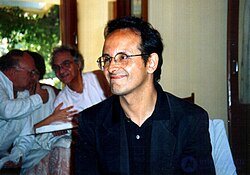
Francisco Varela
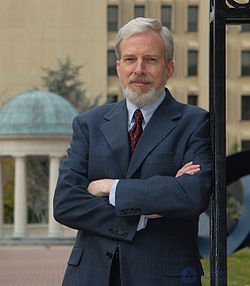
Stuart A. Umpleby
In the 1970s a new cybernetics emerged in various fields, but especially in biology. Some biologists, under the influence of cybernetic ideas (Maturana and Varela, 1980; Varela, 1979; Atlan[Eng.], 1979), "realized that the cybernetic metaphors of the program, on which molecular biology was based, represented a concept of autonomy that was impossible for a living being. Consequently, these thinkers had to invent a new cybernetics, better suited to the organizations that humanity discovers in nature — organizations not invented by humans themselves"[11]. The possibility that this new cybernetics is applicable to social forms of organization has remained a subject of theoretical debate since the 1980s.
In economics, the Cybersyn project attempted to introduce a cybernetic planned economy in Chile in the early 1970s. The experiment was stopped as a result of the 1973 coup, and the equipment was destroyed.
In the 1980s the new cybernetics, unlike its predecessor, took an interest in "the interaction of autonomous political figures and subgroups, as well as the practical and reflexive consciousness of the subjects who create and reproduce the structure of the political community. The main view is a consideration of recursiveness, or the self-dependence of political actions, both with regard to the expression of political consciousness and the ways in which systems are created on the basis of themselves"[12].
The Dutch sociologists Geyer and Van der Zouwen[Dutch] identified in 1978 a number of features of the emerging new cybernetics. "One of the features of the new cybernetics is that it treats information as constructed and reconstructed by a human being interacting with the environment. This provides an epistemological foundation for science when viewed from the observer's point of view. Another feature of the new cybernetics is its contribution to overcoming the problem of reduction (the contradictions between macro- and micro-analysis). In this way it links the individual with society"[13]. Geyer and Van der Zouwen also noted that "the transition from classical cybernetics to the new cybernetics leads to a shift from classical problems to new problems. These changes in thinking include, among others, changes from an emphasis on the controlled system to the controlling one and the factor that guides the controlling decisions. And a new emphasis on communication between several systems that try to control each other"[14] .
Recent efforts in the study of cybernetics, control systems and behavior under conditions of change, as well as in related fields such as game theory (the analysis of group interaction), feedback systems in evolution and research on metamaterials (materials whose properties, beyond Newtonian properties, derive from the atoms that compose them), have led to a revival of interest in this increasingly relevant field[15].

Comments