
Lecture 10 min.
Most Suno AI users know about structural tags like [Verse], [Chorus], and [Bridge], but far from everyone uses text markup to control the vocal performance itself. Yet the way the lyrics are formatted often determines how the artificial intelligence will place stresses, pause, convey emotion, stretch notes, and emphasize individual words.
With a few simple techniques — all caps, hyphens between syllables, repeated vowels, ellipses, parentheses, and other text markers — you can noticeably change how a track sounds without changing the music prompt. These techniques help you achieve more expressive vocals, natural phrasing, a backing-vocal effect, vocal accents, and even elements of improvisation.
This guide collects the most popular text markup methods for Suno AI: from basic stress-control techniques to advanced methods for creating vocal effects and emotional delivery. The article will be useful both for beginners who are just starting to work with music generation and for experienced users looking for the highest possible quality.
contents
Vocal text shaping techniques for influencing the performance style of an AI vocal.
They can be described as follows:
| Technique | Example | Possible effect in Suno |
|---|---|---|
| ALL CAPS | I'M FLYING UP! | stronger expression, emphasis |
| Stretching vowels | summeeer, aaaah | a long note, a vocal drawl |
| Hyphens between syllables | run-ning, don't-leave | staccato, clear separation of syllables |
| Ellipsis | I'm waiting for you... | a pause, a sigh, a slowing of the phrase |
| Commas | I, maybe, will return | short micro-pauses |
| Repeating words | run, run, run | rhythmic emphasis |
| Parentheses | I love you (love you) | a backing-vocal or echo effect |
| Quotation marks | you said "goodbye" | sometimes highlights the intonation of a quote |
| Exclamation marks | Stop!!! | an emotional outburst |
| Question mark | Where are you? | questioning intonation |
| Line break | a separate line | additional phrasing |
| Onomatopoeia | oh-oh, la-la-la, hey! | vocalizations and hooks |
| Repeating consonant letters | mmmm, hmmm | humming, murmuring |
| Dash | I — will return | a dramatic pause |
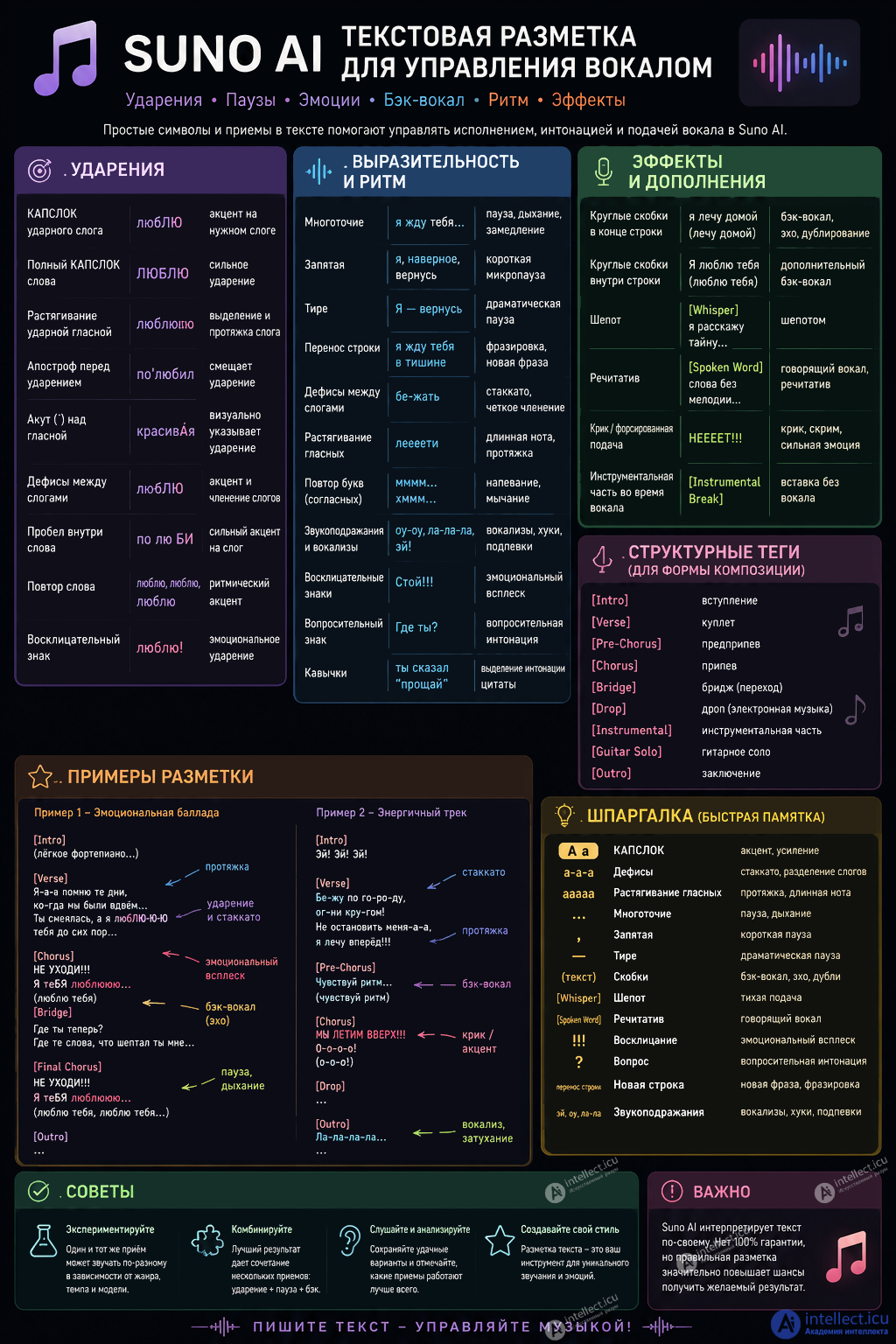
Example of combining them:
DON'T LEAVE...
I-i-I know,
that you'll come back to me...
Run, run, run!
(come back to me)
(to me...)
O-o-o-oh!
For Suno and similar generators (for example, Suno or Udio), this is more a set of unofficial "hacks" for controlling vocal delivery through text than a formal musical language. Many of them work heuristically: the effect depends on the model, the genre, and the specific prompt.
Text symbols and notes that help control music generation in Suno are usually called, in musical terminology, text directives, song structure markup, or metatags.
These techniques are often used:
In a broader sense, such elements can be called:
Example for Suno:
[Intro]
Soft piano and ambient pads
[Verse]
The city sleeps beneath the rain...
[Chorus]
We rise above the storm tonight...
[Guitar Solo]
[Final Chorus]
We rise above the storm tonight...
For Suno, stress is one of the most important things, because the model often relies not on the rules of the language but on the visual form of the text. Here are the main techniques used by experienced prompt engineers.
| Technique | Example | Effect |
|---|---|---|
| CAPS on the stressed syllable | loVE, ruN | emphasis on the desired part of the word |
| The whole word in CAPS | LOVE YOU | strong emotional stress |
| Repeating the stressed vowel | loooove, flyyyy | highlighting and stretching the stressed syllable |
| Apostrophe before the stress | be'loved, for'get | sometimes helps shift the stress |
| Acute accent (´) over a vowel | lóve, beaútiful | may help in some models |
| Splitting syllables with a hyphen | be-LOVED, don't-LEAVE | accentuates the desired syllable |
| Space inside a word | be LOV ed me | an extreme way of highlighting |
| Repeating a word | love, love, love | strengthening the emphasis through rhythm |
| Exclamation after a word | love! | emotional stress |
| Round-bracket backing vocal | love you (love) | extra emphasis through an echo |
I love yOU...
I LOVE you...
I love yoU-U-U!
I love you...
so much.
Each variation usually produces a different vocal delivery.
NO-O-OO!
HEY!
HEY!
YES!
wa-a-a-aiT...
NOOOOOOO!!!
[Whisper]
I lo-ove you...
ALL CAPS      = emphasis
aaaaa        = drawn-out note
hy-phen       = staccato / syllables
...          = breath / pause
!!!          = emotional burst
(text)      = backing vocal / echo
mmm..., ooo  = vocalization
word word  = rhythmic emphasis
line break = phrasing
The most reliable methods for English text in Suno are usually these:
A combination of them works best:
I-i-I love yOU...
lo-VE-E-E!
(love you)
In Suno, for a male vocal you can write the following in the prompt:
For example:
Romantic pop song, male vocal, warm baritone voice, acoustic guitar, emotional and uplifting.
For a female vocal in Suno, use these phrases:
Example prompt:
Pop ballad, female vocal, warm and emotional voice, piano and strings, romantic mood.
In Suno, the genre is usually set directly in the prompt or in the Style of Music field. You can mix several genres and describe the mood, instruments, and vocals.
The main genre groups:
For Suno, it is better to write instruments in English. Here is a short cheat sheet:
Romantic song:
Acoustic guitar, piano, soft strings, female vocal
Calm atmosphere:
Piano, ambient pads, soft percussion
Rock ballad:
Electric guitar, piano, live drums, male vocal
Modern pop:
Synthesizer, deep bass, electronic beats, female vocal
Epic music:
Orchestra, choir, cinematic strings, epic drums
The more detailed the "genre + instruments + voice + mood" combination, the more accurately Suno understands what music you want to create.
Text in Suno AI is not just the words of a song but a full-fledged tool for controlling the vocals. Using stress, pauses, stretched vowels, all caps, hyphens, and other markup elements correctly lets you significantly influence the intonation, rhythm, and emotional expressiveness of the performance.
It is important to remember that Suno does not always interpret these techniques the same way: the result depends on the model, the genre, the tempo of the track, and the context of the lyrics. So the best approach is to experiment, combine different methods, and save successful discoveries for future projects.
Once you master text markup techniques, you will be able to get more natural vocals, control the delivery better, and create tracks that sound exactly the way you intended. Use this article as a reference and regularly add to your set of techniques as new Suno AI features and updates appear.

Comments