
Lecture 2 min.
The "Walking Algorithm" genetic algorithm is an algorithm used to evolve and optimize the walking of a virtual creature.
The Walking Algorithm uses the ideas of evolution to determine the optimal way for a creature to move. A population of "creatures" is a set of chromosomes containing genes that encode the creature's movement parameters.
When the algorithm starts, an initial population is generated at random, made up of different combinations of movement parameters.
Then each individual is evaluated with a specific fitness function that determines how successfully the creature moves. The individuals that achieve the best results are selected for crossover and for creating a new population of "creatures".
Genetic operators such as crossover and mutation are applied to the parents' genes to create offspring with some changes. This process is repeated over several generations until a certain stopping condition is reached.
When the algorithm finishes, the best solution is chosen as the optimal way for the creature to move.
The Walking Algorithm can be used in various fields, such as computer graphics, games, robotics, animation and others. It makes it possible to optimize a creature's movement while taking into account its physical constraints, its environment and its goals.
Genetic algorithms are designed to solve optimization and modeling problems by successively selecting, combining and varying the parameters being sought, using mechanisms reminiscent of biological evolution.
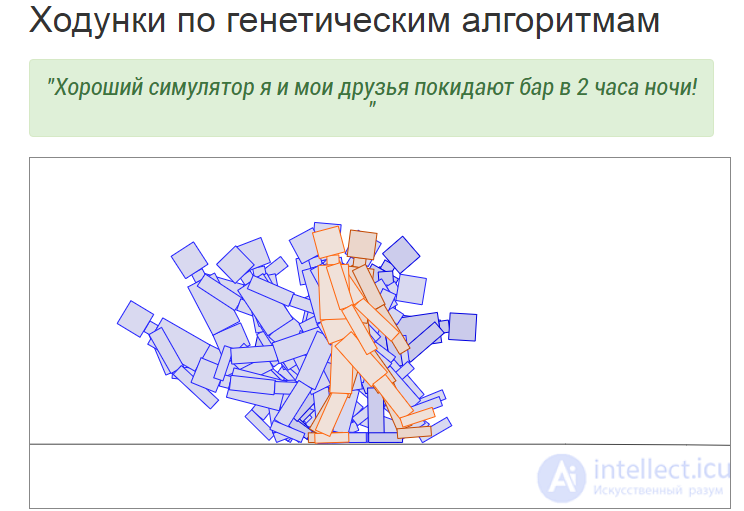
One of the main advantages of the Walking Algorithm is its ability to find an optimal solution in complex and changing conditions, where traditional optimization methods may be ineffective. In addition, this algorithm can be applied to optimize the movement of creatures of various shapes and sizes, which makes it a universal tool for creating virtual characters and robots.

Comments