
Lecture
Frame shifting, broadly speaking, is a cognitive process in which a person or a system changes their point of view (frame) on a problem in order to find a new solution or gain a better understanding of the situation. This method is widely used in creativity, science, business, and even everyday life, helping people find unexpected ways out of difficult situations.
It has found its main application in describing shifts in events, perceptions, and concepts depending on linguistic and cultural context. This phenomenon was studied by professors David Luna, Torsten Ringberg, and Laura A. Peracchio, who analyzed how multilingual and multicultural people perceive the world differently depending on the language they are using.
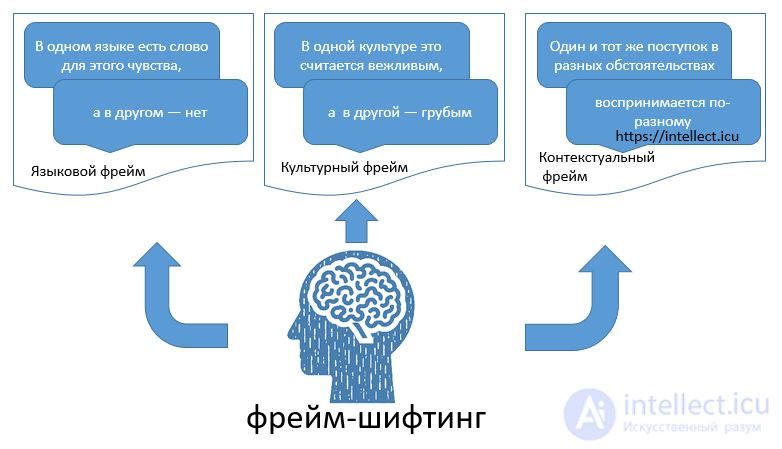
The term frame — literally, a “shot” or “framework” — in its most general sense denotes a structure that holds certain information.
In cognitive science, a frame is a way of organizing information and interpreting the world. It determines which aspects of a situation we notice, how we relate them to one another, and what conclusions we draw. For example, a cup of coffee can be perceived as a morning pick-me-up or as a symbol of a cozy conversation in a café.
Frame shifting occurs when we consciously or unconsciously change the context of perception and, as a result, open up new possibilities for solving problems.
Practitioners claim that through techniques of self-suggestion, deep relaxation, and visualization, one can experience a sense of presence in an alternate reality. This process resembles lucid dreaming or hypnagogic states — the transition between wakefulness and sleep.
Key shifting methods include:
The Raven Method — concentrating on the desired reality before falling asleep, often while repeating affirmations (“I am shifting to my desired reality”).
The Elevator Method — imagining that you are riding up in an elevator, becoming more immersed in another reality with each floor.
The Scripting Method — writing down the details of the fictional world one wants to “shift” to, in order to strengthen the effect of the visualization.
From a psychological standpoint, shifting can be regarded as a form of self-hypnosis or guided meditation that activates the imagination and altered states of consciousness. It is not an actual journey to other worlds, but a deeply immersive fantasy accompanied by intense emotional experiences.
A way of escaping reality — for many, it is a form of escapism that helps them cope with stress and everyday problems.
The development of creative thinking — visualizing alternate worlds trains the imagination.
A sense of control — the ability to create one’s own ideal reality and control the events within it.
Frame shifting can be thought of as changing the filter through which we look at a problem. This can be done in several ways:
Changing the context — examining the problem in a different setting. For example, if a programmer cannot find a bug in the code, they might try to look at it through the eyes of a user.
Changing the scale — moving from the particular to the general and back again. An architect might first work on the details of a project and then look at it from a bird’s-eye view.
Using analogies — transferring solutions from one field to another. For instance, inspiration drawn from natural structures has led to new engineering solutions (biomimicry).
Changing roles — putting oneself in the place of another person or even an object. For example, a designer might imagine how a user interacts with their product in order to identify points of friction.
Every language and culture forms a unique “frame” — a lens for perceiving reality. When a person switches between languages, they may involuntarily change their point of view, emotional reactions, and style of thinking. For example, the same person may be more reserved and formal when communicating in one language and more emotional in another.
Research shows that:
Language influences decision-making and risk assessment. For example, in their native language people tend to be more intuitive, while in a second language they tend to be more rational.
Self-perception can change: in one language a person may feel more open, while in another they may feel more reserved.
Emotions depend on vocabulary: some feelings are easier to express in one language than in another.
Ask unconventional questions — for example, “What if we removed this element?” or “How would an animal solve this problem?”
Change your usual environment — work in a new place, talk to different people, try unconventional approaches.
Look for alternative explanations — consider different causes of phenomena, even if they seem illogical.
Use the outside-opinion method — ask how other people see the problem.
Brands adapt their advertising for different linguistic and cultural groups, taking differences in perception into account.
Understanding frame shifting helps in the development of effective educational programs.
Awareness of this phenomenon fosters better mutual understanding within multinational teams.
Frame shifting allowed Albert Einstein to formulate the theory of relativity when he imagined himself riding alongside a beam of light.
In artificial intelligence, frame shifting helps machine learning models adapt to new tasks and contexts, making them more flexible and versatile.
Companies that successfully shift frames find new market niches. For example, Apple turned the phone into a multimedia hub, changing the way people thought about mobile devices.
In negotiations, frame shifting helps one see the situation from the other side’s perspective, which often leads to compromise.
Artists and writers use frame shifting to create unexpected plots and concepts. For example, Christopher Nolan’s films frequently shift temporal and spatial frames, which makes the narrative unique.
Although there is no scientific evidence of “traveling” to other worlds, shifting remains an intriguing phenomenon that demonstrates the power of the human mind and its capacity to model alternate realities.
Frame shifting is a powerful cognitive tool that makes it possible to find unconventional solutions and gain a deeper understanding of the world around us. Developing this skill helps in science, business, art, and everyday life, making us more flexible and creative.
Frame shifting is a powerful tool of adaptation and cognitive flexibility that helps people think more broadly and find new meanings in familiar things.

Comments