
Lecture
Electric capacitance — a characteristic of a conductor, a measure of its ability to accumulate electric charge. In circuit theory, capacitance refers to the mutual capacitance between two conductors; it is the parameter of a capacitive element of an electric circuit (a capacitor), represented as a two-terminal device.
In the International System of Units (SI), capacitance is measured in farads, the commonly accepted symbol for capacitance being C.
Capacitance is calculated as the ratio of the electric charge to the potential difference between the conductor and infinity, or between conductors
C=Qφ−φref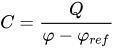 ,
,
where Q — charge, φ — potential of the conductor, φref — potential of the other conductor or the potential at infinity (usually taken as zero).
Capacitance depends on the geometry and shape of the conductors and on the electrical properties of the surrounding medium (its permittivity).
For a single conductor, capacitance equals the ratio of the conductor's charge to its potential, assuming all other conductors are infinitely far away and that the potential at an infinitely distant point is taken as zero. In mathematical form, this definition is written as
 ,
,
where Q — charge, φ — potential of the conductor. For example, the capacitance of a conducting ball (or sphere) of radius R is (in the SI system):

where ε0 — the electric constant (8.854⋅10−12 F/m),  — the relative permittivity.
|
Derivation of the formula
It is known that Since |
For a system of two conductors, separated by a dielectric or vacuum and carrying equal but opposite charges ±Q, the capacitance (mutual capacitance) is defined as the ratio of the charge magnitude to the potential difference between the conductors. If the potential of one of the conductors is taken as zero, the formula C=Q/φ remains valid for this case as well.
A discrete circuit element based on the system described above, possessing significant capacitance, is called a capacitor. The two conductors in this case are called plates.
For a parallel-plate capacitor, the capacitance equals:
 ,
,
where S — the plate area (the plates are assumed identical), d — the distance between the plates.
The electrical energy stored by a capacitor is
2 ,
,
where U — the voltage between the plates.
Capacitance is conventionally denoted by the capital Latin letter C (from the Latin capacitas — capacity, volume).
In the SI system, capacitance is expressed in farads[ , abbreviated «F». A conductor has a capacitance of one farad if, at a surface potential of one volt, it carries a charge of one coulomb. One farad is a very large capacitance; real conductors have capacitances on the order of nano- or microfarads. The «farad» is named after the English physicist Michael Faraday.
The unit of capacitance in the CGS system is the centimeter. Relation: 1 cm of capacitance ≈ 1.1126 pF; 1 F = 8.988×1011 cm of capacitance.
on these quantities). values, capacitance is a constant, but in the case of a nonlinear medium, where εr depends on the electric field strength, the capacitance will change with voltage. , the «capacitance» element can be assigned a reactance
 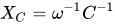 .
.The differential (small-signal) capacitance is defined as the derivative of the conductor's charge with respect to potential
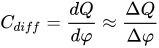 ,
,
which is determined for selected conditions  . This quantity characterizes the response of the conductor to a small change in potential. If the dependence of charge on potential is linear, then
  , but more complex cases occur in practice.
Measurements of the so-called capacitance-voltage characteristics of metal-dielectric-semiconductor structures — the dependences  at various frequencies ω of the potential's variation over time t according to the law φ=φ0+Δφsin(ωt) — have become widespread. Such measurements provide valuable information about the quality of the dielectric.
Physicists have found the first example of a substance with ferroelectric properties that can exhibit negative electric capacitance. The possibility of such an effect was theoretically predicted by the Soviet physicist Lev Landau about 70 years ago, but its experimental observation had previously been considered practically impossible. The authors call the results important both for fundamental science and for technological applications. The paper was published in the journal Nature.
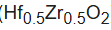 is explained precisely by Landau's theory. In the simplest case, the capacitance of a parallel-plate capacitor is always a positive coefficient between the charge on the plates and the applied voltage. That is, the greater the applied voltage, the greater the charge that can be accumulated in the capacitor. If a capacitor had negative capacitance, the charge on it would increase as the voltage decreased and would decrease as the voltage increased. Landau's theory predicted that negative capacitance would be observed if the thermodynamic Helmholtz free energy corresponding to a given ferroelectric, as a function of polarization, had two minima. It was precisely this characteristic that was measured in the new experiment.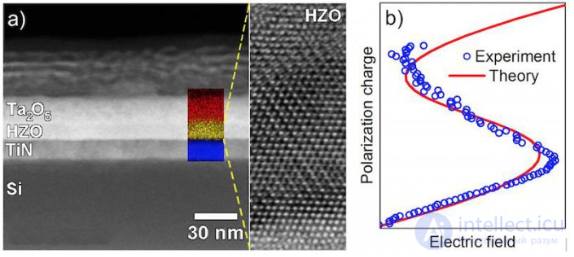
Comparison of the experimental results with Landau's theory
The authors note that the new material may find application in the near future, since negative capacitance can be used to amplify the applied potential, thereby reducing power losses to a level unattainable by present-day electronics.
«Most ferroelectrics are very difficult to integrate into modern semiconductor manufacturing methods, but  is already used in these processes,» explains the paper's lead author Michael Hoffmann of the Laboratory of Nanoelectronic Materials (Germany). — This means that products using this effect could soon appear. Another advantage of
  is that it retains its ferroelectric properties even at film thicknesses of less than 10 nanometers, which is important for future miniaturization».
Calculating the electric capacitance of a system requires solving Laplace's equation ∇2φ = 0 with a constant potential φ on the surface of the conductors. This is trivial in cases with high symmetry. There is no solution in terms of elementary functions in more complex cases.
In quasi-two-dimensional cases, analytic functions map one situation onto another, and the electric capacitance does not change under such mappings. See also the Schwarz—Christoffel mapping.
| Type | Capacitance | Comment |
|---|---|---|
| Parallel-plate capacitor |  |
S: Area d: Distance |
| Two coaxial cylinders |  |
l : Length R1: Radius R2  : Radius : Radius |
| Two parallel wires | 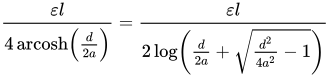 |
a: Radius d: Distance, d > 2a |
| Wire parallel to a wall | 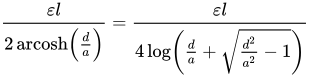 |
a: Radius d: Distance, d > a l: Length |
| Two parallel coplanar strips |
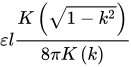 |
d: Distance w1, w2 : Strip widthskm: d/(2wm+d) k2: k1k2 |
| Two concentric spheres |  |
R1: Radius R2: Radius |
| Two spheres of equal radius | 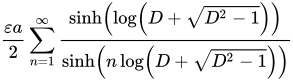   |
a : Radius d: Distance, d > 2a D = d/2a γ: Euler's constant |
| Sphere near a wall | 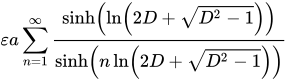 |
a: Radius d: Distance, d > a D = d/a |
| Sphere | εa | a: Radius |
| Circular disc[ |  |
a : Radius |
| Thin straight wire, finite length |
 |
a: Wire radius l: Length Λ: ln(l/a) |
The quantity inverse to capacitance is called elastance. The unit of elastance is the daraf, but it is not defined in the SI system of physical units[13].

 , substituting the found φ here, we obtain
  .
.
Comments