
Lecture 12 min.
Dynamic protection (DP), colloquially explosive reactive armor (ERA), is a protective device, a variety of protection for armored combat vehicles, whose principle of operation is to use a directed explosion of an explosive charge against a projectile that has struck the vehicle, in order to sharply reduce its penetrating ability.
In general, DP consists of metal containers holding a dynamic protection element (DPE) and placed on top of the main armor of a tank (main battle or special), an armored personnel carrier, an infantry fighting vehicle, and so on. A DPE consists of a layer of explosive placed between two thin metal plates. The principle of operation of dynamic protection is that when a munition interacts with a DP container, the explosive, reacting to the deformation, detonates toward the projectile. The idea of a counter-explosion as a way of protecting against shaped-charge weapons was proposed in the late 1940s at the Soviet Research Institute of Steel, as a consequence of reflection on the experience of the Second World War, when shaped-charge projectiles first appeared on the battlefield [not in the source].
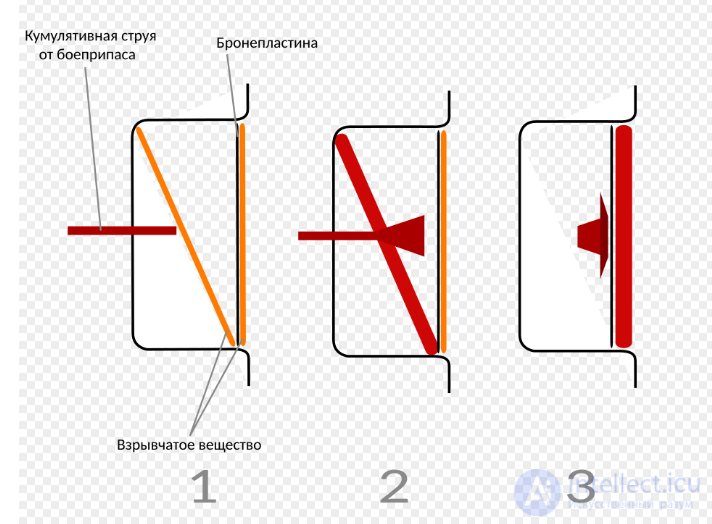
Principle of operation of a dynamic protection block:
1. The shaped-charge jet enters the block
2. The first layer of explosive detonates, dispersing the shaped-charge jet
3. The second layer of explosive detonates, throwing the armor plate toward the shaped-charge jet and absorbing its energy
The first test of "active" (dynamic) protection was carried out in June 1944 by Sergey Ivanovich Smolensky, then chief engineer of the Moscow branch of TsNII-48 (today JSC "Research Institute of Steel"). He tested the first active-protection scheme against 57-mm German armor-piercing projectiles. In the USSR, works on this subject were already being published in the late 1940s .
Dynamic protection for tanks was first used in experimental prototypes in the late 1940s. One of the early examples was the use by British Centurion tanks of experimental devices for active protection against shaped-charge projectiles. These devices were metal containers with explosive that could detonate in response to an approaching projectile.
However, the concept of dynamic protection came into wider spread and use in combat conditions during the Cold War, beginning in the early 1950s. This was connected with the increasing proliferation of anti-tank missiles and shaped-charge projectiles, against which traditional methods of armor protection proved less effective.
Dynamic protection technology continued to develop, including various designs and concepts, such as active protection systems (APS), which use missiles or other means to intercept and destroy a threat in the air.
In the 1950s a series of experiments on destroying flying anti-tank munitions with linear shaped charges was conducted at Picatinny Arsenal; on their results it was concluded that such charges could be effective with an adequate triggering mechanism, but tactical limitations were also noted; a report on this was declassified in 1980.
Prototype dynamic protection samples that passed range trials were developed in the USSR in the 1960s by the Research Institute of Steel under the leadership of Academician Bogdan Voitsekhovsky (Lenin Prize of 1965). However, for a number of subjective reasons, in particular the psychological unpreparedness of high-ranking representatives of the army and industry, the rigid position of the leadership of the Ministry of Defense and, above all, of Chief Marshal of Armored Forces A. Kh. Babadzhanyan, who regarded the tank as a means of transporting assault troops in battle, a concept into which DP did not fit at all [Comm. 1], production of dynamic protection in the USSR was not begun until the mid-1980s.
The military leadership of the USA, and especially of the FRG, treated this novelty with the same skepticism. Over the following two decades, up to the US invasion of Iraq, not a single item with dynamic protection was adopted into service in these countries. Although R&D of the relevant kind was carried out by the ISL Institute (France/Germany) for a whole decade beginning in 1973 .
 External images |
|
|---|---|
 |
Israeli M48A3 tank (Magach 3) with "Blazer" type DP. Armored Vehicles Museum in Kubinka, February 2009. |
After the end of the Six-Day War between Israel and Egypt, the German munitions physicist Manfred Held (an employee of Messerschmidt-Bölkow-Blohm — Apparatebau / Schrobenhausen) took part in 1967—1968 in tests conducted by the Israeli army and defense industry to evaluate the effectiveness of shaped-charge warheads on Egyptian (Soviet) T-54 and T-55 tanks. Held was in Israel as an expert on shaped-charge warheads, sent to that country to study the vulnerability of Soviet armored vehicles — data that the German Ministry of Defense was extremely interested in obtaining[10]. The mission became possible as a result of a secret agreement between the BND and the Mossad[11].
According to the official version, first voiced by Israeli sources, Shlomo Shpiro in particular[10][11], during the tests Held encountered an unusual phenomenon: the expected complete through-penetration of the turret, consisting of penetrating the armor, the jet's passage inside the turret space and its exit through the opposite wall of the turret, did not occur in all tests. When the shaped-charge jet caused the detonation of ammunition stored in the tank, the secondary explosion acted on it in such a way that the jet did not reach the opposite wall of the turret or, at least, no longer penetrated it. This fact allowed Held to draw the following conclusion: the "counter-explosion" (German: Gegenexplosion) that occurs on an explosion or a strike against armor is capable, if kept under control, of producing a beneficial effect and thereby counteracting armor penetration[12].
However, this version is disputed by representatives of two independent branches of dynamic protection developers in the post-Soviet space — specialists of the Malyshev Plant in Kharkiv and of the Moscow Research Institute of Steel, in both cases relying on archival data on design documentation as well as on the composition of the contractors of dynamic protection work in the late 1960s. It must be clearly understood that in the development of weapons protected by a secrecy classification there are no miraculous coincidences such as a co-contractor of the work, G. A. Blezer, having emigrated to Israel and a DP of the "Blazer" brand having appeared by chance in Israel[13].
In 1970 Held obtained a patent for dynamic protection (explosive reactive armor, ERA) for use as additional protection of a tank [14][15]. The circumstances in which Held came up with the idea of "reactive" armor and the off-profile nature of his experiments/research gave a number of authors grounds to call Held's invention of dynamic protection accidental[16], in contrast to the R&D carried out in the USSR over decades (the 1960s—1970s).
Having failed to persuade the military leadership of Germany and other NATO member states to adopt his developments, M. Held returned in 1974 to Israel, where another Arab-Israeli war, the 1973 war (Yom Kippur War), had just ended.
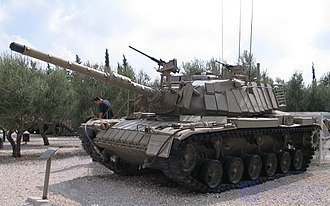
Israeli M60A1 tank with "Blazer" dynamic protection installed
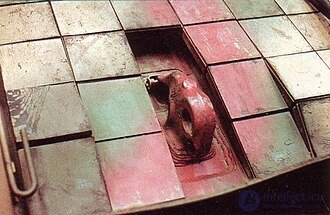
Dynamic protection elements on the upper front hull plate of the Polish PT-91 Twardy tank
In 1974 Held presented his invention to representatives of the Israel Defense Forces, and during the demonstration the effectiveness of the protective action of dynamic protection was shown[12]. The result of Held's demonstration of his invention was an instruction from the Israeli government to the arms company Rafael to begin preparing ERA dynamic protection for serial production[17].
Rafael (Rafael Armament Development Authority) set up production of Blazer add-on ERA modules, adapting them to specific vehicles, and subsequently promoted the product worldwide together with Israel Military Industries[18].
Blazer reactive armor was first fitted to Israeli tanks: the Centurion, M-60 and M-48 during the 1982 Lebanon War. A batch of American M-48 and M-60 tanks had been transferred to Israel from Germany . In Israel they were fitted with Blazer ERA kits, which in effect "neutralized" the damaging effect of the Malyutka ATGM from all approach directions and of the PG-7/RPG-7 shaped-charge grenade[19]. The successful use of Blazer ERA gave a powerful stimulus to the development and testing of similar protection systems around the world.
Add-on reactive armor is designed to reduce the effectiveness of shaped-charge munitions only.
The principle of operation of such protection (using devices with a flat reactive armor element as an example) is that when a shaped-charge jet passes through the reactive armor element, the metal plates that originally adjoined the explosive layer begin to move, as a result of detonation, toward the jet, crossing its path. As a result, the jet has to penetrate newly presented sections of the moving plates. At the same time, the jet is subjected to the dynamic action of the explosion products, and is also affected by the lateral impulse from the collision with the plates.
As a result, the originally straight shaped-charge jet takes on a zigzag shape, it stretches unevenly and breaks up into separate pieces, which over time leads to the complete disintegration of the part of the jet affected by the reactive armor element and causes a substantial reduction in its armor penetration — by 50–80% .
Built-in reactive armor is more versatile and works against all types of anti-tank projectiles. That is, it provides protection against both shaped-charge projectiles and armor-piercing discarding-sabot projectiles (APDS).
Tests showed that traditional add-on reactive armor either fails to trigger or barely reduces the armor penetration of APDS rounds. However, the situation changed sharply if the reactive armor elements were covered by thick plates (15–20 mm thick) of high-hardness steel. Such protection showed a reduction in the armor penetration of both shaped-charge and sabot projectiles.
The principle of operation of universal reactive armor is that when an APDS projectile penetrates the front screen (the cover of the reactive armor), a stream of fragments is formed that triggers detonation of the reactive armor element. The detonation of the explosive in the element causes the screen (the reactive armor cover) to move (be thrown), striking the body of the APDS projectile and able to destroy it. This substantially worsens the conditions under which the APDS projectile penetrates the main armor barrier and leads to a reduction in its armor-piercing capability .
In Ukraine, reactive armor with a different mode of action, "Nozh" (Knife), and its modification "Duplet", were also developed. Their principle of operation is based on cutting the projectile or shaped-charge jet with so-called "shaped-charge knives". An attempt to implement a similar principle was made in the USSR in its time. Despite some advantages of this method over classical reactive armor, it is widely criticized, primarily because of the large quantity of explosive it requires.
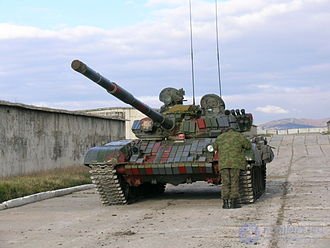
A T-72 main battle tank in Georgia. Reactive armor elements are visible on the hull and turret
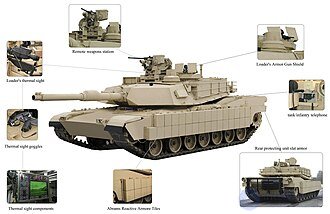
An M1A2 with the TUSK (Tank Urban Survival Kit) package for improved survivability in an urban environment, 2005. Reactive armor blocks are mounted along the sides of the armored hull
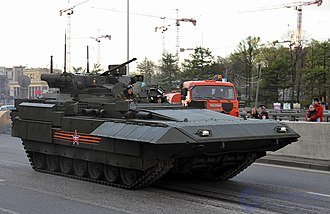
Reactive armor blocks on the front of the hull of the T-15 heavy infantry fighting vehicle
First-generation reactive armor (for example, the Soviet Kontakt-1 and the Israeli Blazer) was built as removable containers mounted on the outside of the tank's hull and turret. It protected the tank mostly against shaped-charge projectiles only. The tactical and technical requirements did not provide for protection against kinetic-energy armor-piercing projectiles. It was distinguished by a simple design and the availability of the materials used. The bursting charge was the plastic explosive Semtex (Israel), based on RDX. The design of the Blazer add-on reactive armor fitted to the M-48A3 tank is examined in detail in the work cited, see[20]
According to 1982 test data, as a result of fitting the Kontakt reactive armor system to the main tanks of the USSR, the probability of a tank being defeated by ground-based shaped-charge weapons decreased: for the T-55A and T-62 by a factor of 4–4.3, and for the T-80B, T-72A and T-64B by a factor of 1.8–2[13].
Second-generation reactive armor, which appeared in the second half of the 1980s, became effective also against kinetic munitions — APDS and APFSDS projectiles — and, at equal mass, considerably surpassed combined passive armor in level of protection. Of the second-generation systems, the best known is the Soviet Kontakt-5, which uses the 4S22-4S23 reactive armor elements.
Third-generation reactive armor is represented by the Russian Relikt[21], the Ukrainian Nozh and Duplet, and a number of foreign designs. Modern variants of reactive armor provide protection against armor-piercing fin-stabilized discarding-sabot projectiles (APFSDS) and shaped-charge munitions.
Fourth-generation reactive armor is represented by the Russian Malakhit.
Sign in and the lectures you have studied will be marked in this list.
Choose a course
Comments