
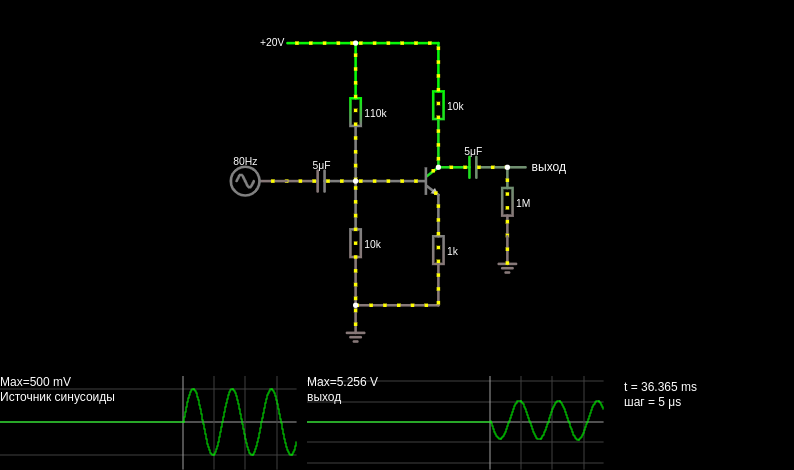
This is a common-source amplifier, which amplifies the input voltage by about 30 times. The gain of this amplifier is determined in part by the transconductance of the MOSFET. This depends on the bias point in the circuit; here it averages about 9 mA/V. This means that a change in the gate voltage causes a change in the drain current that is 9 mA/V times larger than the change in gate voltage. The drain current flows through the 4 kΩ resistor. The capacitor connected to the source should act as a short circuit at the input frequency, so it and the source resistor can be neglected. A 50 mV change in the input signal causes a change in drain voltage of 9 mA/V * 50 mV * 4000 Ω, or about 1.8 V. This means the predicted gain at the output is 36. Here it is smaller because the transconductance changes over the input cycle (the amplifier is not perfectly linear), we ignored the output resistor, and the source capacitor is not quite a short circuit as we assumed.
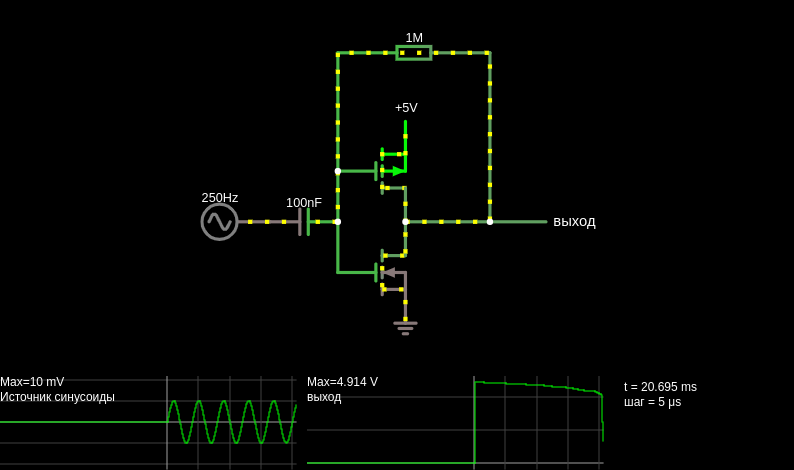
This page is a utility for simulating common-source amplifier online with specified initial values.


Comments