
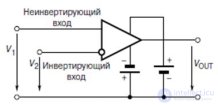
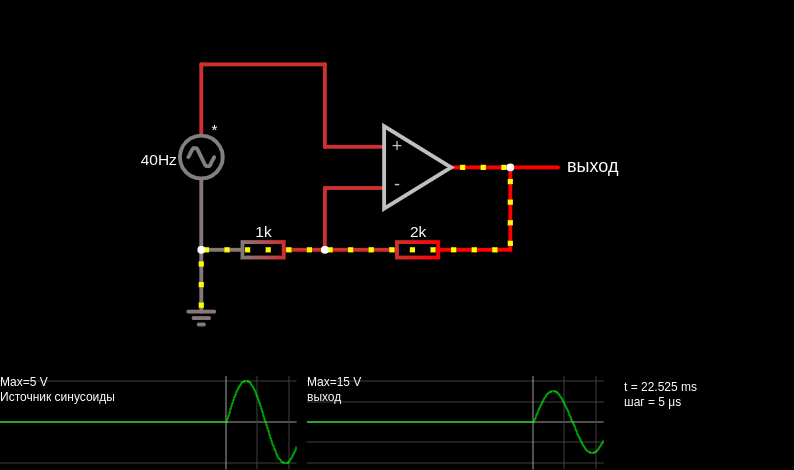
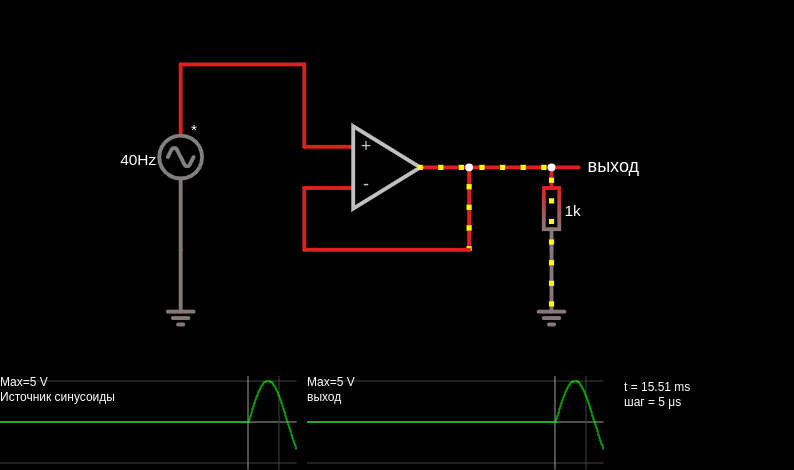
The circuit on the left converts a positive impedance into a negative one. So, for example, instead of Ohm's law (E = IR), it makes the resistor obey E = -IR. The circuit on the right shows a positive impedance (a 150 Ω resistor) for comparison. The op-amp tries to keep its - input at the same voltage as the + input, which is connected to the input signal. Thus the converted impedance (the 150 Ω resistor) responds as if it were connected directly to the input signal. Any current it needs comes from the op-amp and flows through the lower 100 Ω resistor. Since the + input has the same voltage as the - input, the current and voltage drop across the upper 100 Ω resistor must be the same as across the lower one. As a result, when the input voltage is positive, current flows into the input rather than out of it. The input current is the same as the current through the impedance, but in the opposite direction.
This page is a utility for simulating negative impedance converter online with specified initial values.






Comments