
Lecture
Serverless computing (or serverless technologies, as they are sometimes called) is a promising cloud computing model that has appeared on the horizon of application development and architecture in recent years. It is precisely the desire to tap the enormous potential of serverless frameworks that has drawn many major market players into the general boom of cloud services. Software industry giants such as Google, Microsoft, IBM and Amazon already offer their customers the chance to move on-premises business processes and achieve operational efficiency on flagship serverless platforms such as AWS Lambda and Azure Functions.
Put simply, serverless architecture is an event- and request-driven technological solution that allows application developers to build efficient working environments in the cloud, equipped with all the computing resources needed to organize an uninterrupted development process. Such frameworks are very convenient, especially when deadlines are tight and the tasks at hand are resource-intensive.
Moreover, choosing serverless services makes it possible to streamline application development processes and thereby increase the effectiveness of other business process optimization practices, including DevOps and Agile.
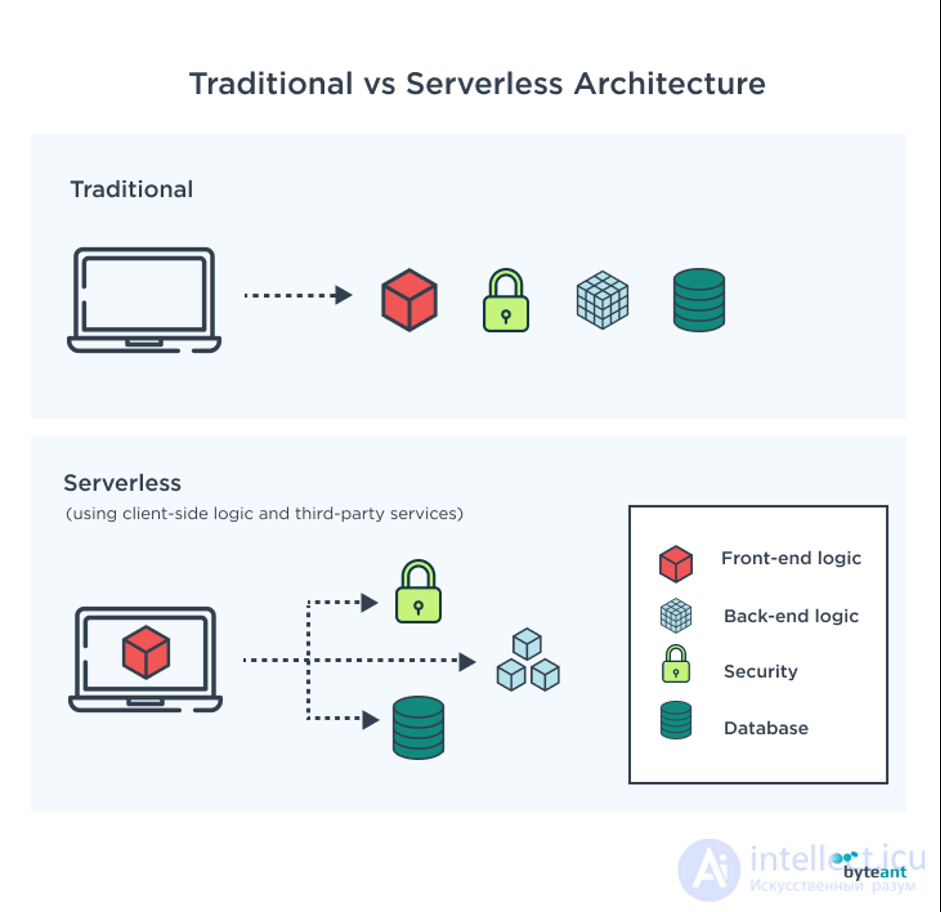
On the one hand, both of these architectures have similar functional properties: they help minimize operating costs, shorten the application deployment cycle, adapt to constantly changing development requirements, and streamline everyday tasks with heightened demands on time and resources. On the other hand, there are a number of striking differences between the microservice and serverless models that you definitely should get to know.
Microservices. This technological solution is a more compact variety of service-oriented architecture (SOA) that gives programmers full access to the necessary libraries hosted on cloud servers. It makes it possible to deploy many functional modules, as well as a number of protocols and APIs, including JSON, RESTful, AMQP, SOAP and others.
In a microservice architecture, data containerization is usually provided by executable software packages (for example, Docker). All the necessary data is unpacked on demand when developers call a specific API. A large number of template microservices makes it possible to organize continuous application deployment through operational processes implemented on a cloud platform.
It is also worth remembering that a microservice architecture can turn out to be a rather expensive pleasure for business owners, because even idle microservices effectively remain active, so you have to pay for host server resources on a daily or monthly basis.
Serverless architecture. Serverless architecture looks far more promising for application developers because it provides cloud working environments on demand. This means that serverless functions are launched only at the moment a particular event is detected. After that, the functions perform a sequence of operations depending on the commands received from users. Then the serverless platform applies a set of pre-prepared algorithms and rules, performs the computations and returns up-to-date results. However, for every little thing you will have to pay double, both for development and for use.
Once all operations are complete, the working environment immediately shuts down and stays in that state until the next task is requested. It is exactly this behavior that lets us call serverless architecture a true on-demand application development environment.
In general, microservices are much better suited to scenarios such as e-commerce websites, where the ability to containerize all sorts of large-scale data sets is a priority. Serverless computing shows enormous potential when it comes to optimizing the time and financial costs of development.
In addition, serverless architecture proves preferable when business processes are event-driven and do not require continuous execution of operational tasks. This is especially true of Internet of Things (IoT) applications, which are characterized by alarms and notifications that demand prompt response. To get a clearer picture, let us take a closer look at some useful features and characteristics of serverless computing.
The serverless development model uses preconfigured events, and a number of distributed cloud services are used to optimize the software deployment workflow. This approach usually implements two complementary service models:
backend as a service (BaaS);
function as a service (FaaS).
Let us look at some of their features in more depth. The BaaS model uses the capabilities of third-party multitenant architectures to improve efficiency when deploying and provisioning resources for your applications. The standard functionality of this model is usually delivered in the form of SDKs or API gateways, with all the necessary actions performed exclusively in the cloud and usually treated as components of legacy on-premises infrastructure or program code. Such a solution delivers a truly fast development cycle, while full responsibility for the ongoing maintenance of software and infrastructure rests on the shoulders of the BaaS provider. Moreover, the capabilities of this model are practically limitless, which allows application developers to scale application deployment flows on the fly.
FaaS platforms, such as AWS Lambda, are the types of event-driven development architectures that provide reliable hosting services combined with a pay-as-you-go payment model. Resources are used only at those moments when specific functions or user-defined events require action. The most common triggers for activating FaaS functions are scheduled events, file uploads, new commits in repositories, incoming email, database updates, HTTP API calls, and so on.
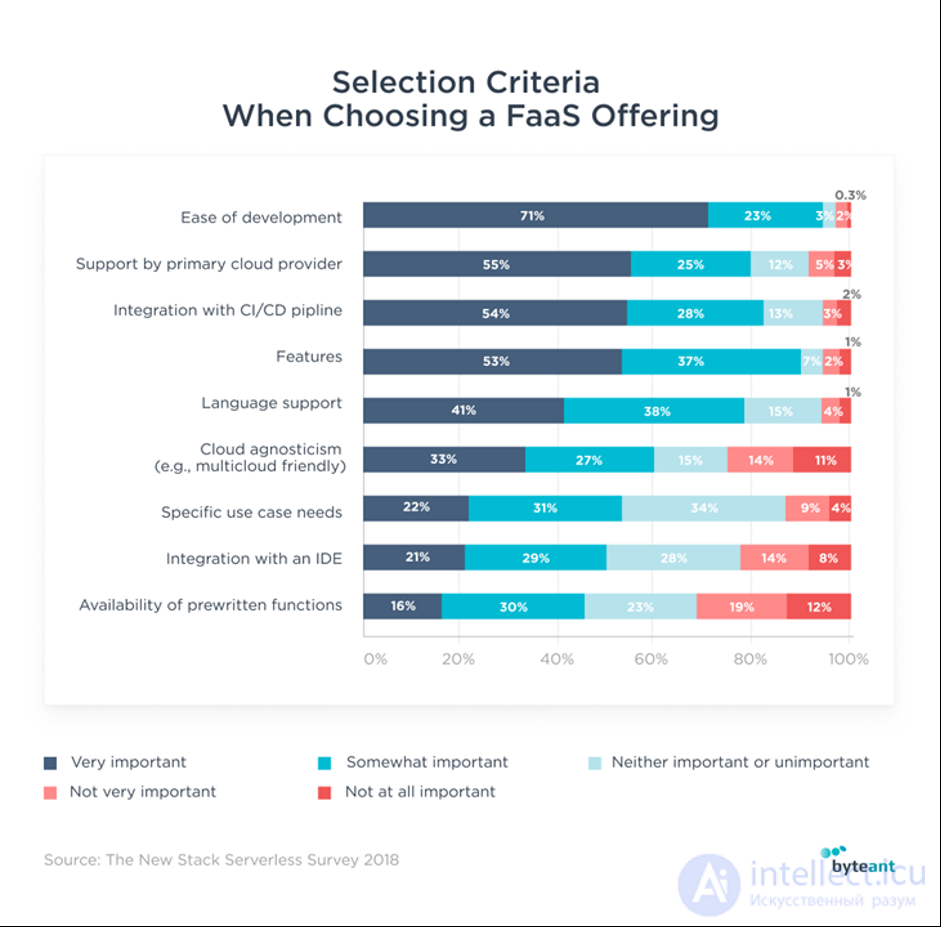
The main criteria programmers consider when choosing a FaaS solution are the convenience of the development process and the availability of support from the cloud provider. These and other important factors are shown in the chart below.
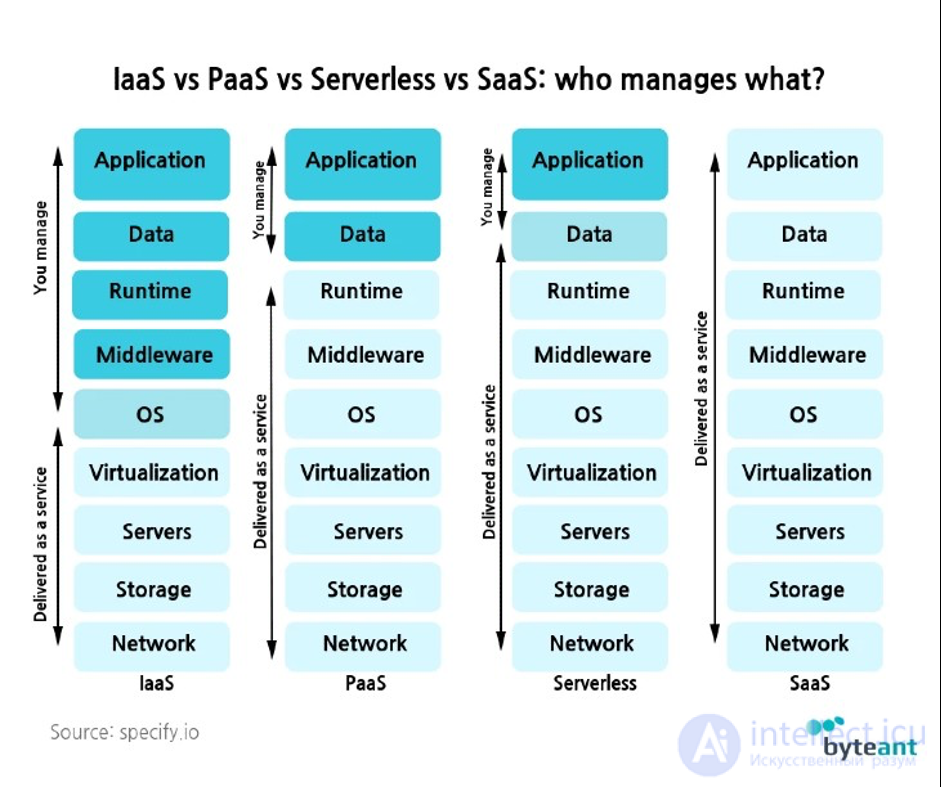
Used together, the BaaS and FaaS models help developers solve complex, resource-intensive problems of hosting data, infrastructure and business logic elements. It turns out that serverless architectures incorporate both of these approaches and thereby give users a wide range of functional benefits. The diagram below clarifies the difference between serverless and other popular cloud service solutions (data from the TheNewStack survey).
Ever since serverless architecture took up the baton from microservices, DevOps and other fashionable technologies, it has won wide popularity among small and medium-sized companies as well as large enterprises. Modern companies choose serverless solutions in pursuit of faster product launches, lower operating costs and an overall increase in productivity. For all their enormous potential, which has yet to be fully realized, a number of areas of application of serverless computing have already emerged where their practical value for business is beyond dispute.
Automatic website scalability. After moving to a serverless architecture, provisioning infrastructure resources will no longer be a headache for you. Developers will be able to write code easily, creating and deploying business applications and websites in less time. In addition, such cloud solutions give users full automated scalability whenever additional computing resources are needed.
Big data analytics. Serverless technologies can be especially effective for orchestrating large, heterogeneous sets of analytical data that were previously scattered across different on-premises servers, without a unified division of responsibility between back-office and front-office teams. Now you can write a separate application that collects and processes information across all business channels, accessing isolated data sets. Such a serverless application will collect, classify and analyze big data within a single database.
Improving interaction between IoT devices. Integrated IoT devices, including all kinds of sensors, RFID tags, smartphones and other gadgets, play an integral role in the operations of most companies. This is where serverless functions prove especially useful: they help end users avoid unpleasant situations with slow internet traffic in a number of problem areas. Moreover, automatic scaling makes it possible to save operating costs, reduce latency and, as a result, significantly increase user satisfaction.
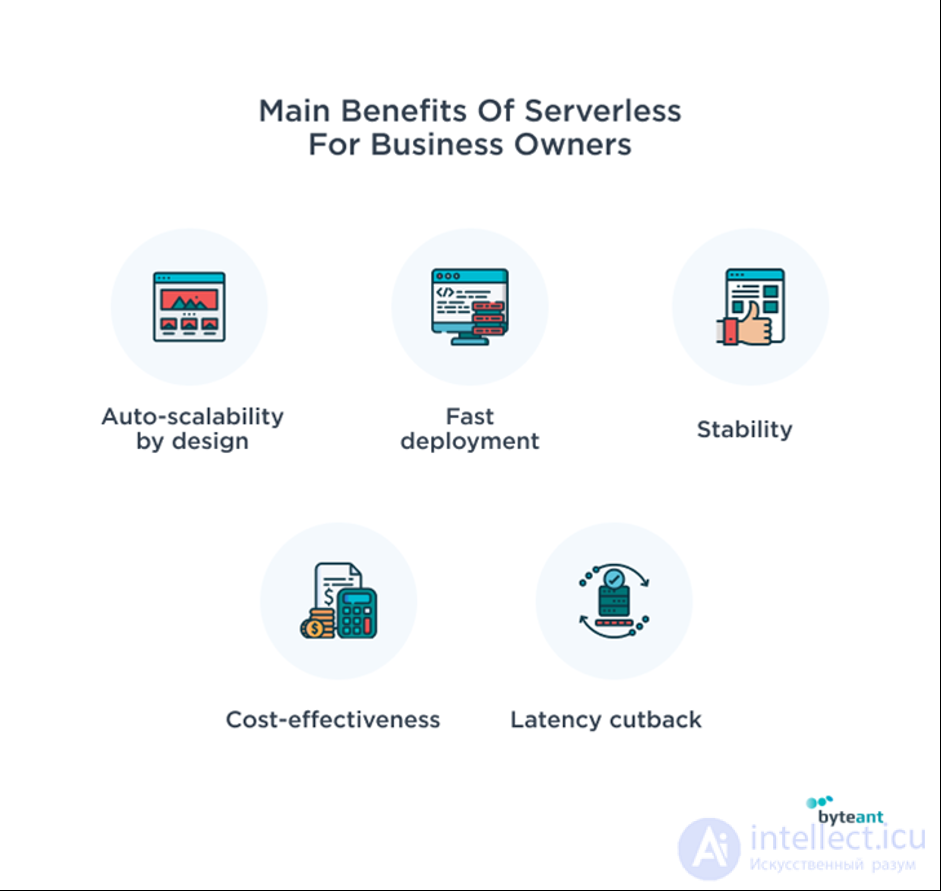
The effectiveness of event-driven architecture (EDA), which underlies serverless computing, is not doubted by IT industry professionals. This architecture offers the following valuable benefits:
Built-in support for automatic scaling. A characteristic feature of the solution is its high flexibility, which allows computing resources and functionality to be scaled exactly when needed. Conversely, under reduced (off-peak) loads the working environment shuts down.
A more convenient deployment environment. In serverless infrastructures it is easier and more convenient for programmers to develop and deploy their applications. They no longer need to worry about secondary matters, such as how to maintain the infrastructure or how to keep data synchronized in a timely manner. The inherent flexibility of serverless architecture guarantees ease of automation for most technological processes.
Stability. Serverless architecture allows you to shift the lion's share of data and infrastructure management duties onto the cloud service provider. Thus, not having to worry about infrastructure support, orchestration and distribution of code data, or about resolving resource downtime problems, all of which were a huge headache on previous-generation on-premises software platforms, will save your team an enormous pool of working time.
Cost-effectiveness. Cost minimization is perhaps the most important factor that makes serverless infrastructures stand out sharply from countless other cloud solutions. It is payment for the actual amount of resources used that helps avoid unjustified costs when developing and deploying applications. You pay only for those periods of server operation when certain scheduled events trigger the corresponding actions in the cloud.
Reduced latency. By using cloud servers to deploy infrastructure, companies can place their resources on the servers closest to end users. This ensures easy connectivity and compatibility of data formats without time-critical failures and system downtime.
In the end, it is up to you to decide what to choose: microservices or serverless frameworks. Moreover, you can easily tailor both of these technologies to your business needs.

Comments