
Lecture 8 min.
Fights between MVD officers and offenders are, as a rule, brief, lasting a few minutes or even a few seconds. Within this short time the officer must neutralize his opponents. The ultimate purpose of such fights is usually the apprehension and escorting of the criminals. Apprehension techniques are based on applying pain-compliance holds to the joints of the arms and legs, where sensitive nerve endings are located that produce sharp pain when acted upon.
When making an apprehension or defending himself, an officer has to use strikes and choking techniques, and to perform them as effectively as possible he must know the various vulnerable parts of the human body. Such parts include nerve ganglia, joints with the sensitive nerve endings located in them, large blood vessels, and the airways.
MVD specialists have identified the following vulnerable target zones, which police officers must know (see figure): 1) ankle joint – shin; 2) knee joint; 3) perineum – lower abdomen; 4) solar plexus – cardiac plexus; 5) interclavicular notch – throat – chin; 6) hypochondrium – ribs; 7) collarbone – side of the neck; 8) upper lip – base of the nose; 9) bridge of the nose – eyes; 10) temple – ear; 11) back of the head – seventh cervical vertebra; 12) between the shoulder blades – central part of the spine; 13) lower back – kidneys; 14) elbow – armpit – shoulder; 15) fingers and hands.
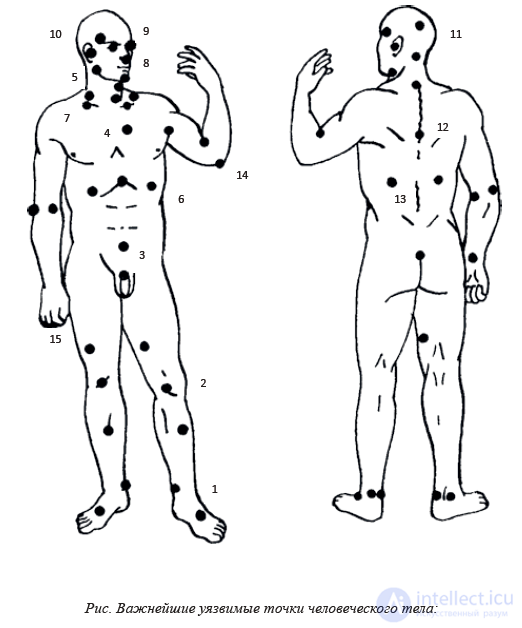
Fig. The most important vulnerable points of the human body:
1) ankle joint – shin; 2) knee joint; 3) perineum – lower abdomen; 4) solar plexus – cardiac plexus; 5) interclavicular notch – throat – chin; 6) hypochondrium – ribs; 7) collarbone – side of the neck; 8) upper lip – base of the nose; 9) bridge of the nose – eyes; 10) temple – ear; 11) back of the head – seventh cervical vertebra; 12) between the shoulder blades – central part of the spine; 13) lower back – kidneys; 14) elbow – armpit – shoulder; 15) fingers and hands
The most vulnerable parts of the human body are its joints. The anatomical features of human joints determine four principles for performing pain-compliance holds.
Extending a joint beyond its natural range of extension makes it possible to perform the pain-compliance holds known as the "lever" (of the elbow, knee, shoulder, finger, wrist, etc.).
Flexing a joint beyond its natural range of flexion makes it possible to perform the pain-compliance holds known as the "press" (of the wrist or the foot).
Rotating a joint beyond its natural range of rotation makes it possible to perform the pain-compliance holds known as the "knot" (of the elbow, knee, finger or foot).
Bending a joint over an object (usually a limb of the attacker) makes it possible to perform the pain-compliance holds known as "compression" (of the calf muscle, the Achilles tendon or the biceps).
Specialists consider the most widespread apprehension technique to be the "arm bent behind the back," in which the elbow joint is acted upon (by means of a "knot"). "Elbow-joint levers" are also applied to the elbow both from a standing position (following an "inward arm lever") and on the ground.
The nerve endings located in the wrist joint make it possible to perform such a pain-compliance hold as the "wrist press." Acting on the hands with the pain-compliance holds "outward wrist knot" and "inward wrist knot" makes it possible to carry out such apprehension techniques as the "outward arm lever" and the "inward arm lever." The most vulnerable parts of the arm are the finger joints; acting on them with "finger levers" is used when breaking free from grips.
The ankle joint is highly vulnerable even to weak kicks, whether delivered from above or from the side, which is used when breaking free from grips. When the foot is trapped under the armpit, one of the very effective leg pain-compliance holds, "Achilles tendon compression," can be applied.
The shin at the front of the leg is not covered by muscle, so even relatively weak blows to it damage the periosteum, causing sharp pain and bruising. A strong impact causes pain shock up to the point of loss of consciousness, as well as a crack or fracture of the bone.
The knee joint can be struck with a kick; a blow against the natural direction of flexion is especially dangerous, as it destroys the joint. Various types of pain-compliance holds are applied to the knee joint: the "lever," the "knot," and compression of the calf muscle. The latter techniques are successfully used when apprehending offenders.
The opponent's neck (throat) is acted upon when performing choking techniques (with the fingers, the forearms, the lapels of clothing, or the legs). When the neck is compressed, the airways and the flow of blood to the head are cut off, which after 10–15 s causes loss of consciousness, and after 30–40 s of choking irreversible processes begin in the brain; therefore, if the supply of blood and oxygen to the brain is not restored in time by releasing the grip, a fatal outcome is very likely. Blows to the throat are even more dangerous: they cause sharp pain and suffocation and can also result in death.
This zone also includes the chin, which is a common target for blows to the head, whether straight, hooking or delivered from below. Even a light blow to the chin shakes the vestibular apparatus, and in doing so temporarily suppresses the cardiovascular system's ability to supply the brain with oxygen, which leads to loss of consciousness (a knockdown or knockout). And a fall from a person's full height onto a hard surface can lead to severe consequences, up to and including death. Any blows to the head can have such consequences, since they affect the person's brain regardless of which point they are delivered to – the upper lip and the base of the nose, the bridge of the nose and the eyes, or the temple and the ear.
Blows to the torso require greater force than blows to the head, but they are no less dangerous. Thus, a blow to the solar plexus, and especially to the cardiac plexus, can lead not only to a temporary stoppage of breathing but also to complete cardiac arrest and death. Blows to the ribs or the hypochondrium cause sharp pain not only because of damage to the intercostal muscles but also because of injury to the internal organs that the ribs protect. Strong blows can rupture the liver or the spleen, which contain a great deal of blood; its loss also entails severe consequences.
All of the vulnerable zones listed above may be attacked only with caution and with the force of the blows carefully measured.
Thus, in the zone we have examined, a blow to the elbow joint against its natural direction of flexion can cause serious injury. Pain-compliance holds using the "lever" and the "knot" of the shoulder can also be applied to the shoulder joint.
Dislocation of the shoulder from an impact during a fall is a common injury. But the most dangerous point in this zone is the armpit, in which the brachial nerve plexus is located, the median and ulnar nerves pass, the subclavian artery and vein run, and numerous lymph nodes and vessels are found. A strong blow to this point can rupture the capsule of the shoulder joint and cause pain shock and even death.
The most sensitive zone, especially in men, is the perineum – lower abdomen. Even light blows to the groin cause sharp pain, while strong blows can lead to loss of consciousness and even to death.
All blows from behind – from the back of the head to the coccyx – are very dangerous; it is no accident that they are prohibited in combat sports. Located here are such zones as the spine, the lower back and the kidneys, and blows to them can lead to paralysis of the limbs, internal bleeding, pain shock and a fatal outcome.
Sign in and the lectures you have studied will be marked in this list.
Choose a course
Comments